• KGS/USD = 0.01144 0%
  • KZT/USD = 0.00193 -0%
  • TJS/USD = 0.10858 0.09%
  • UZS/USD = 0.00008 0%
  • TMT/USD = 0.28571 0%
  • KGS/USD = 0.01144 0%
  • KZT/USD = 0.00193 -0%
  • TJS/USD = 0.10858 0.09%
  • UZS/USD = 0.00008 0%
  • TMT/USD = 0.28571 0%
  • KGS/USD = 0.01144 0%
  • KZT/USD = 0.00193 -0%
  • TJS/USD = 0.10858 0.09%
  • UZS/USD = 0.00008 0%
  • TMT/USD = 0.28571 0%
  • KGS/USD = 0.01144 0%
  • KZT/USD = 0.00193 -0%
  • TJS/USD = 0.10858 0.09%
  • UZS/USD = 0.00008 0%
  • TMT/USD = 0.28571 0%
  • KGS/USD = 0.01144 0%
  • KZT/USD = 0.00193 -0%
  • TJS/USD = 0.10858 0.09%
  • UZS/USD = 0.00008 0%
  • TMT/USD = 0.28571 0%
  • KGS/USD = 0.01144 0%
  • KZT/USD = 0.00193 -0%
  • TJS/USD = 0.10858 0.09%
  • UZS/USD = 0.00008 0%
  • TMT/USD = 0.28571 0%
  • KGS/USD = 0.01144 0%
  • KZT/USD = 0.00193 -0%
  • TJS/USD = 0.10858 0.09%
  • UZS/USD = 0.00008 0%
  • TMT/USD = 0.28571 0%
  • KGS/USD = 0.01144 0%
  • KZT/USD = 0.00193 -0%
  • TJS/USD = 0.10858 0.09%
  • UZS/USD = 0.00008 0%
  • TMT/USD = 0.28571 0%
22 December 2025

Viewing results 523 - 528 of 858

Two-Dimensional Outlook Characterizes Western Media Response to SCO Summit

The Western media’s binary response to the latest Shanghai Cooperation Organization (SCO) summit in Astana creates an unnecessary – and perhaps unintentional – “us-versus-them” dichotomy. Characterizing the SCO as the “anti-NATO” alliance where China, Russia and Iran come together, this style of coverage makes no mention of the evident efforts of the majority of post-Soviet states to balance Russia’s decades-long influence in the region. It is also notable that the same outlets serving up this black and white coverage are not even in attendance at the summit, preferring to take aim from abroad. Central Asian states cannot escape the realities of their geography and have to largely rely on Russia and China for their economic prosperity. At the same time, their future independence requires that they are a respected part of the international rules-based order as well as on their increased contribution to global supply chains. Kazakhstan’s recent democratic reforms are in direct contrast to the authoritarian image cast on so-called “anti-NATO” countries. Armenia has announced plans to quit Russia’s Collective Security Treaty Organization (CSTO) military alliance. Generally, the countries in the region have – with different degrees of enthusiasm – implemented a multi-vector foreign policy, including following international sanctions against Russia and issuing statements supporting the “territorial integrity of Ukraine.” Uzbekistan’s courts even went so far as to convict a citizen for joining Russian troops fighting in Ukraine. Those looking to force an antiquated one-size-fits-all Cold War paradigm on Central Asia will ultimately be frustrated. The ongoing SCO event in Astana is bringing together a mainly Eastern-centric group of leaders speaking about deeper cooperation among the Organization’s members. While the Western press may simply decry this gathering as anti-Western, the fact that Central Asia stood in support of international sanctions against Russia and stayed neutral in the conflict with Ukraine, much to the chagrin of Vladimir Putin and his retinue, shows the region holds more shades of grey than stark black and white. Central Asia cannot be expected to fall entirely into the orbit of Western or Eastern leaning powers. The region’s republics will, and should, aim to be aligned with both. Arguably, the West, Russia, and China may all be disappointed in the end, but that outcome may well be in the best interests of the Central Asian states.

South Korea to Build Biofuel Plant in Uzbekistan

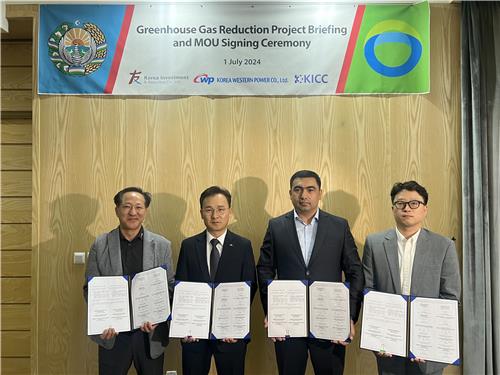
A plant producing biofuel from cotton stalks will be built in the town of Furkat in the Ferghana region of Uzbekistan with the support of South Korea's Korea Western Power. According to Korean media, the biofuel will be offered to Uzbek farmers as an environmentally friendly alternative to coal-based greenhouse heating. Within the next ten years, this project is expected to reduce atmospheric emissions by 120,000 tons and make a profit of over $2 million dollars. Earlier, Uzbek media reported that a South Korean institute will assist Uzbekistan in building a "smart" greenhouse for research and the cultivation of agricultural products.

Astana Hosts SCO Summit: A New Platform for Kazakh Diplomacy

With the first events of the Shanghai Cooperation Organization (SCO) Summit taking place this morning in Kazakhstan’s capital, Astana, conversations are beginning about what the host country will be discussing – and with whom. The SCO is a political, security and economic alliance in the wider Eurasia region, aimed at promoting trade and investments between member states, as well as global security. Its nine full members are Kazakhstan, Kyrgyzstan, Tajikistan, Uzbekistan, China, Russia, Iran, India and Pakistan. The Organization – which includes four observer states and 14 dialogue partners – covers half of the world’s population, and almost a third of global GDP. Kazakhstan’s multi-vector approach to its foreign policy has seen the country combining its role within the SCO with cooperation with Western governments, through dialogue with the European Union and the United States’ C5+1 platform. President Tokayev recently commented that: “Kazakhstan is committed to multilateral cooperation. In our foreign policy we proceed from the national interests, and are in favor of solving all disputable issues on the basis of rational compromise. In addition to the SCO, this year our country is chairing five other international organizations. This is an unprecedented case, one could say an achievement in the history of Kazakh diplomacy.” This multi-vector approach is key to Kazakhstan’s international diplomacy. Indeed, ‘mutually beneficial cooperation’ and ‘mutually beneficial strategic partnership’ have become the watchwords of Tokayev’s presidency. Over the past decade, Kazakhstan has become an increasingly important land-bridge between East and West, both in terms of trade and diplomacy. Due to projects such as the Belt and Road Initiative and the Middle Corridor, Kazakhstan’s location has made it an indispensable ally to China, whilst playing a pivotal role in the expansion of transcontinental trade has led to Central Asia, in the words of Tokayev, “become a global stakeholder.” In the opinion of experts, more of the same can be expected at this week’s SCO Summit. In an interview conducted by the Kazinform news agency, local political analyst Valery Volodin stressed that: “It goes without saying that each government will be defending its own interests [at the Summit]. But Kazakhstan will be placing an emphasis on regional stability, which will allow countries to implement a host of joint projects with China and Russia. Besides this, Kassym-Jomart Tokayev’s gift for diplomacy will push the SCO to become not just a discussion club, but a real mechanism to solve problems in Eurasia using dialogue between governments.” In an article in The Geopolitics, Michael Rossi, a professor of political science at Long Island University, posited that Kazakhstan is not playing the so-called ‘Great Game’ between East and West, but rather pointing out the scope for "Big Opportunities". “Kazakhstan’s positive relations with countries often in conflict, such as Russia and Ukraine, China and the United States, Azerbaijan and Armenia, and Israel and the Palestinian territories, grant Astana legitimacy,” Rossi writes, “to act as a buffer and stabilizing force among major powers. This positioning allows Kazakhstan to reduce tensions and potentially mediate conflicts. Under...

SCO Summit: Tokayev and Xi Laud Kazakhstan-China Ties

On the eve of the 2024 Shanghai Cooperation Organization (SCO) Summit, hosted this year by Kazakhstan in its capital Astana, the leaders of Kazakhstan and China were keen to highlight the strength of their countries’ partnership. The SCO is a political, security and economic alliance in the wider Eurasia region, aimed at promoting trade and investments between member states, as well as global security. The Organization – which includes nine full members, four observer states and 14 dialogue partners – covers half of the world’s population, and almost a third of global GDP.  In comments to China’s Xinhua news agency, Kazakh President Kassym-Jomart Tokayev spoke of a “close political dialogue” between the two countries, supported by the SCO, thanks to which “China is consolidating its position as Kazakhstan’s leading trade and investment partner”.  Mutual trade between the countries reached a historic record of $41 billion in 2023. Tokayev added that “China became one of the top four foreign investors in Kazakhstan in 2023, investing around $2 billion in direct investments, a year-on-year growth of 16.4%. The total volume of Chinese investment in the Kazakh economy is over $25 billion. Around 4,700 Kazakh-Chinese enterprises operate in our country.” In his comments to Xinhua Tokayev also highlighted Kazakhstan’s growing cultural ties with China, mentioning a new agreement on a visa-free regime between the countries, the creation of cultural centers in both nations, and the fact that 2024 has been named the “Year of Kazakhstan tourism in China”. The president himself lived in China for eight years, where he studied Chinese in Beijing before working for the Soviet Union’s embassy to China. In turn, in a letter published by the Kazinform news agency, China’s leader Xi Jinping noted: “China is now Kazakhstan’s largest trading partner and its top export destination. Major strategic projects including the Zhanatas wind farm, Turgusun hydropower station, and the modernization of Shymkent Oil Refinery have been completed and commissioned. China-Kazakhstan crude oil and natural gas pipelines are operating in a safe and stable manner. The ‘green lanes’ for fast customs clearance of agricultural products are available at all border ports between the two countries, which makes green agri-products of high quality from Kazakhstan easily accessible for Chinese consumers. The potential for cooperation in new energy and transportation infrastructure has been unleashed. The transport and logistics terminal in Xi’an, the Western Europe-Western China Highway, and the China-Europe Railway Express all operate smoothly, providing a strong boost to the development of both China and Kazakhstan.” Kazakhstan has a multi-vector approach to its foreign policy; its role within the SCO complements the country's cooperation with the United States through the C5+1 platform, and a constant dialogue with the European Union. In a recent speech about Kazakhstan's chairmanship of the Shanghai Cooperation Organization this year, President Tokayev commented: "Kazakhstan is committed to multilateral cooperation. In our foreign policy we proceed from the national interests, and are in favor of solving all disputable issues on the basis of rational compromise. In addition to the...

First Container Train on South Korea – China – Kazakhstan – Uzbekistan Route

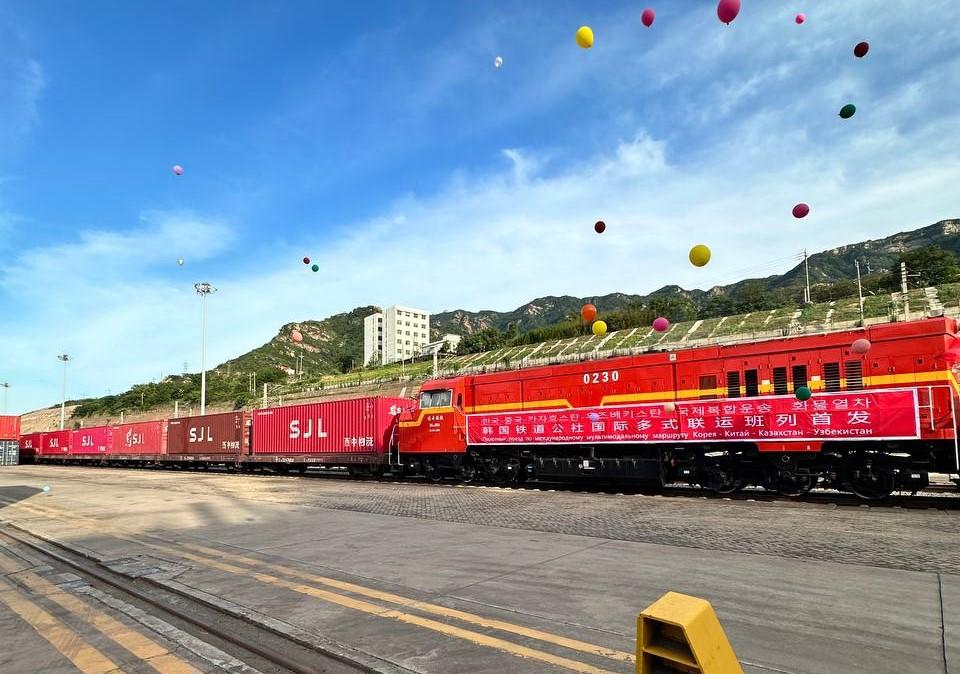
On June 26, on the initiative of South Korea, China, Kazakhstan, and Uzbekistan railway administrations, and in cooperation with SJ Logistics Group, a ceremony was held at the Kazakh-Chinese logistics terminal in the port of Lianyungang, to launch the first container train from South Korea to Uzbekistan through China and Kazakhstan. The national railways company Kazakhstan Temir Zholy (KTZ), the subsidiary of which, KTZ Express, operates the route through Kazakhstan, reported that covering 7 thousand kilometres, the railway opens new avenues for economic interaction between the associated countries. Speaking at the ceremony, Deputy General Director for Commerce of KTZ Express Ulugbek Orazov, noted: “The launch of the pilot train demonstrates our common desire to develop joint multimodal transportation, which will certainly open up new horizons for trade and interaction in the region.” He continued by adding that the event marked an important step in the development of new opportunities to increase the transit potential of Kazakhstan as well as its establishment as a key transport hub in the international supply chain.    

The National Bank of Uzbekistan Places Bonds on the London Stock Exchange

JSC National Bank for Foreign Economic Activity of the Republic of Uzbekistan (Uznatsbank) has successfully placed bonds on the London Stock Exchange  in two tranches totalling $411 million :  $300 million maturing in 5 years, and 1.4 trillion UZS ($111 million) maturing in 3 years. Uznatsbank's placement of the bonds follows Uzbekistan's successful placement of sovereign bonds, totalling $1.5 billion in three currencies, in international financial markets on May 21. Funds raised by bonds on the London Stock Exchange will primarily be used to carry out directives, issued by the President of Uzbekistan at a meeting on May 20, to attract foreign investment by commercial banks. Monies will also be invested in critical projects across various economic sectors to stimulate the country's economic growth. Uznatsbank is one of the Uzbekistan's first commercial banks to place bonds in the national currency in the international financial market and as such, the transaction will serve as a benchmark for other commercial banks and enterprises of the country. The London Stock Exchange, founded in 1801, is one of world's  leading stock exchanges.