
• KGS/USD = 0.01144 0%
  • KZT/USD = 0.00198 -0%
  • TJS/USD = 0.10903 0.18%
  • UZS/USD = 0.00008 0%
  • TMT/USD = 0.28571 0%
  • KGS/USD = 0.01144 0%
  • KZT/USD = 0.00198 -0%
  • TJS/USD = 0.10903 0.18%
  • UZS/USD = 0.00008 0%
  • TMT/USD = 0.28571 0%
  • KGS/USD = 0.01144 0%
  • KZT/USD = 0.00198 -0%
  • TJS/USD = 0.10903 0.18%
  • UZS/USD = 0.00008 0%
  • TMT/USD = 0.28571 0%
  • KGS/USD = 0.01144 0%
  • KZT/USD = 0.00198 -0%
  • TJS/USD = 0.10903 0.18%
  • UZS/USD = 0.00008 0%
  • TMT/USD = 0.28571 0%
  • KGS/USD = 0.01144 0%
  • KZT/USD = 0.00198 -0%
  • TJS/USD = 0.10903 0.18%
  • UZS/USD = 0.00008 0%
  • TMT/USD = 0.28571 0%
  • KGS/USD = 0.01144 0%
  • KZT/USD = 0.00198 -0%
  • TJS/USD = 0.10903 0.18%
  • UZS/USD = 0.00008 0%
  • TMT/USD = 0.28571 0%
  • KGS/USD = 0.01144 0%
  • KZT/USD = 0.00198 -0%
  • TJS/USD = 0.10903 0.18%
  • UZS/USD = 0.00008 0%
  • TMT/USD = 0.28571 0%
  • KGS/USD = 0.01144 0%
  • KZT/USD = 0.00198 -0%
  • TJS/USD = 0.10903 0.18%
  • UZS/USD = 0.00008 0%
  • TMT/USD = 0.28571 0%
05 December 2025

Our People > Daniel Abdyldaev

Daniel Abdyldaev's Avatar

Daniel Abdyldaev

Contributor

Daniel Abdyldaev is the Chief Investment Officer of Accelerate Prosperity, the largest startup accelerator in the Kyrgyz Republic; Managing Partner at ADVentures, a venture capital fund supporting founders across Central Eurasia; and Co-Founder of chANGELS, a leading angel investment network. Daniel teaches Startup Building at Compass College, the leading creative industries college in the Kyrgyz Republic.

Articles

How Kyrgyzstan’s Fastest-Growing Restaurant Tech Startup Is Revolutionizing Dining

Bishkek has long been known for its vibrant restaurant scene. Now the sector is implementing innovations, making the lives of its customers even easier. Meet Pai, the Kyrgyz startup serving as a digital concierge between restaurants and their customers. “In Kazakhstan, I saw a product where you could pay your bill right at your table with two taps and leave without interacting with the staff. That's when I realized you could build a whole world around this, turning every interaction between a guest and an establishment into a digital experience,” says Ehrlan Zholdosh, CEO and Co-Founder of Pai. Zholdosh is not a newcomer to the industry; his experience in product design and management in Eastern Europe and the Middle East was an asset when launching his own company, Pai. Old Habits Die Hard  It’s a universal restaurant experience around the globe when you’re done with your meal and ready for the check – it can take an age to come, and that’s if you can find waitstaff in the first place. Now, with Pai, which essentially turns every table into a payment terminal, this process has been streamlined to the point where it takes only seconds to pay and even leave a tip. The very first MVP (minimum viable product) was launched in Mar 2024. This is when Aibek Nogoev joined as a Co-Founder to completely overhaul the technical side of the product. The co-founder’s team has complementary skillsets — the third Co-Founder, Kairygul Kalbaeva, has over ten years of experience in the restaurant business, which came in handy when onboarding the first customers, as she understands how restaurants operate inside out. As for the Pai team, the majority of its members were hired in ololoPlanet, one of the locations of ololo, the largest chain of tech hubs in Central Asia, where Pai has its offices. Apart from enabling customers to pay faster and more smoothly, Pai aims to build a restaurant super-app that integrates with the ERP systems restaurants use, including customizable loyalty programs. Another strategic benefit for restaurants using Pai is a non-invasive way to collect user data. The Snowball Effect In September, Pai won first place in the country’s largest hackathon, Startup Nation. It may have been tough to onboard customers at the beginning of Pai’s journey, but now there are over 70 active restaurants and more than 100 in the waitlist, with hundreds of thousands of users and a daily turnover in excess of $20,000. Recent changes to Kyrgyz tax legislation linked to the efforts to make the restaurant industry less opaque have been a massive boost as well. The authorities are trying to combat the shadow economy, pushing businesses, including restaurants, to become significantly more transparent, and many in the restaurant industry see Pai as the best solution. Its customer base now includes the majority of the largest restaurant chains in the Kyrgyz Republic, including global franchises. The key challenge lies in its integration with ERP systems, which delivery services usually don’t integrate with. Pai...

3 weeks ago
Kyrgyz Startup Designs ‘Growave’, an E-Commerce Tool to Retain Customers on Shopify

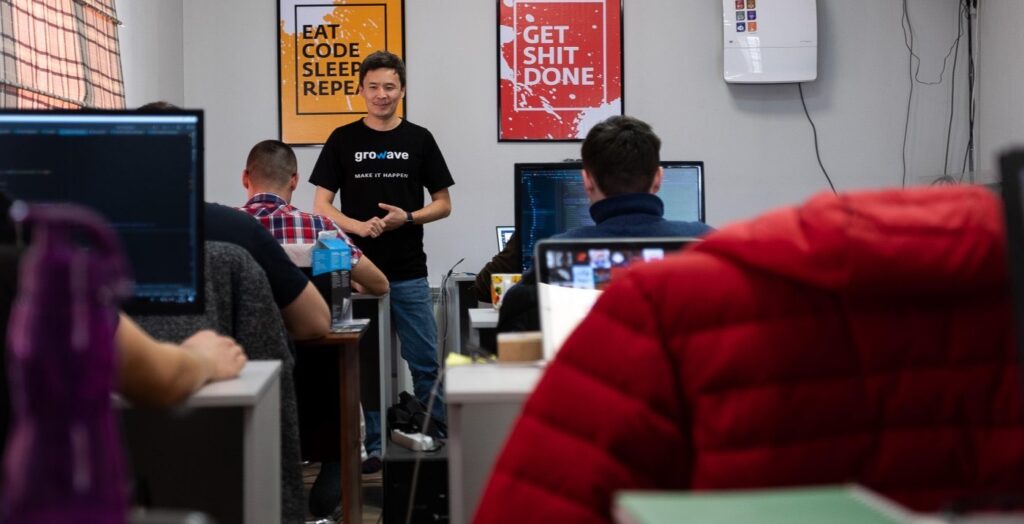
Eldar Galiev is the CEO and Co-Founder of Growave, a Kyrgyz startup that helps companies retain customers on the retail platform Shopify.  “There were times in my life when I seriously thought about moving abroad. The deciding factor [in staying] was the realisation that many people close to me live in the Kyrgyz Republic. That is something to be cherished. That is why I stayed here”, explained Galiev in 2020. Success after several failures Galiev started his career early. During his sophomore year, he started working for the software company Skalfa. Like many talented founders, he left university during his senior year to focus on building his own products. Growave was not the first company Galiev started. “My first serious project, Hire-Experts, came after three years of working at a product company. At that point, I decided to start my own business and found a startup. The first two attempts failed. The third one, Hire-Experts, turned out to be more or less successful — it later became a company that develops software solutions for online communities,” Galiev said in 2021. This experience helped Galiev when he decided to build Growave in 2014. Growave is a family startup; Galiev created the company with his wife, Munara, and brother Ermek. Their skillsets complement each other, with Galiev overtaking business development, Munara handling HR and finance, and Ermek leading on the tech side.  Galiev and his co-founders saw an opportunity when they couldn’t find products focusing on relationships between brands and their customers. Galiev understood that the local markets were too small and went straight to building a global product from scratch. The team did not have experience of being sellers themselves, so the first iterations of the product did not perform very well.  Soon, they came up with a free plan for customers, which helped them gain their first 500 clients. And with feedback collected from them, they managed to build something that customers actually needed. Now, Growave is a marketing platform for e-commerce, helping companies to retain their customers with an all-in-one solution including loyalty, referrals, wishlists, reviews, and Instagram UGC. Galiev believes that it is not only advertising that is important, but also building long-term relationships with customers. This, in turn, prompts customers to stay loyal to certain Shopify sellers. [caption id="attachment_38510" align="aligncenter" width="1280"] Image: Growave[/caption] 'Bootstrapping' ninjas Unlike many global startups, Growave has not raised any external funding from VCs to date, making the company an amazing example of bootstrapping -- growing a business without external funding. In 2017, three years after its launch, Growave became profitable. Before that, Growave had gone through a turbulent time when the co-founders had to invest their income from other projects.  This great example of bootstrapping now has 60+ employees. Still, Galiev is talking to VCs to get their feedback about the startup and to pitch Growave as a solution for their portfolio companies. Now Growave can boast a customer base of over 15,000 companies from more than 150 countries. Over half of...

1 month ago

ArtSkin: Prosthetics with a Sense of Touch from Kyrgyzstan

The Kyrgyz startup ecosystem is still in its nascent stages and can’t boast an endless number of founders pursuing their dreams. But those focused on building hardware startups, which is generally significantly more challenging, are even a rarer breed. Despite all of that, there is an ambitious attempt to build artificial skin for prosthetics. Meet ArtSkin. Not like a human hand “Since childhood, I was mad about science and tech, and the first big thing that I made was a prototype of the first airplane by the Wright brothers. I dropped it from the second floor, and it was crushed after flying four meters. Later, when I was twelve, I saw a TV program about robot battles, and it was crazy! Since then, I have wanted to be able to make any kind of robots, and my dream has come true,” says Iliias Dzheentaev’s biography on LinkedIn. Dzheentaev is the CEO and Founder of ArtSkin.  ArtSkin is a hardware startup from Kyrgyzstan that develops artificial skin for prosthetic limbs. It was launched by Dzheentaev in 2024. Before that, he spent three years studying how human skin, the nervous system, and receptors work to understand how to design a device allowing proper touch sensations. The process was time-consuming and challenging due to the lack of relevant information. “My initial prototype was a robotic arm manipulator. I encountered a challenge with grasping flexible objects – figuring out how to make the robot recognize when its claw had squeezed tightly enough to hold the object securely. To solve this, I developed a mechanism that overcomes the resistance of different materials, enabling the robot to firmly grasp objects of various shapes, textures, and densities. Although the mechanism was simple, it made me realize how important this problem is for robotics. This insight then led me to thinking about people who use prosthetics and whether they actually feel anything when wearing them”, Dzheentaev tells The Times of Central Asia. He was not happy with the contemporary prosthetic solutions – basic body-powered mechanical prosthetics rely on physical motions, and more advanced bionic prosthetics translate electrical signals generated by muscle activity into movements, both of which lack feedback. And without the latter, control is incomplete, while with a human hand, one can easily understand its position as well as feel touch and pressure. With this in mind, Dzheentaev built his prototype with a single sensor to test the device on himself. First steps Things got serious when Dzheentaev visited the High Technology Park of the Kyrgyz Republic (HTP), where he was inspired by other founders pitching and raising funds for their startups. At the time, unfamiliar with this environment, Dzheentaev was using his salary to buy electronic components, order materials, and do designs. Not long after, Dzheentaev took part in HTP’s two programs: Dive into Silicon Valley and Unicorn from KG. The finalists for the first one were selected in February 2024. Dive into Silicon Valley in an entry-level incubation program, which sends founders to spend two...

3 months ago

From Coasters to Code: Bermet Koshoeva’s Leap into Tech Entrepreneurship

Five years ago, spotting Kyrgyz tech entrepreneurs in global accelerators was almost unheard of. Even locally, tech founders were rare. Fast forward to today, and it feels like Kyrgyz innovators are making their mark, especially at Antler. Last year, the global startup accelerator welcomed several Kyrgyz founders in its Vietnam and Malaysia cohorts. Among them is Bermet Koshoeva, a marketing professional turned tech entrepreneur with her startup, Onion. An Unconventional Path Koshoeva’s path to becoming a founder is far from traditional. Her early years followed a familiar trajectory, earning a Bachelor’s degree in Business Administration from Turkey’s Fatih University and working in marketing roles. Things took a unique turn when she pursued a Master’s degree in Agriculture through the prestigious Erasmus Mundus Programme, studying in Denmark and France. The agricultural focus was symbolic, as both her father and grandfather worked in the sector. However, Koshoeva’s studies steered her in a different direction. During her Master’s thesis, Koshoeva had her first entrepreneurial experience. While exploring investment opportunities, she stumbled upon the potential for sellers on Amazon. With an initial investment of $1,000, she started selling mug coasters and managed to turn it into $2,500. “When my studies were coming to an end, I wondered what I would do next and how I would earn a living,” Koshoeva told The Times of Central Asia. “I wasn’t emotionally ready to jump into a full-time job after such an intense academic experience, so I decided to invest in something.” Her Amazon success, combined with her professional marketing background, established Koshoeva as a local marketing expert. She shared her expertise as both a professional consultant and an educator, teaching marketing at the American University of Central Asia and serving as the Head of Creative Business at Compass College, the first art and design college in Central Asia. Onion’s Mission Koshoeva founded Onion in October 2024, originally envisioning it as a platform for collecting and analyzing qualitative research data, such as interviews and surveys. This aligned closely with her marketing background. However, a pivotal experience at Antler Malaysia in April 2025 led her to refine Onion’s focus. During the accelerator program, she pivoted to addressing AI-powered search optimization. The new direction positions Onion in a rapidly evolving space as search trends shift away from traditional Google results to AI-driven tools like ChatGPT and Perplexity. These emerging tools are still refining their contextual accuracy, but they represent the future. Onion helps brands become visible in these AI-powered searches, ensuring they appear when it matters most. Challenges and Vision Although Antler Malaysia eventually decided not to invest in Onion, Koshoeva is determined to push forward. Her analytical skills, honed over years of market research, are guiding her through this emerging niche. “In recent years, I’ve conducted extensive market analyses across various industries, including IT and SaaS,” Koshoeva told TCA. “Through research, I’ve identified a promising niche that’s only beginning to take shape. While not everyone sees its potential yet — even Antler wasn’t ready to invest — I’m...

5 months ago

The Kyrgyz AI Startup Making U.S. Immigration Simpler

These days, public debate is dominated by the issues of immigration and AI. But until the emergence of the new startup Alma, they had existed as entirely separate discussions. Alma's co-founder Aizada Marat, raised in Kyrgyzstan, has been one of the first to ask: can AI be used to simplify immigration? Marat first came to the U.S. as a FLEX (Future Leaders Exchange) student when she was 17, before graduating from Harvard Law School in 2015. It was then that her own immigration problems began. Due to visa issues, Marat had to move to London, before coming back to America three years later. “Since relocating to the Bay Area in 2018 [for family reasons] the seed of becoming a founder was planted in my head.” Marat has said on her social media. “When I moved back to the U.S., that's when the immigration nightmare began. As I would with any other service provider, I used Google to find lawyers who could help me with my immigration process. I found a firm. I hired them. I was given the wrong advice. That advice led me to almost miss out on a job offer that, thankfully, I later secured. I also couldn't travel and see my family during that time. With that frustration in mind, I realized I had to start a company to solve the problem professionals were facing.” [caption id="attachment_32658" align="aligncenter" width="2048"] Image: Aizada Marat/Alma[/caption] Before Marat could become an entrepreneur, she needed to learn more about business. This is how she ended up at McKinsey, one of the leading global consulting firms. Soon after, Alma was born. Alma is a legal-tech startup, which uses AI to simplify the immigration process. The company was founded in October 2023 by Marat and Assel Tuleubayeva, a former product manager at Step. A month later the startup secured $500,000 of investments from Village Global, John Hale, and other angel investors. In March 2024 Marat and Tuleubayeva found Shuo Chen, who was previously a manager with Uber. In July 2024 Alma raised $5.1 million in combined seed and pre-seed rounds from leading venture capital funds..Last month it was selected for Google Cloud’s AI Accelerator. Alma was founded as a company offering solutions for law firms, but in 2024 it took the decision to help professionals directly, without any intermediaries. Marat, Tuleubayeva and Chen are immigrants themselves, who combined have had to apply for around 15 separate visas to allow them to work in the U.S. This month Alma reached over 300 clients, including both B2C and B2B. “I'm an immigrant who went through the immigration maze myself, so this is deeply personal", Marat tells The Times of Central Asia. "With my legal and business background, starting Alma made perfect sense. Immigrants drive the U.S. economy, and to stay competitive in the AI race, we need to help the best talent achieve their American dream." She adds: “Alma disrupts the immigration in the US and forever streamlines it for the better. Small and big companies...

6 months ago
