


Uzbekistan and Acwa Explore Carbon Credits for Four Wind Farms
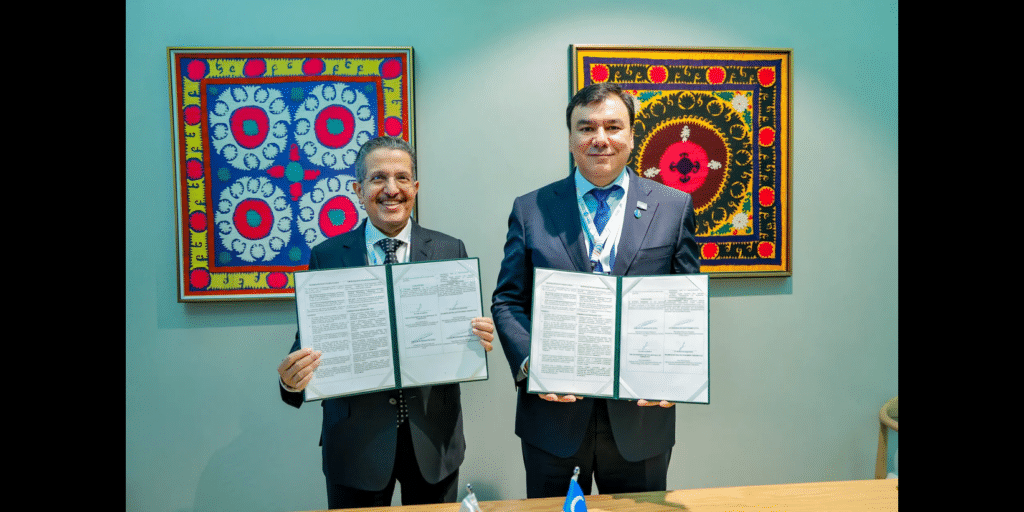
Uzbekistan and Saudi energy company Acwa will assess whether four wind projects in the country could generate carbon credits for sale on the international market. The review will start with the 1.5-gigawatt Kungrad wind farm, which is under construction in Karakalpakstan. Uzbekistan’s government and Acwa signed a memorandum of understanding at the 31st United Nations (UN) climate conference in Antalya, Türkiye. Aziz Abdukhakimov, the president’s adviser on environmental affairs and chair of the National Committee on Ecology and Climate Change, signed for Uzbekistan. Acwa founder and board chair Mohammad Abdullah Abunayyan signed for the company. The assessment covers the Kungrad, Bash, Dzhankeldy, and Karatau wind projects. Uzbekistan and Acwa will examine whether they meet the Paris Agreement’s requirements and how to obtain approval and register them under international carbon market mechanisms. The parties will improve procedures for verifying emissions data. They also agreed to better monitoring and reporting. Carbon credit sales could provide an additional source of revenue for the projects. Under Article 6.4 of the Paris Agreement, a UN-backed mechanism allows projects to earn tradable credits for verified reductions in greenhouse gas emissions. Credits can be issued only after the projects have been approved. The agreement also covers climate risks to wind farms and energy storage systems. The parties plan to share information on how extreme temperatures and dust or sandstorms affect equipment and to use climate data in early warning systems. Construction of the Kungrad wind farm was formally launched in September. The project includes a 300-megawatt battery storage system. Plans to connect the wind farm to Uzbekistan’s power grid call for about 930 miles of high-voltage transmission lines. Three new substations are planned, alongside upgrades to two others. Uzbekistan’s presidential office puts the project cost at $2.6 billion. Acwa lists it at $3.07 billion and identifies the National Electric Grid of Uzbekistan as the electricity buyer under a 25-year power purchase agreement. Kungrad will have five times the combined generating capacity of Acwa’s two operating wind projects in Karakalpakstan, Nukus-1 and Nukus-2. Together, they have 300 megawatts of generating capacity and 100 megawatts of battery storage. Acwa estimates that once all its energy projects in Karakalpakstan are complete, they will have a combined generating capacity of about 2.3 gigawatts and produce around 8.77 billion kilowatt-hours a year. That would cover the electricity needs of about 2.4 million households. The projects could also save around 2.1 billion cubic meters of natural gas and avoid nearly 5 million metric tons of carbon dioxide emissions each year. The company expects Kungrad to create about 4,000 jobs at peak construction. It estimates that about $750 million worth of supplies and project work could be sourced in Uzbekistan, including local manufacturing. In its announcement, Uzbekistan’s ecology committee did not say when the Kungrad review would be completed or how many credits the project could generate if approved. Nor did it provide an estimate of potential revenue from carbon credit sales.
