

• KZT/USD = 0.00222
  • TJS/USD = 0.10830
  • UZS/USD = 0.00008
  • TMT/USD = 0.29760
  • KZT/USD = 0.00222
  • TJS/USD = 0.10830
  • UZS/USD = 0.00008
  • TMT/USD = 0.29760
  • KZT/USD = 0.00222
  • TJS/USD = 0.10830
  • UZS/USD = 0.00008
  • TMT/USD = 0.29760
  • KZT/USD = 0.00222
  • TJS/USD = 0.10830
  • UZS/USD = 0.00008
  • TMT/USD = 0.29760
  • KZT/USD = 0.00222
  • TJS/USD = 0.10830
  • UZS/USD = 0.00008
  • TMT/USD = 0.29760
  • KZT/USD = 0.00222
  • TJS/USD = 0.10830
  • UZS/USD = 0.00008
  • TMT/USD = 0.29760
  • KZT/USD = 0.00222
  • TJS/USD = 0.10830
  • UZS/USD = 0.00008
  • TMT/USD = 0.29760
  • KZT/USD = 0.00222
  • TJS/USD = 0.10830
  • UZS/USD = 0.00008
  • TMT/USD = 0.29760
13 October 2026

Viewing results 1 - 6 of 3

Central Asia in the Global Innovation Rankings: Supercomputers, Engineers, and the Economics of Government Ambitions

In the Global Innovation Index (GII), published on September 29 by the World Intellectual Property Organization (WIPO), Kazakhstan climbed eight places to rank 73rd among 139 economies. Uzbekistan ranked 77th and Kyrgyzstan 92nd. Tajikistan placed 112th, while Turkmenistan was not included in the study. The overall rankings, however, conceal some interesting details. Uzbekistan ranks second worldwide in the share of graduates in science and engineering. Kyrgyzstan ranks second in labor productivity growth, while Tajikistan leads in utility model applications relative to the size of its economy. Utility models are a simpler form of patent protection, usually for smaller inventions. Such strong results in individual indicators stand in contrast to the countries' relatively modest overall rankings. Part of the explanation lies in the study's methodology. WIPO evaluates education and scientific capacity alongside infrastructure and investment. It also considers business activity and research output. A country may train large numbers of engineers or register technical innovations while lagging in research output and investment, with limited commercial activity. For Central Asia, the rankings also offer a way to compare economic performance with the scale of governments' technological ambitions. Kazakhstan: Supercomputers in Search of Customers In recent years, Kazakhstan has assembled an impressive portfolio of digital projects. The Alem.Cloud and Al-Farabium supercomputers, along with the Data Center Valley project in Ekibastuz, are intended to improve the country's computing infrastructure. The Alem.ai artificial intelligence (AI) center and the KazLLM and AlemLLM large language models are designed to develop its AI capabilities. Training opportunities are also expanding through AI-Sana and Tomorrow School, with TUMO Astana offering education in AI and other digital fields. However, the wider use of AI remains relatively modest. The Digital Qazaqstan strategy through 2029 cites figures for the second half of 2025 showing that generative AI adoption in Kazakhstan stood at 13.7%, compared with a global average of 16.3%. Kazakhstan ranked 24th in the United Nations (UN) E-Government Development Index in its 2024 survey but 73rd in the 2026 GII. Kazakhstan's digitalization model has long centered on government services. The country's high position in the UN study reflects this focus. Commercial technologies present a more complicated picture: here, the government must rely on research teams, private developers, investors, and customers willing to pay for their services. The arrival of supercomputers expands the country's technical capabilities. How extensively they will be used outside government projects remains to be seen. Uzbekistan: Engineering Education and IT Services Exports The country has long focused on workforce development for the IT industry. An export-oriented digital services sector is growing around IT Park. Foreign companies are operating in the country, while training programs in programming and AI are expanding. Tashkent intends to support its workforce development policies with domestic computing infrastructure. Under the AI development strategy adopted in 2024, Uzbekistan plans $50 million in AI infrastructure spending and the training of one million specialists. AI laboratories are also planned at 15 universities. A smaller supercomputer is already operating, and preparations are underway to acquire a more powerful system....
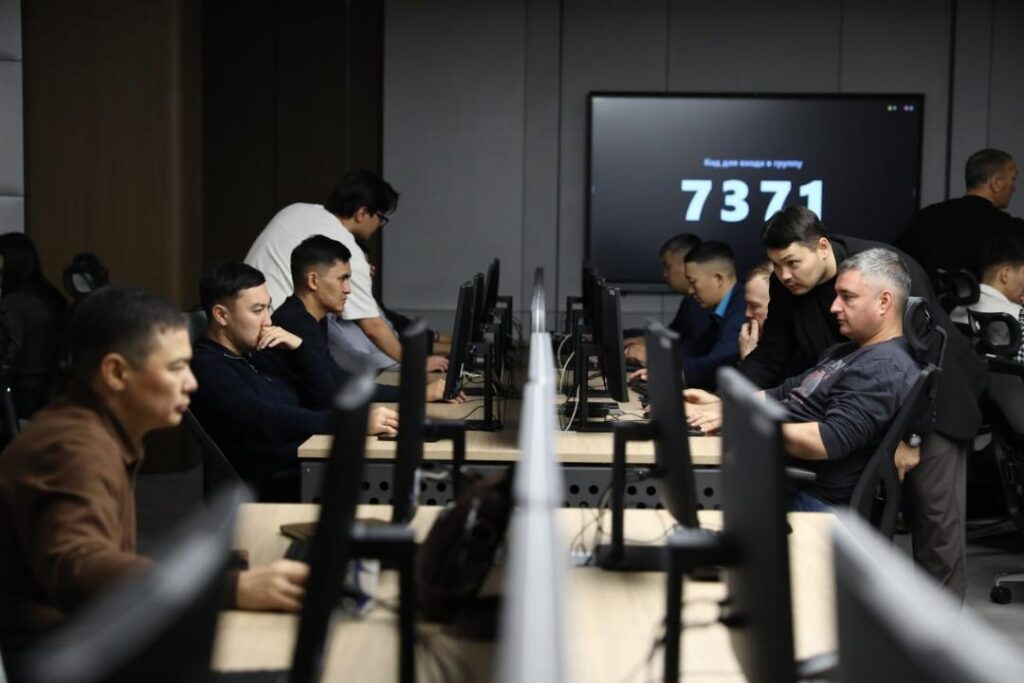

Kazakhstan Begins Military AI Training for 75 Personnel

Kazakhstan has begun training military personnel to create software using artificial intelligence (AI) without having to write code themselves. A total of 75 participants, including conscripts from the Air Defense Forces and Ground Forces, will take the course at Maqsut Narikbayev University (MNU) in Astana. The approach, known in the AI industry as "vibe coding," allows users to create digital tools by describing tasks in everyday language. AI generates the code, while users check the results and refine their instructions as needed. During the course, participants will learn to visualize data and develop applications. "Our goal is to give military personnel skills they can apply in their daily duties. We teach them to create their own digital solutions for specific tasks, from analyzing data on the country and its regions to automating workflows. The main thing is to show them how it works and help them overcome the initial barrier so they can go on to develop their own ideas independently," explained Sergey Pen, deputy chairman of the MNU Management Board for science, innovation, and artificial intelligence. The training is part of the AI+X program, run by MNU under a three-year government pilot initiative. For practical sessions, the university uses its specialized AI Agentic Lab and computing resources. The use of AI for military tasks also raises questions about data security. Kazakhstan is developing a dedicated AI system for military personnel that is intended to keep information within a secure environment rather than transmit it to external services.

Kazakhstan AI Training Expands Nationwide as Programs Scale Up

Kazakhstan is expanding a free school for programming and artificial intelligence (AI) to 14 regions as part of a national drive to prepare people to use the technology. Government figures show that more than 100,000 university students have completed advanced AI courses, but evidence of what the training is producing in practice remains limited. Tomorrow School offers adults a free 18-month course in programming and AI. It began operating outside Astana in 2026, and its network now covers 14 regions, with further growth planned across the country. Students need no previous programming experience and learn through practical projects and peer-to-peer instruction. The school currently has 493 students, and according to government figures, 57 participants have already found jobs in the information technology sector. Few published statistics from Kazakhstan’s growing AI-training system report employment outcomes rather than enrollment or course completion. TUMO Astana is a free center for teenagers aged 12 to 18, based on an educational model first developed in Armenia in 2011 and since expanded internationally. TUMO combines self-directed learning with workshops and practical projects in technology and design, including programming, robotics, and generative AI. The center currently has 2,376 active students. By the end of 2026, it plans to increase enrollment to 5,000. The largest enrollment is in AI-Sana, a national program aimed at giving university students AI skills and helping them develop their own technology projects. Students can take courses through Coursera, Huawei ICT Academy, the NVIDIA Deep Learning Institute, and Astana Hub. More than 100,000 students have completed advanced training under the program, receiving more than 703,000 certificates between them. Because participants can complete several courses, the certificate total is much higher than the number enrolled. Of more than 22,000 proposed AI projects, 515 are now being tested or implemented, according to government figures. That total may be more revealing than the certificate count, although the announcement neither describes the work nor identifies where it is taking place. In 2027, organizers plan to help 1,500 student teams develop their projects into technology startups. Kazakhstan’s focus on retraining reflects changes in the labor market. The World Economic Forum estimates that 39% of workers’ existing skills will change or become outdated by 2030, while AI and big data are among the fastest-growing areas of demand. The International Labour Organization cautions against equating the spread of AI with the disappearance of jobs, saying generative AI is more likely to transform jobs by automating some tasks than to replace workers entirely. For more advanced training and research, Kazakhstan has established Qazaq AI Research University (QAIRU). Since September 2026, it has offered two bachelor’s programs, one in AI and Machine Learning and the other in Physical AI, along with graduate programs combining AI with fields including finance, energy, medicine, industry, and public administration. The university has 525 students: 388 undergraduates, 32 master’s students, and 105 participants from national companies in its AI+X Executive MBA program.
