• KGS/USD = 0.01144 0%
  • KZT/USD = 0.00205 0%
  • TJS/USD = 0.10784 0%
  • UZS/USD = 0.00008 0%
  • TMT/USD = 0.28490 0%
  • KGS/USD = 0.01144 0%
  • KZT/USD = 0.00205 0%
  • TJS/USD = 0.10784 0%
  • UZS/USD = 0.00008 0%
  • TMT/USD = 0.28490 0%
  • KGS/USD = 0.01144 0%
  • KZT/USD = 0.00205 0%
  • TJS/USD = 0.10784 0%
  • UZS/USD = 0.00008 0%
  • TMT/USD = 0.28490 0%
  • KGS/USD = 0.01144 0%
  • KZT/USD = 0.00205 0%
  • TJS/USD = 0.10784 0%
  • UZS/USD = 0.00008 0%
  • TMT/USD = 0.28490 0%
  • KGS/USD = 0.01144 0%
  • KZT/USD = 0.00205 0%
  • TJS/USD = 0.10784 0%
  • UZS/USD = 0.00008 0%
  • TMT/USD = 0.28490 0%
  • KGS/USD = 0.01144 0%
  • KZT/USD = 0.00205 0%
  • TJS/USD = 0.10784 0%
  • UZS/USD = 0.00008 0%
  • TMT/USD = 0.28490 0%
  • KGS/USD = 0.01144 0%
  • KZT/USD = 0.00205 0%
  • TJS/USD = 0.10784 0%
  • UZS/USD = 0.00008 0%
  • TMT/USD = 0.28490 0%
  • KGS/USD = 0.01144 0%
  • KZT/USD = 0.00205 0%
  • TJS/USD = 0.10784 0%
  • UZS/USD = 0.00008 0%
  • TMT/USD = 0.28490 0%

Viewing results 1 - 6 of 98

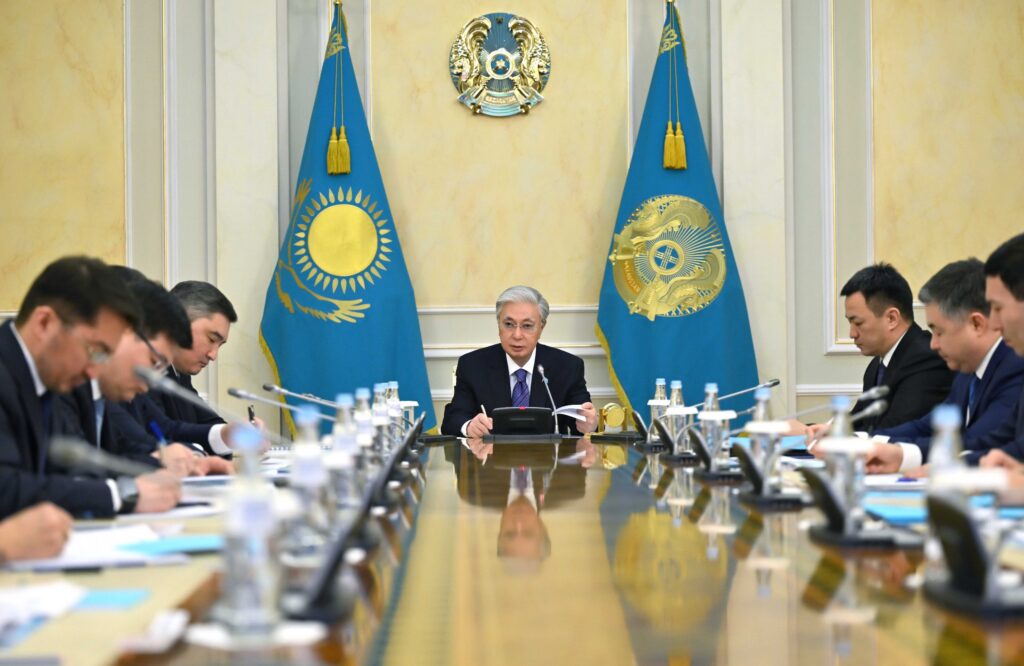
Tokayev Proposes Regional AI Partnership Center with Japan in Astana

President Kassym-Jomart Tokayev has proposed establishing a regional center in Astana to facilitate cooperation between Central Asian nations and Japan in digital transformation and artificial intelligence (AI) development. Speaking at the inaugural summit of the Central Asia-Japan Dialogue, Tokayev endorsed Tokyo’s initiative to build an AI partnership with the region. He noted that Kazakhstan has committed to developing a digital state and highlighted recent milestones, including the launch of the Alem.ai International Artificial Intelligence Center, the deployment of two supercomputers in 2025, and the ongoing implementation of the Digital Qazaqstan strategy. Kazakhstan is prepared to serve as a platform for regional AI collaboration, Tokayev said, suggesting that the proposed initiative be anchored at the Astana Hub and Alem.ai, both of which possess advanced infrastructure and a growing international tech ecosystem. He expressed particular interest in Japan’s expertise in water management digitalization, including water conservation, scientific research, and remote sensing. The president also proposed cooperation in sustainable agriculture, citing Kazakhstan’s interest in Japanese technologies for smart farming, drought-resistant crop development, and resource-efficient agricultural practices. He invited Japanese scientists to participate in establishing a joint research platform and proposed holding the first expert meeting in Astana. Tokayev further emphasized Kazakhstan’s interest in Japanese technology and investment in the energy sector from coal industry modernization and clean energy development to nuclear power. He noted that Kazakhstan supplies roughly 40% of the world’s nuclear fuel and holds substantial reserves of rare earth and critical minerals essential to the global energy transition. As  previously reported by the Times of Central Asia, Kazakhstan recently launched the region’s most powerful supercomputer and reached an agreement with NVIDIA to roll out AI education programs through the Deep Learning Institute.

From GDP to AI: EAEU Leaders Review Integration Milestones in St. Petersburg

The leaders of the Eurasian Economic Union (EAEU) gathered on December 21 at the Yeltsin Presidential Library in St. Petersburg, Russia, to assess the bloc’s progress and outline future integration priorities. The summit was attended by the leaders of EAEU member states, President of Russia, Vladimir Putin, President of Belarus, Aleksandr Lukashenko, Prime Minister of Armenia, Nikol Pashinyan, President of Kazakhstan, Kassym-Jomart Tokayev, President of Kyrgyzstan, Sadyr Zhaparov, and Chairman of the Board of the Eurasian Economic Commission, Bakytzhan Sagintayev. In an expanded format, representatives of Uzbekistan, Indonesia, Iran, and Cuba also participated. The meeting took place against the backdrop of continued global economic fragmentation, as the EAEU looks to position itself as a stable integration platform within an increasingly multipolar economic order. [caption id="attachment_41254" align="aligncenter" width="2560"] Image: Akorda[/caption] Opening the meeting, Vladimir Putin proposed a year-end review and highlighted key decisions aimed at deepening cooperation. He stated that the EAEU has solidified its position as an independent and self-sufficient center within the evolving multipolar world. Putin pointed to rising combined GDP figures and noted that EAEU membership has contributed to economic stability and improved living standards across member states. These assessments framed the EAEU not only as a regional trade bloc but as a long-term economic center adapting to shifting global alignments. [caption id="attachment_41258" align="aligncenter" width="2560"] Image: Akorda[/caption] Putin also cited progress in building the union’s payment infrastructure, removing trade barriers, and enhancing transport connectivity. Among individual economies, Kyrgyzstan stood out with a GDP growth rate of around 10%. Much of the focus, however, remained on translating macroeconomic gains into deeper market integration across energy, finance, and logistics. Belarusian President Alexander Lukashenko, addressing the summit as chair of the EAEU, called for renewed approaches to economic engagement with third countries over the next five years. He endorsed deeper ties with what he termed the “global majority,” while acknowledging existing challenges, such as delays in establishing unified energy markets and hesitancy among member states to form a common financial market. Nonetheless, he described the Union State of Russia and Belarus as the “locomotive of integration” in the post-Soviet region. The discussion highlighted a recurring tension for the bloc: expanding external partnerships while still completing core internal market harmonization. [caption id="attachment_41259" align="aligncenter" width="2560"] Image: Akorda[/caption] Kazakh President Kassym-Jomart Tokayev emphasized the EAEU's milestone year as it entered its second decade. He projected a 2% increase in the union’s combined GDP in 2025 and noted that intra-union direct investment had surpassed $20 billion. Kazakhstan alone saw a nearly sevenfold increase in EAEU-related investment from $600 million in 2015 to $4 billion in 2024. [caption id="attachment_41260" align="aligncenter" width="2560"] Image: Akorda[/caption] Tokayev also proposed the systematic integration of artificial intelligence technologies into EAEU operations, from trade forecasting to customs duties assessment. He highlighted the union’s potential as a global transport and logistics hub and advocated for the swift implementation of the Caspian Sea shipping agreement. Uzbek President Shavkat Mirziyoyev noted that Uzbekistan’s trade with EAEU countries had nearly doubled to $20 billion over its...

The Digital Future of Central Asia: Who Is Shaping It, and How?

Digital security is now a key component of most processes in every country. A large share of organizations is moving, or has already moved, their processes online, which requires increased attention and control. Many Central Asian countries are already rolling out AI technologies at the state level. Financial institutions, social systems, crypto services, rental services, and other high-risk areas can no longer develop effectively without biometric identification and AI. Central Asia is gradually developing its own biometric landscape, and if we look at it not as a set of disparate projects but as an emerging infrastructure, it becomes clear that the countries are moving at very different speeds. Kazakhstan: Leader in Biometrics and Digital Identity in the Region Today, Kazakhstan is the undisputed leader in Central Asia in the field of biometric technologies. In this region biometrics has long gone beyond isolated pilots and has become part of the digital infrastructure on which a significant part of the economy operates.  Unlike neighboring countries, where biometrics is most often limited to video surveillance or exclusively state initiatives, Kazakhstan has developed a mature market of independent developers and technology companies creating competitive products both for private organizations and for government platforms. Thanks to active digitalization, biometrics in the country has become not an add-on, but the primary mechanism for identity verification. The state additionally stimulates this process: it expands the use of biometric identification in ministerial processes, strengthens the requirements for remote verification, and transfers critical services, such as the issuance of an Electronic Digital Signature (EDS), to biometric authentication. In this way, an environment is being built in which online processes gain full legal validity and the population receives convenient access to services without the need to visit physical offices. Kazakhstan’s key distinction is that it has a full-fledged biometrics market, not just government-driven initiatives. The private sector actively invests in biometric solutions, integrates them into its processes, and competes on the quality of the user experience. Banks strive to reduce entry barriers for clients,   MFIs (software development kits) increase protection against fraud, crypto exchanges strengthen their compliance structure, and marketplaces implement biometric identification to secure transactions. This has created an effect unique for the region: biometrics has ceased to be a one-off project and has turned into an everyday part of business. Against this background, independent local companies are developing that are capable of creating advanced technological solutions within the country. Among them, Biometric.Vision stands out in particular, an international company originating from Kazakhstan, one of the key players in the Kazakhstani market that has formed its own technological stack and operates across several industries. The company has become a technological partner for banks, financial organizations, government services, and regulated industries, providing software modules for remote identification, biometric verification, liveness checks, and fraud prevention. Local products make it possible to respond quickly to new regulatory requirements, adapt to them, and address the real needs of local businesses. For Kazakhstan, the presence of local players in the biometrics market is...

Kazakhstan Turns from Pipelines to Processors

Kazakhstan’s strategic plan for advanced computing represents a diversification of its traditional oil, gas, and transit profile and of the wider national economy. A $2 billion Nvidia-linked initiative now turns on three main elements. First is a national supercomputer using Nvidia H200 chips, with headline AI performance around 2 exaflops. Second is a planned 100 MW data-center campus, designed to expand capacity for commercial users over several years. Third is a “sovereign AI hub” concept that promises long-term chip access for sensitive public-sector workloads. Prior to this package, Kazakhstan had already moved unusually quickly to build high-end AI and computing infrastructure, treating digital capacity as central to its development policy. The national supercomputer is now the most powerful system in Central Asia and is housed in a Tier III state data center intended for use by universities, startups, and corporate tenants. The hardware push accompanies a wider digital policy agenda, including new training programs with Nvidia to expand the country’s AI talent base. Parallel initiatives with the United States seek to anchor Kazakhstan more firmly within Western regulatory and connectivity frameworks, as part of a broader attempt to move beyond hydrocarbons and build domestic capability in computation-heavy activities. Kazakhstan’s New AI Statecraft Astana is presenting the Nvidia package as an economic instrument, not just a hardware upgrade. Senior officials now describe advanced computing as a new pillar of national development, on a par with hydrocarbons and transit. Recent policy statements frame AI and digital infrastructure as central, not a side theme of “innovation” policy. In parallel, the long-running “Digital Kazakhstan” agenda has moved from e-government and broadband roll-out into a second phase where data centers, national platforms, and specialized training come to the foreground. Within that shift, “sovereign AI” is becoming a core organizing idea. Officials and local specialists talk about national language models that can handle Kazakh, Russian, and other regional languages, and about keeping sensitive public-sector data on infrastructure under national jurisdiction. The new supercomputer and the sovereign AI hub are presented as the place where that work will happen at scale: training and serving models for government services, regulatory tasks, and domestic firms, rather than relying entirely on foreign platforms. The Nvidia partnership is therefore framed as a way to secure long-term access to leading chips for these “sovereign” workloads, even as global export rules tighten. The same initiative also underwrites a shift in Kazakhstan’s self-presentation from a “pipeline corridor” to Kazakhstan as a corridor for data and high-end digital services. The government has begun to link the sovereign AI hub and supercomputer to a set of fiber-optic projects across the Caspian that aim to tie Central Asia more tightly into Eurasian data routes. The same geography that once made Kazakhstan a crucial link for oil, gas, and rail freight can now make it a regional conduit for digital traffic and AI-enabled services. Kazakhstan is also using the package to deepen a specific diplomatic track with the United States. Joint announcements and working groups on digital transformation,...

Face Pay, Palm Scans, and AI Cameras: Inside Kazakhstan’s Digital Transformation

Daily life in Almaty, Kazakhstan’s largest city, increasingly resembles scenes from a futuristic film. Subway fares can be paid with a glance, schoolchildren enter campuses by scanning their palms, and traffic flows are monitored by an expansive video surveillance system. With just a smartphone, citizens can apply for a marriage license, open a business, or access official documents within seconds. Kazakhstan has embraced rapid digitalization, positioning itself as a regional leader in GovTech and fintech. Authorities promote this trajectory as a means to create a secure and efficient environment, and the public has largely welcomed it. The country now boasts one of the world’s highest penetration rates for cashless payments and digital services. Yet the swift adoption of emerging technologies has brought new challenges. The digital infrastructure is evolving faster than the country’s legal frameworks can adapt, raising concerns among experts about how to balance technological convenience, public safety, and the right to privacy. Biometric Security or Overreach? Kazakhstan’s biometric systems are being integrated into a growing ecosystem of everyday services. A prominent example is the Alaqan system in schools, which replaces traditional entry cards with palm-scanning technology. Currently in a pilot phase at nearly 300 schools, the government plans to expand the system nationwide within the next two to three years, should it prove to be successful. Supporters argue this enhances child safety by preventing unauthorized access. Critics, however, warn that it also involves building a vast biometric database of minors, requiring unprecedented security protocols. Simultaneously, the Ministry of Digital Development is rolling out a national video surveillance network powered by artificial intelligence. The system, which integrates citywide cameras into a unified platform, will enable real-time facial and license plate recognition and detect incidents such as fights, large gatherings, or abandoned items. Minister of Artificial Intelligence and Digital Development Zhaslan Madiyev described the system as a tool to monitor public safety 24/7. Equipment Dependence and Strategic Risk Much of Kazakhstan’s surveillance infrastructure relies on equipment from major Chinese companies such as Hikvision and Dahua. Their products are favored for their cost-effectiveness, but concerns have been raised internationally over cybersecurity vulnerabilities and potential data access “backdoors.” Several U.S. and EU countries have imposed restrictions on these firms for national security reasons. In Kazakhstan, which pursues a multi-vector foreign policy, the issue is viewed more as technical than political. Experts recommend diversifying suppliers and enforcing strict data encryption protocols, regardless of the origin of the equipment. Kazakhstan’s exposure to cybersecurity risks became clear in February 2024, when a leak involving the Chinese firm iSoon compromised databases belonging to local telecom operators and targeted government institutions, including the Unified Pension Fund. The incident prompted an urgent reassessment of data security practices. Centralized data hubs, experts noted, can only function securely if accompanied by significant investment in cybersecurity infrastructure. Legislation Lagging Behind While Kazakhstan has a law on personal data, experts argue it is outdated, particularly given the rapid integration of artificial intelligence into public systems. Recent legislative amendments now allow biometric identification to...

Opinion: Kazakhstan Bets Big on AI to Power Local and Global Growth

A bold vision for Kazakhstan’s future In his recent State of the Nation address, the President of Kazakhstan articulated a bold and ambitious future for the country. He presented a new vision, central to which was the announcement of artificial intelligence adoption and digitization as new national priorities, positioning them as essential for the country’s economic modernization and long-term competitiveness. The speech marked a significant moment for the government. Historically, much of its policy focus has been on managing risk and navigating regulatory uncertainty. Now, the administration is pivoting to focus instead on high-growth, innovation-led initiatives to build a more competitive and resilient Kazakhstan that can thrive in a rapidly changing global economy. In his address, President Tokayev announced the creation of the Ministry of Artificial Intelligence and Digital Development. Its initial mandate is to develop the Digital Code, a comprehensive framework that will set out how every sector of the economy, from finance and energy to education and healthcare, will integrate AI and digital tools in a structured and sustainable way. Leapfrogging into the digital economy Kazakhstan is embracing leapfrog innovation to harness tools such as AI and blockchain technologies to help accelerate economic growth and diversify its economy. This bet will ensure that the nation remains competitive for generations to come in a digital-led global landscape where technology leadership increasingly defines prosperity. Central to the project’s long-term success is the evolution of Kazakhstan’s educational system, and the country has recently approved its first national framework for integrating AI into its curriculum, signaling a major shift toward future-ready learning. This initiative covers areas including ethics, legal regulation, personal data protection, and academic integrity. Kazakhstan is now one of the first countries to adopt its own national approach in this field, having drawn on the recommendations of UNESCO, OECD, and the EU’s work to ensure global best practices. Building tomorrow’s AI leaders today From the 2025–2026 academic year, AI is being integrated throughout the curriculum with the aim of converting classrooms into technology-literate talent pipelines. Students will benefit from new online courses, while teachers will be supported with professional development programs (with over 11,000 teachers already trained and more to follow). Globally, the adoption of AI in education is surging. According to AllAboutAI, in 2025, 86% of students worldwide use AI in their studies, and half of all teachers will leverage AI for lesson planning. The market for AI in education is projected to reach over $2.7 trillion by 2033, having been valued at $177 billion in 2023. With nearly 30% of Kazakhstan’s population under the age of 15 and a median age of just 29, the country is well placed to transform its students into a new generation of professionals ready to contribute to the country’s technological evolution and global competitiveness. Universities such as the Astana IT University (AITU), International Information Technology University, and the Kazakh-British Technical University, all part of the NNEF ecosystem, are at the forefront of integrating AI across their curricula, ensuring that students gain the skills they need for the digital economy and innovation-driven...