


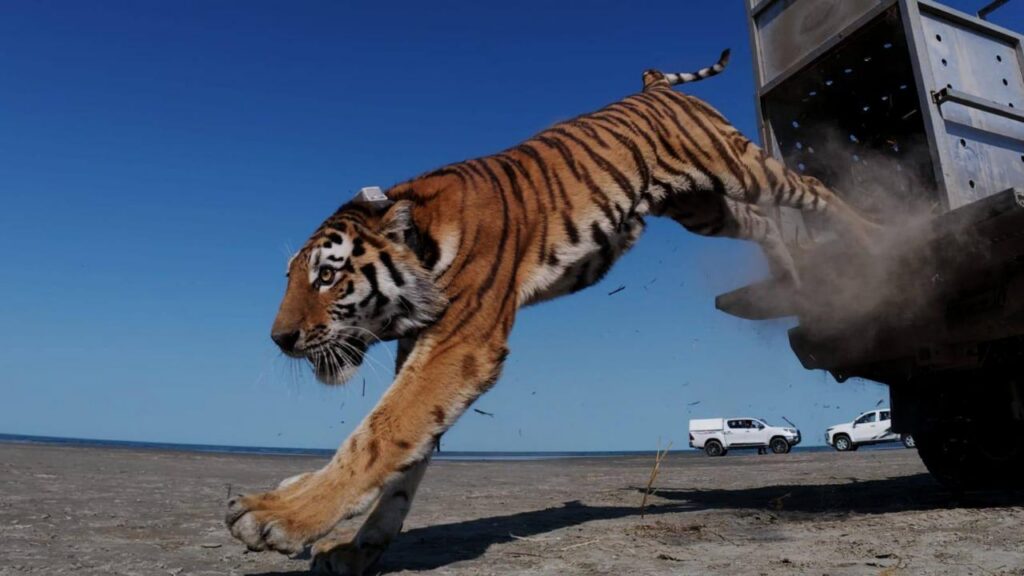
Kazakhstan Releases First Tiger into Wild in More Than 70 Years
Kazakhstan has released a tiger into the wild for the first time in more than 70 years, beginning the practical phase of a long-running program to restore the predator to the Ili River delta. The female Amur tiger, Umit, was released at the Ile-Balkhash State Nature Reserve on July 31, the Ecology Ministry announced on August 3. “Today we witnessed a truly historic event,” Ecology Minister Yerlan Nysanbayev said. He described the release as the result of more than a decade of work by Kazakhstan, Russian specialists, scientists, and international conservation partners. Before the release, Umit underwent veterinary examinations and assessments of her health, hunting ability, behavior, and response to people. Officials fitted her with a GPS/GSM satellite collar. Reserve staff are now tracking her around the clock through satellite data and camera traps. The adult male tiger, also named Amur, remains under observation and must complete further behavioral assessments before any release. Two cubs, Turan and Ussuri, will remain in prepared enclosures until they are at least 18 months old. Officials will assess each animal separately. The four wild-caught tigers arrived from Russia’s Khabarovsk region in May. They joined Bogdana and Kuma, two captive Amur tigers transferred from the Netherlands in September 2024 for breeding. The Dutch pair will remain in an enclosure, while suitable offspring may later be prepared for release. Tigers once occupied reed beds and floodplain forests along the Ili and Syr Darya rivers. Hunting, habitat loss, and the collapse of wild prey populations drove the Turan, or Caspian, tiger from Kazakhstan. The last recorded animal in the country was killed in 1948. Kazakhstan is using Amur tigers because genetic research found a very close relationship between the surviving Russian Far East population and the extinct Caspian population. The study found that their main mitochondrial DNA types differed by only one nucleotide. Kazakhstan announced plans to restore tigers in 2010 and created the Ile-Balkhash reserve in 2018. The protected area covers the Ili delta and the southern shore of Lake Balkhash, one of the former strongholds of the Turan tiger. Preparations have included restoring floodplain habitat and rebuilding the prey base. Authorities released 205 Bukhara deer into the reserve between 2018 and 2024 and relocated more than 100 kulans. Roe deer and wild boar populations have also increased. A July review by Kazakh and Russian specialists examined the release preparations and issued technical recommendations. The NBSAP Accelerator Partnership said that, “Success will be measured not simply by releasing individual animals, but by establishing a secure, self-sustaining tiger population.” The program also includes measures to reduce conflict with nearby communities. Residents will receive individual alerts if a tracked tiger comes within five kilometers of a home or settlement. The reserve has established teams to deter, tranquilize, or capture an animal if necessary. A public hotline has operated since May 2025. A compensation herd has been created to reimburse owners if a tiger kills livestock. These measures are designed to prevent the animals from associating settlements with food...
