• KGS/USD = 0.01144 0%
  • KZT/USD = 0.00198 -0%
  • TJS/USD = 0.10901 0%
  • UZS/USD = 0.00008 0%
  • TMT/USD = 0.28490 0%
  • KGS/USD = 0.01144 0%
  • KZT/USD = 0.00198 -0%
  • TJS/USD = 0.10901 0%
  • UZS/USD = 0.00008 0%
  • TMT/USD = 0.28490 0%
  • KGS/USD = 0.01144 0%
  • KZT/USD = 0.00198 -0%
  • TJS/USD = 0.10901 0%
  • UZS/USD = 0.00008 0%
  • TMT/USD = 0.28490 0%
  • KGS/USD = 0.01144 0%
  • KZT/USD = 0.00198 -0%
  • TJS/USD = 0.10901 0%
  • UZS/USD = 0.00008 0%
  • TMT/USD = 0.28490 0%
  • KGS/USD = 0.01144 0%
  • KZT/USD = 0.00198 -0%
  • TJS/USD = 0.10901 0%
  • UZS/USD = 0.00008 0%
  • TMT/USD = 0.28490 0%
  • KGS/USD = 0.01144 0%
  • KZT/USD = 0.00198 -0%
  • TJS/USD = 0.10901 0%
  • UZS/USD = 0.00008 0%
  • TMT/USD = 0.28490 0%
  • KGS/USD = 0.01144 0%
  • KZT/USD = 0.00198 -0%
  • TJS/USD = 0.10901 0%
  • UZS/USD = 0.00008 0%
  • TMT/USD = 0.28490 0%
  • KGS/USD = 0.01144 0%
  • KZT/USD = 0.00198 -0%
  • TJS/USD = 0.10901 0%
  • UZS/USD = 0.00008 0%
  • TMT/USD = 0.28490 0%
07 December 2025

Viewing results 1 - 6 of 4

Medieval Wall Paintings Discovered at Ancient Kanka Site in Uzbekistan

Archaeologists in Uzbekistan have uncovered rare wall paintings dating back to the 10th-11th centuries at the ancient site of Kanka in the Tashkent region, according to a report by UzA. The excavation is being led by researchers from the Institute of History at the Academy of Sciences of Uzbekistan, with support from the Tashkent regional administration. Dilnoza Jamolova, the institute’s deputy director, stated that the mural fragments were discovered within the remains of a large caravanserai located in the shahristan (inner city) of ancient Kanka. The structure, situated approximately 60 meters south of the city’s southern gate, measures around 100 by 70 meters and is noted for its significant architectural features. Inside one of the caravanserai’s rooms, archaeologists found fragments of wall paintings that had fallen from the walls. The pieces, ranging from 15×20 to 30×35 centimeters, confirm that the building’s interior was once adorned with mural artwork. Experts say the discovery is notable evidence that wall painting, a tradition believed to have declined following the Arab conquest, experienced a revival in the Tashkent region during the 10th and 11th centuries. Similar wall paintings have been identified at other prominent Central Asian archaeological sites, including Samarkand and Ahsikent. The ongoing study, which involves restorers from the Samarkand Archaeological Institute under the Cultural Heritage Agency, also suggests the existence of a distinct mural art tradition in medieval Tashkent. In earlier excavations at Kanka in 2023, researchers discovered murals dating back to the 5th-7th centuries. The latest findings are expected to offer new insights into the cultural and artistic life of the region and to deepen scholarly understanding of Tashkent’s medieval heritage. Previously, The Times of Central Asia reported on another major archaeological discovery in southern Uzbekistan, where scientists found evidence that hunter-gatherer communities were harvesting wild barley as early as 9,200 years ago, challenging long-standing theories about the origins of agriculture in the ancient world.

Underwater Secrets of the Steppe: Archaeologists Unearth Ancient Artifacts in Kazakhstan’s Bogen Reservoir

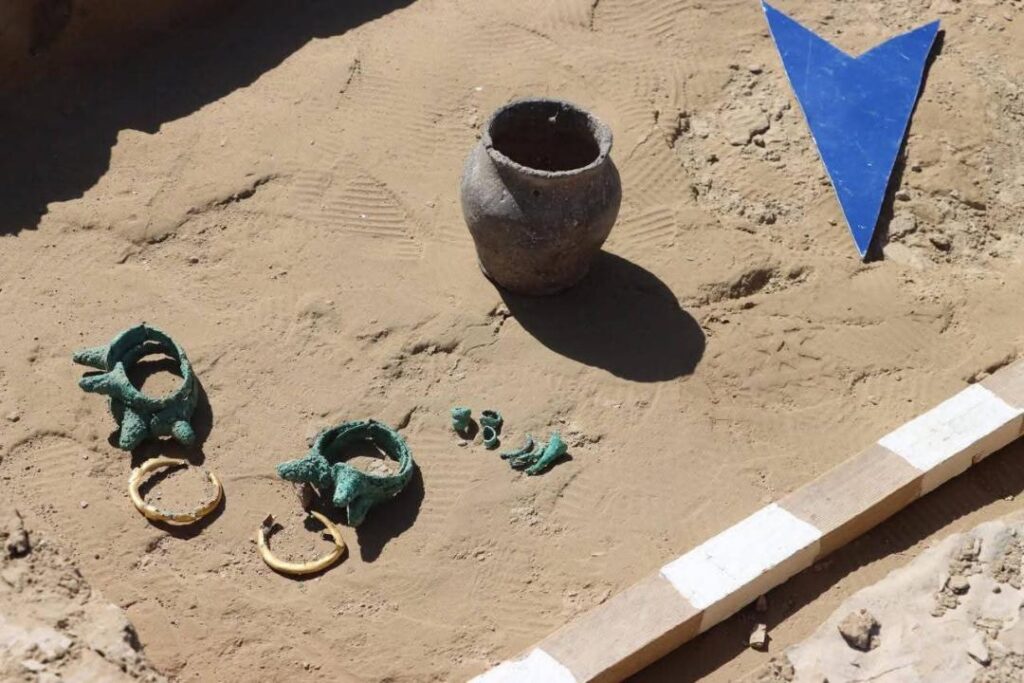
A team of archaeologists from the Zhanibekov University Research Center has uncovered a trove of ancient artifacts at the Bogen Reservoir in the Ordabasy district of Kazakhstan’s Turkestan region. An unusually dry season significantly lowered the water level, revealing archaeological remains hidden for centuries. Paleolithic Tools and Bronze Age Burials Within just one week of surveying, researchers recovered dozens of Late Paleolithic and Mesolithic stone tools, including chalcedony flakes, cores, and cutting plates. Several Bronze Age burial sites were also excavated. While skeletal remains were poorly preserved, the grave goods were remarkable: decorated ceramics, a gold-plated bronze temple ornament, rings, bracelets, earrings, and hundreds of tiny beads likely used in headdresses. A particularly notable discovery was a burial dated to the 1st century BC-1st century AD. It contained three socketed arrowheads, a utility knife, a belt buckle, and a ceramic jug. Experts say such finds affirm the continuous human settlement of the region over millennia. After analysis, the artifacts will be transferred to a local museum. Bronze Knives, a Saka Ring, and a Lost Medieval City Earlier this year, The Times of Central Asia reported that archaeologists from Margulan University had unearthed two bronze knives near Lake Toraygyr. While attributed to the early Saka period, their design reflects stylistic elements of the Early Iron Age, evidence of both advanced metallurgy and cultural connectivity across Central Asia. At another site, researchers from Al-Farabi Kazakh National University discovered a gold ring from the Scythian era, weighing nearly 8 grams and featuring a lion motif. Experts interpret the human-animal hybrid symbolism as representative of the spiritual worldview of Saka elites in the 4th-3rd centuries BC. The burial also contained the remains of a man and a woman, alongside stone, iron, and gold artifacts. In Zhetysu, archaeologists revealed the ruins of a medieval city likely destroyed during the Mongol invasions. Excavations uncovered preserved brickwork, a defensive tower, and evidence of intense fire damage. Experts have drawn comparisons with other UNESCO-listed sites such as Talgar (Talhiz) and Koilyk. Meanwhile, the Saryarka Archaeological Institute has identified 25 historical and cultural sites in the Shet district of central Kazakhstan. These range from the Bronze Age through the Iron Age and into the medieval period. Excavations are pending, awaiting official permits. The “Golden Man” of East Kazakhstan and the Buddhist Crossroads One of the country’s most celebrated discoveries in recent years remains the 2018 unearthing of the so-called “Golden Man of East Kazakhstan” by archaeologist Zeinolla Samashev. More than 3,000 gold artifacts, including earrings, necklaces, and horse harness ornaments, were recovered from a burial dating to the 7th-8th centuries BC. Further south, in the Aiyrandy Gorge of the Merke district, archaeologists uncovered the remains of an ancient Buddhist temple, including a carved stone head of the Buddha. The find underscores the region’s historic role as a crossroads of religions and cultures along the Silk Road. From Paleolithic tools and Saka-era treasures to lost medieval cities and Buddhist sanctuaries, Kazakhstan’s recent archaeological discoveries reveal an extraordinary continuity of settlement...