• KGS/USD = 0.01144 0%
  • KZT/USD = 0.00200 0%
  • TJS/USD = 0.10514 -0.09%
  • UZS/USD = 0.00008 0%
  • TMT/USD = 0.28490 0%
  • KGS/USD = 0.01144 0%
  • KZT/USD = 0.00200 0%
  • TJS/USD = 0.10514 -0.09%
  • UZS/USD = 0.00008 0%
  • TMT/USD = 0.28490 0%
  • KGS/USD = 0.01144 0%
  • KZT/USD = 0.00200 0%
  • TJS/USD = 0.10514 -0.09%
  • UZS/USD = 0.00008 0%
  • TMT/USD = 0.28490 0%
  • KGS/USD = 0.01144 0%
  • KZT/USD = 0.00200 0%
  • TJS/USD = 0.10514 -0.09%
  • UZS/USD = 0.00008 0%
  • TMT/USD = 0.28490 0%
  • KGS/USD = 0.01144 0%
  • KZT/USD = 0.00200 0%
  • TJS/USD = 0.10514 -0.09%
  • UZS/USD = 0.00008 0%
  • TMT/USD = 0.28490 0%
  • KGS/USD = 0.01144 0%
  • KZT/USD = 0.00200 0%
  • TJS/USD = 0.10514 -0.09%
  • UZS/USD = 0.00008 0%
  • TMT/USD = 0.28490 0%
  • KGS/USD = 0.01144 0%
  • KZT/USD = 0.00200 0%
  • TJS/USD = 0.10514 -0.09%
  • UZS/USD = 0.00008 0%
  • TMT/USD = 0.28490 0%
  • KGS/USD = 0.01144 0%
  • KZT/USD = 0.00200 0%
  • TJS/USD = 0.10514 -0.09%
  • UZS/USD = 0.00008 0%
  • TMT/USD = 0.28490 0%
27 February 2026

Viewing results 1 - 6 of 10

Kazakhstan Moves to Export Its Legendary Aport Apples

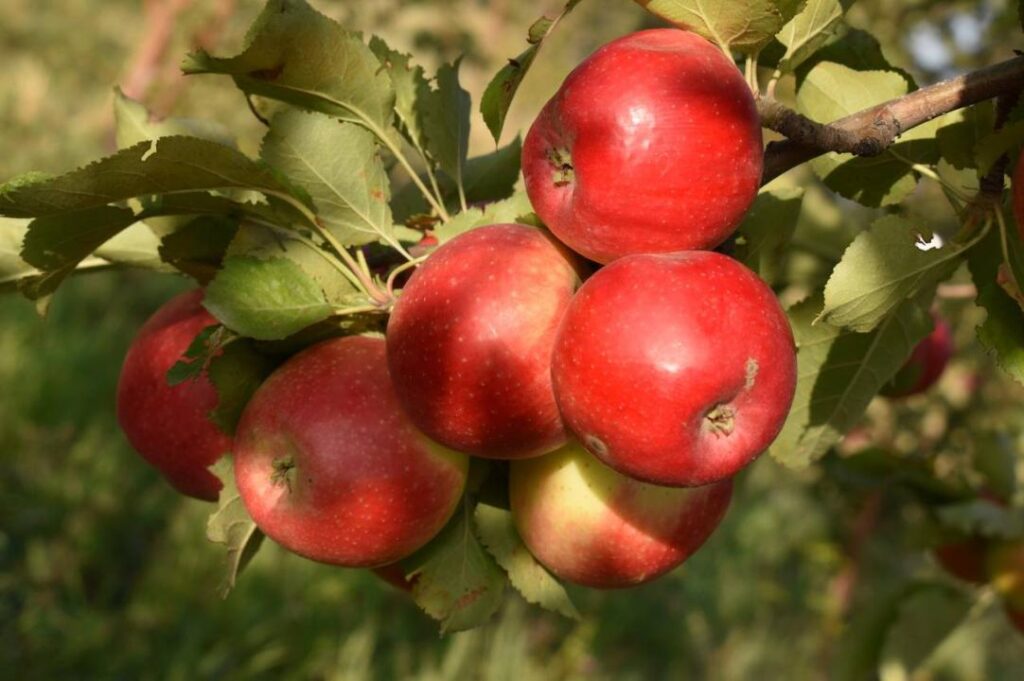
Kazakhstan is preparing to introduce its iconic Almaty aport apples to international markets after the variety attracted strong interest from European partners at Grune Woche 2026 in Germany. During the exhibition, QazTrade and the Association of Almaty Aport Producers signed a memorandum aimed at promoting aport apples and their processed products abroad, according to the Ministry of Trade and Integration of Kazakhstan. The aport is one of Kazakhstan’s most distinctive apple varieties and is closely associated with the natural and cultural heritage of Almaty, widely regarded as the ancestral home of apples. Known for their large size, rich aroma, and juiciness, aport apples are also highly demanding to cultivate. High-quality aport can only be grown at elevations between 850 and 1,250 meters above sea level, primarily in the foothills surrounding Almaty. Unlike commercial apple varieties that begin bearing fruit within four to six years, aport trees typically require eight to nine years before producing their first harvest. Despite the longer maturation period, the apple’s distinctive qualities and heritage value position it as a premium niche product. “The main advantage of aport is its uniqueness. Unlike mass-produced varieties designed for volume and long storage, aport stands out for its vivid taste, rich aroma, and large fruit size. Our orchards are located above 850 meters above sea level, which affects the firmness of the pulp and depth of flavor. In Germany, we presented not only fresh apples but also processed products such as fruit pastilles and apple chips. We also produce aport-based juice, vinegar, and dried fruit,” said Roman Safarov, president of the Association. According to QazTrade, participation in Grüne Woche confirmed strong export potential, particularly for processed aport products. “The Almaty aport is registered as a geographical indication. This status confirms its unique characteristics shaped by the natural conditions of the Almaty foothills, special soils, clean water, and temperature fluctuations. The geographical indication protects the brand and allows it to be promoted as a premium product in international markets,” said QazTrade CEO Aitmuhammed Aldazharov. Horticulture is increasingly viewed as a strategic growth area within Kazakhstan’s agro-industrial sector. According to Yerbol Taszhurekov, apple orchards in Kazakhstan now cover nearly 29,000 hectares, concentrated mainly in the southern regions of Almaty, Turkestan, Zhambyl, and Zhetisu. In the Almaty and Zhetisu regions alone, orchards span more than 2,400 hectares and include over 416,000 trees. Kazakhstan is also working to revive the aport variety, which had previously faced near extinction. Under a targeted 2024-2028 program involving private investors and specialized nurseries, authorities aim to produce certified saplings and expand commercial cultivation. By 2027, plans call for planting at least 110 hectares of new aport orchards.
Kazakhstan Launches Michurin Orchard to Advance High-Tech Horticulture

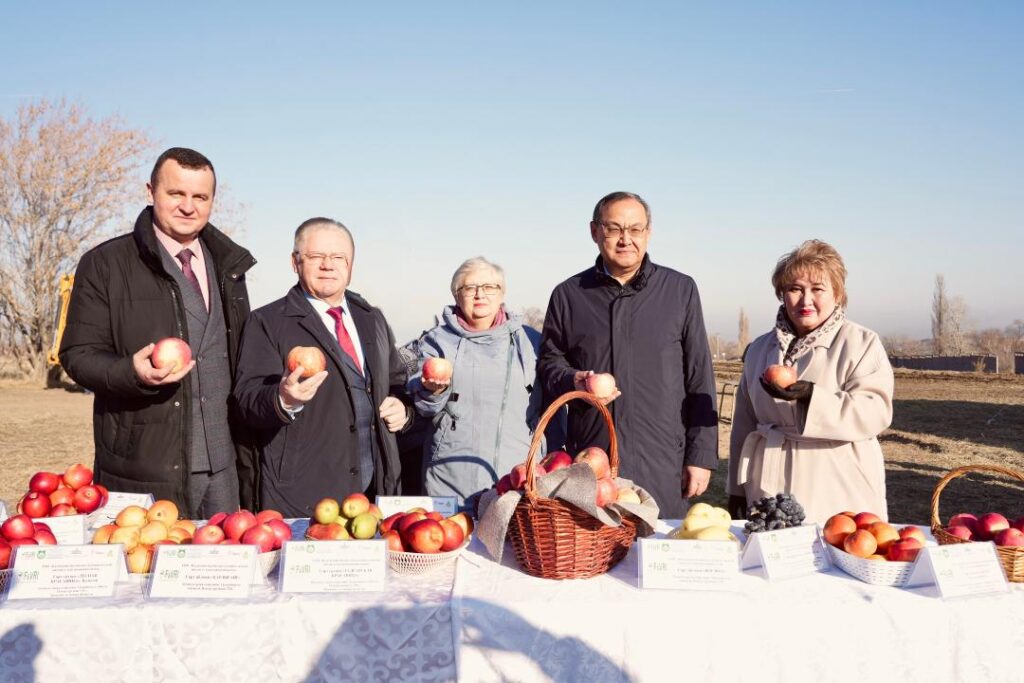
Kazakhstan has taken a significant step in modernizing its agricultural sector with the inauguration of the Michurin Orchard, a collaborative venture between the National Academy of Sciences of Kazakhstan and the Russian Academy of Sciences. The orchard, launched on December 1 in the village of Almalyk, Almaty region, will serve as a flagship platform for developing intensive horticulture and integrating science with high-value agricultural production. The initiative is part of the Kazakh-Russian Center for Advanced Technologies in the Agro-Industrial Sector, established in April 2025. Named after Ivan Michurin (1855-1935), a renowned Russian pioneer in plant selection, the orchard will operate as an open-air research and production site. Its core objectives include testing promising fruit and berry varieties, applying intensive horticultural techniques, and deploying water-, energy-, and resource-saving technologies. Initial plantings will focus on high-yield Russian apple cultivars adapted to Kazakhstan’s climate, along with pear, cherry, sweet cherry, plum, and a broad range of berries such as raspberry, honeysuckle, currants, sea buckthorn, and rose hips. Akhylbek Kurishbayev, President of the National Academy of Sciences of Kazakhstan, described the orchard as “a long-term investment in the development of Kazakhstan’s fruit growing industry.” He emphasized that the initial three-hectare planting represents the foundation of a new generation of resilient, high-productivity varieties capable of withstanding climatic stress. Kurishbayev noted that the Michurin Orchard will contribute to national breeding programs, build a sustainable raw material base for food processing industries, ranging from juices and concentrates to functional foods and help shift Kazakhstan’s agro-industrial model from raw-materials dependence to knowledge-intensive production. The orchard will also function as a live testing ground for horticultural technologies, from the selection of planting material to the delivery of premium fruit to consumers. Horticulture is emerging as a strategic growth sector within Kazakhstan’s agro-industrial complex. According to Deputy Minister of Agriculture Yerbol Taszhurekov, Kazakhstan’s apple orchards now span nearly 29,000 hectares, predominantly located in the southern regions of Almaty, Turkestan, Zhambyl, and Zhetisu. In Almaty and Zhetisu regions alone, apple orchards cover more than 2,400 hectares and include over 416,000 trees. In parallel, Kazakhstan is working to revive the iconic aport apple, a variety deeply intertwined with the country's botanical heritage and the city of Almaty, widely regarded as the ancestral home of the apple. Under a targeted 2024-2028 program involving private investors and specialized nurseries, the government aims to produce certified saplings and scale commercial aport cultivation. By 2027, Kazakhstan plans to plant 110 hectares of aport orchards.

Kazakhstan Expands Apple Orchards, Prioritizing Legendary Aport Variety

Kazakhstan’s apple orchards now span nearly 29,000 hectares, primarily in the southern regions of Almaty, Turkestan, Zhambyl, and Zhetisu. In the Almaty and Zhetisu regions alone, orchards cover more than 2,400 hectares, hosting over 416,000 apple trees. Deputy Minister of Agriculture Yerbol Taszhurekov shared these figures during the Apple Festival held in Astana on October 4. The event also marked the 80th anniversary of the Food and Agriculture Organization (FAO) and World Food Day 2025. “Horticulture is becoming a key sector in the agro-industrial complex. Since 2014, government support measures, including investment subsidies for orchard planting and intensive cultivation technologies, have led to a 43% increase in gross apple harvests and a 27% rise in yield,” Taszhurekov said. The festival placed special emphasis on Kazakhstan’s iconic apple variety, the aport. Widely recognized as the birthplace of the apple, Kazakhstan and specifically the Almaty region, is home to the legendary aport variety. Aport apples are known for their large size, fragrance, and juiciness, but they require very specific growing conditions. High-quality fruit can be cultivated only at altitudes between 850 and 1,250 meters above sea level, primarily in the Almaty foothills. Unlike other varieties that bear fruit within four to six years, aport trees take eight to nine years to produce their first harvest. Despite the longer wait, the fruit’s quality and heritage value make it highly prized. To revive aport cultivation, the Ministry of Agriculture, in partnership with the National Agrarian Scientific and Educational Center, has launched a program for 2024-2028 involving private investors and specialized nurseries. The initiative aims to produce certified saplings for full-scale commercial cultivation. In 2024, seeds from the Sievers apple tree, considered the ancestor of all domestic apples, were collected, and national standards for aport cultivation were established. In 2025, seedlings were planted on ten hectares to serve as a mother garden for nurseries. Over the next two years, the program plans to grow enough saplings to plant 100 hectares of orchards, eventually making aport saplings available to private gardeners for commercial use. Historically, Kazakhstan had 3.8 million aport trees in 1970. By 1984, that number had declined to just 1.4 million. Taszhurekov underscored that aport is not just a fruit, but a symbol of national identity. “We are taking specific measures to revive it as a national brand. Plans include expanding orchards, improving agricultural practices, and promoting this variety internationally. By 2027, we aim to establish 110 hectares of aport orchards,” he said.  

Kazakhstan Launches Ambitious Project to Revive Legendary Aport Apple

Kazakhstan has launched a major initiative to restore one of Almaty's most iconic symbols, the Aport apple variety. The Return of a National Symbol According to the National Agrarian Scientific and Educational Center (NANOC), new Aport orchards will be planted in the Almaty region starting in 2025, covering an area of 110 hectares. The project, set to run through 2028, plans to introduce approximately 25,000 seedlings. Funding has already been secured, and experts from KazNII Horticulture LLP have begun implementing the roadmap. “We are confident that the revival of this variety will be an important step in the development of domestic horticulture and will provide Kazakhstanis with high-quality and tasty fruits,” NANOC stated. The first harvest is expected in eight years. According to scientific forecasts, yields could reach up to 57.7 kilograms per tree in the early stages and up to 100 kilograms as the orchards mature. Aport apples are known not only for their distinctive aroma and taste but also for their durability: with proper storage, they remain fresh until March, and with modern preservation methods, even until June. A Fruit Steeped in History The Aport apple is more than just a fruit, it’s a cultural brand of Almaty. With its large size, vibrant color, and rich aroma, the Aport became a hallmark of the city. Historical records show that in 1865, a peasant named Yegor Redko brought Aport seedlings from Russia’s Voronezh Province to the town of Verny (modern-day Almaty). Within a decade, the variety flourished in the unique climate of the Zailiyskiy Alatau, revealing its full potential. By the early 20th century, Aport apples had gained international acclaim. At an exhibition in Germany in 1908, the variety won a prize. Since then, it has been recognized as a Kazakhstani brand. In 2023, the Aport was officially patented as a national product. Justice Minister Azamat Eskarayev has announced efforts to register the Aport as an international brand, including in European countries. Decline and Recovery Challenges The decline of the Aport apple began in the late 20th century, driven by rapid urbanization and the commercial development of former orchard lands. According to Saule Kazybayeva, Deputy Chair of the Board at the Kazakh Research Institute of Fruit and Vegetable Growing, the Aport was replaced by hardier and more commercially viable varieties like Golden Delicious. Moreover, the Aport requires specific care and environmental conditions, making it less appealing for mass production. Another setback has been the degradation of its genetic qualities. The traditional method of grafting Aport onto wild Sivers apple stock is often not properly followed, especially by private farms, resulting in a loss of the variety’s signature flavor. The Current Outlook According to the Ministry of Agriculture, Aport orchards now cover 2,500 hectares across Almaty and Zhetysu oblasts, with around 416,000 trees in total. Almaty itself has about 230 hectares of Aport orchards. However, local authorities acknowledge that both the orchard area and fruit quality are in decline, largely due to disease susceptibility. Despite these challenges, a revitalization program...