


Two Asteroids Named After Uzbek Astronomers
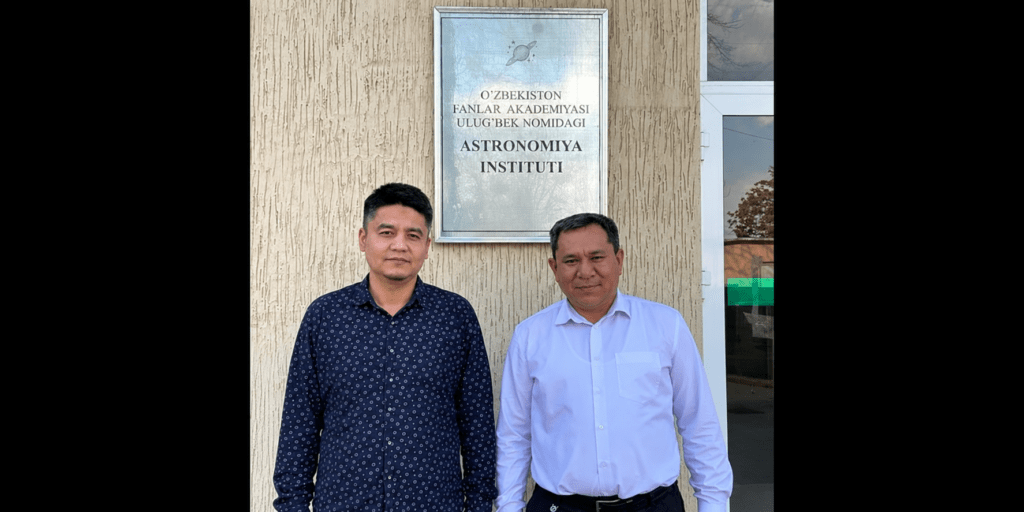
Two Uzbek astronomers have received an unusual form of international recognition: their names have been assigned to minor planets orbiting the Sun. The International Astronomical Union’s Working Group for Small Bodies Nomenclature approved (121339) Otabekburkhonov and (131358) Kamolergashev in its July 9 bulletin. The names will now be used in scientific catalogues and research. Both asteroids were discovered at the Ondřejov Observatory in the Czech Republic by astronomers Petr Pravec and Peter Kušnirák. Otabekburkhonov, first known as 1999 TO15, was found on October 13, 1999. Kamolergashev, previously 2001 KA2, was discovered on May 19, 2001. Otabek Burkhonov, born in 1975, joined the Ulugh Beg Astronomical Institute in 2000 and received his PhD in 2005. He heads the institute’s Laboratory of Galactic Astronomy. His work covers optical photometry, including asteroid light curves, variable stars, gravitationally lensed quasars, and follow-up observations of gamma-ray bursts at Maidanak Observatory. Kamoliddin Ergashev, born in 1988, joined the institute’s Asteroid Group in 2007 and completed his PhD in 2024. His research examines asteroid brightness and rotation, physical characteristics, and the behavior of asteroid pairs, clusters, and binary systems. The two scientists also contributed to NASA’s Double Asteroid Redirection Test (DART), the first mission to demonstrate asteroid deflection through a deliberate spacecraft impact. Their observations from Maidanak helped measure changes in the Didymos-Dimorphos system before and after the September 2022 collision. In February, both received a NASA Group Achievement Award for their role in the international observing campaign. DART shortened Dimorphos’s orbit around Didymos by about 33 minutes, showing that a kinetic impact could alter an asteroid’s motion.
