


Kazakh Scientists to Gain More Opportunities to Work at CERN
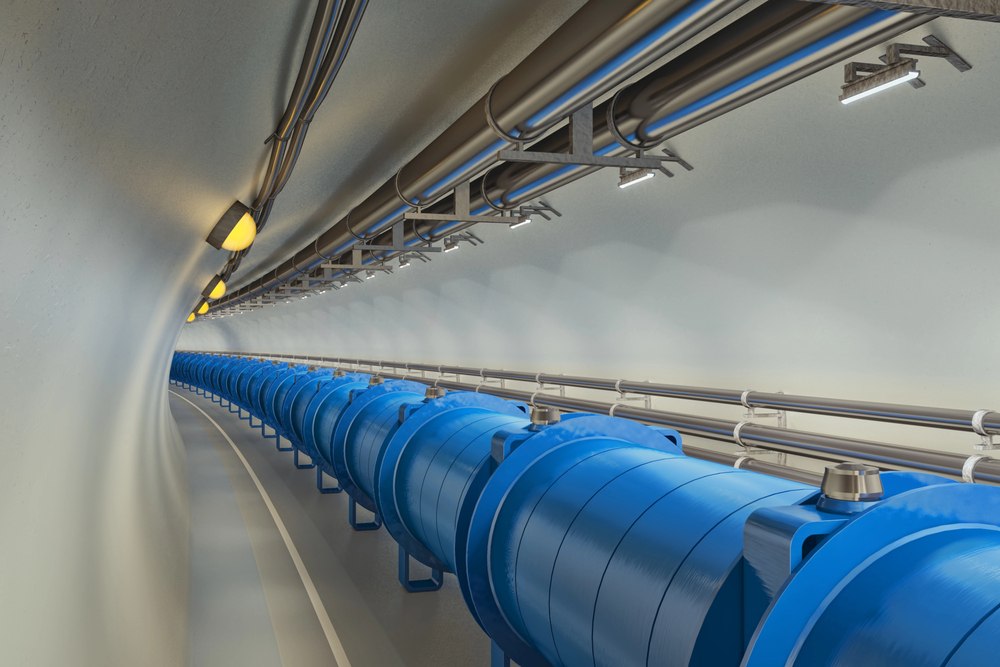
Kazakhstan is preparing an agreement with CERN that would give its scientists more opportunities to participate in experiments and undertake research internships at one of the world’s leading particle physics centers. The talks come as the country begins developing nuclear power plants and faces a growing need for highly qualified physicists and engineers. The prospect was discussed at a meeting between Kazakhstan’s acting Minister of Science and Higher Education Sayasat Nurbek and CERN Director-General Mark Thomson. The two sides have already prepared a draft protocol expanding their 2018 cooperation agreement. The proposed mechanism would allow Kazakh scientists to undertake research internships and participate in CERN projects through the Scientific Internships program of Kazakhstan’s Center for International Programs. CERN, the European Organization for Nuclear Research, was founded in 1954. Its vast scientific complex is located near Geneva on the border between Switzerland and France. It is home to the Large Hadron Collider, a 27-kilometer particle accelerator, used by physicists to accelerate particles to nearly the speed of light, collide them, and study the fundamental structure of matter. The ATLAS and CMS experiments at the Large Hadron Collider led to the discovery of the Higgs boson in 2012, one of the most important breakthroughs in modern physics. CERN has 25 Member States and another 11 Associate Member States. Kazakhstan belongs to neither group. Its cooperation with the organization is based on the 2018 agreement. The draft protocol is intended to create a more formal mechanism for Kazakh researchers to participate in CERN research. For Kazakhstan, training scientists and engineers has become more pressing following the decision to develop nuclear power. In an October 2024 referendum, 71.12% of those who voted supported the construction of a nuclear power plant. In June 2025, Russia’s Rosatom was selected to lead the consortium building the country’s first nuclear power plant near the village of Ulken on the shore of Lake Balkhash, about 400 kilometers from Almaty. Kazakhstan has since expanded those ambitions. A nuclear industry strategy approved in April 2026 calls for at least three nuclear power plants to be operating by 2050. China National Nuclear Corporation (CNNC) has been selected to lead the development of Kazakhstan’s second nuclear power plant. Plans for a third plant are also being developed, although the technology and contractor have not yet been definitively determined. Buying reactors alone will not be enough – the country also needs its own specialists. Kazakhstan is already allocating dedicated places under the international Bolashak scholarship program to train nuclear energy professionals, while local universities are launching programs for future nuclear power plant employees. Bolashak is a state-funded program that pays for Kazakh citizens to study at universities abroad. While CERN does not train nuclear power plant operators, working at the center can give physicists and engineers experience with particle accelerators, sophisticated detectors, computing systems, and international scientific experiments. For Kazakhstan, this offers an opportunity to develop its own scientific expertise in parallel with training personnel specifically for nuclear power plants.
