• KGS/USD = 0.01144 0%
  • KZT/USD = 0.00202 0%
  • TJS/USD = 0.10626 -0.19%
  • UZS/USD = 0.00008 0%
  • TMT/USD = 0.28571 0%
  • KGS/USD = 0.01144 0%
  • KZT/USD = 0.00202 0%
  • TJS/USD = 0.10626 -0.19%
  • UZS/USD = 0.00008 0%
  • TMT/USD = 0.28571 0%
  • KGS/USD = 0.01144 0%
  • KZT/USD = 0.00202 0%
  • TJS/USD = 0.10626 -0.19%
  • UZS/USD = 0.00008 0%
  • TMT/USD = 0.28571 0%
  • KGS/USD = 0.01144 0%
  • KZT/USD = 0.00202 0%
  • TJS/USD = 0.10626 -0.19%
  • UZS/USD = 0.00008 0%
  • TMT/USD = 0.28571 0%
  • KGS/USD = 0.01144 0%
  • KZT/USD = 0.00202 0%
  • TJS/USD = 0.10626 -0.19%
  • UZS/USD = 0.00008 0%
  • TMT/USD = 0.28571 0%
  • KGS/USD = 0.01144 0%
  • KZT/USD = 0.00202 0%
  • TJS/USD = 0.10626 -0.19%
  • UZS/USD = 0.00008 0%
  • TMT/USD = 0.28571 0%
  • KGS/USD = 0.01144 0%
  • KZT/USD = 0.00202 0%
  • TJS/USD = 0.10626 -0.19%
  • UZS/USD = 0.00008 0%
  • TMT/USD = 0.28571 0%
  • KGS/USD = 0.01144 0%
  • KZT/USD = 0.00202 0%
  • TJS/USD = 0.10626 -0.19%
  • UZS/USD = 0.00008 0%
  • TMT/USD = 0.28571 0%
12 February 2026

Viewing results 1 - 6 of 12

CSTO Faces Uncertain Future as Putin Champions Russian Arms

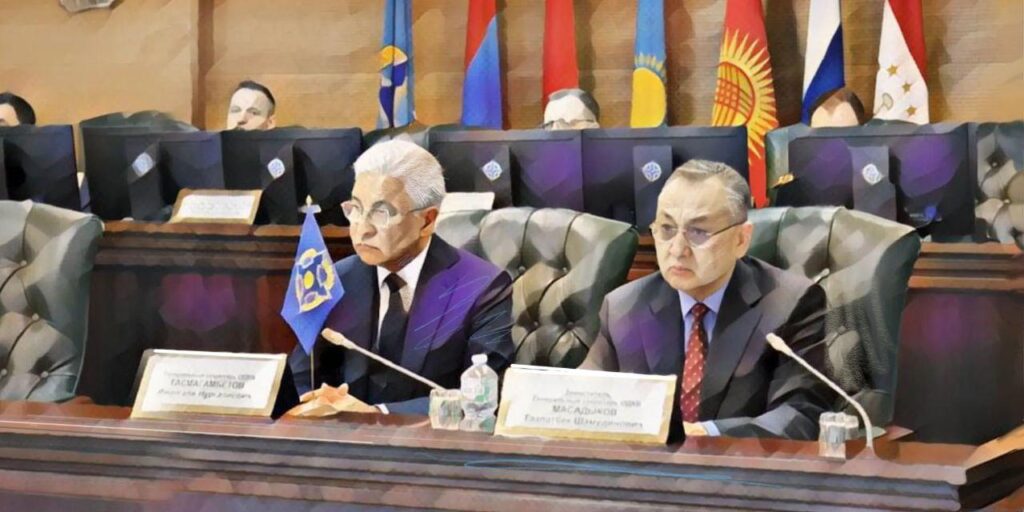
The session of the CSTO Collective Security Council on November 27 in Bishkek underscored a key reality: the bloc, once envisioned as the “Eurasian response to NATO,” now consists of just five active members. Armenia pointedly boycotted the summit, a gesture that spoke volumes about the alliance’s internal fractures. While the presidents of Kyrgyzstan, Russia, Belarus, Kazakhstan, and Tajikistan discussed “multipolarity” and “security,” Kyrgyz authorities erected a massive LED screen near the presidential residence, conveniently blocking the Ukrainian flag atop the Ukrainian embassy. Officials claimed the move was a “protocol requirement.” Moscow used the summit as a platform to outline its long-term strategic goals for the region, seizing the moment amid Armenia’s absence, growing debate over the CSTO’s purpose, and rising competition from other international security alliances in Eurasia. Yerevan’s decision to skip the gathering is a warning sign for fellow CSTO members. Armenia, having faced a real security crisis, evidently no longer views the alliance as a reliable guarantor. This casts doubt on the CSTO’s ability to adapt to a rapidly evolving regional security landscape, where flexibility, responsiveness, and tangible conflict support are increasingly in demand. In his report, CSTO Secretary General Imangali Tasmagambetov emphasized the bloc’s institutional development over the past three years, expanding collective forces, developing cyber capabilities, and establishing new international roadmaps. He also announced the creation of an Information and Analytical Department, signaling an effort to emulate more sophisticated military-political structures. Yet much of his address echoed the standard talking points delivered at previous summits. Tasmagambetov did address Armenia's absence, stating, “The CSTO respects Yerevan’s sovereign right.” Rather than defusing the issue, this acknowledgment only served to highlight the political rupture. Despite the tensions, CSTO leaders signed a broad set of documents, including a collective security strategy, an anti-drug initiative, and new military cooperation plans, reportedly one of the most comprehensive packages in recent years. Nonetheless, the summit’s spotlight belonged to Vladimir Putin and Alexander Lukashenko. The other leaders appeared relegated to the sidelines, affirming declarations to preserve a fragile collective consensus. Putin’s visit to Bishkek spanned two days, during which his pronouncements effectively became the summit’s agenda. He reiterated that the CSTO is a “guarantor of stability” and proposed equipping the bloc’s collective forces with Russian weapons “proven in combat conditions”, a clear reference to the war in Ukraine, though left deliberately vague. With Russia set to assume the CSTO chairmanship in 2026, the Kremlin appears to be steering the alliance toward deeper military-technical integration. Promoting its weapons to member states not only boosts Russia’s arms industry but also increases CSTO members’ reliance on Russian technologies and command systems. Some analysts suggest Moscow’s chairmanship priorities, from cybersecurity to aerospace defense, reflect an effort to position the CSTO as a counterweight to rival military-political blocs. President Lukashenko of Belarus added a European security dimension to the talks, citing NATO’s growing defense budgets and the military buildup in Poland, Germany, and the Baltic states as justification for reinforcing the CSTO. For Kazakhstan, Kyrgyzstan, and Tajikistan, the...

CSTO Signs New Security Roadmap in Bishkek Amid Armenia Boycott and Putin Ukraine Remarks

The Collective Security Treaty Organization (CSTO) reaffirmed its commitment to regional security and political coordination during its annual summit in Bishkek, Kyrgyzstan, on November 27. Leaders from five of the bloc’s six members - Russia, Belarus, Kazakhstan, Kyrgyzstan, and Tajikistan - attended the event and signed off on a series of military, security, and strategic cooperation agreements. Armenia, the sixth CSTO member, boycotted the summit for the second year running, continuing its protest against the alliance’s refusal to intervene during Armenia’s conflict with Azerbaijan, and marking another low in Armenia’s engagement with the CSTO after months of public grievances against the bloc. Despite Yerevan’s absence, the other members adopted a wide-ranging joint declaration reaffirming the alliance’s collective defense commitments and outlining new initiatives to modernize its security framework. Notably, Armenia did not oppose the adoption of the summit documents in its absence. The CSTO, founded in 2002 and led by Russia, has a charter that guarantees mutual defense among members, though the bloc has often struggled to act decisively during regional crises. Still, it remains the only formal security alliance connecting Russia with post-Soviet Central Asian republics. Kyrgyz President Sadyr Japarov hosted the summit, marking the end of his country’s chairmanship. Japarov handed over the role to Russian President Vladimir Putin, who announced that Russia will lead the CSTO in 2026 under the motto “Collective Security in a Multipolar World: Common Goal—Shared Responsibility.” The bloc also appointed Kyrgyzstan’s Taalatbek Masadykov as the next Secretary General. The former deputy head of Kyrgyzstan’s Security Council will begin his three-year term on January 1, 2026. In remarks during the summit, Putin also addressed global concerns about the war in Ukraine, stating that a 28-point peace plan proposed by former U.S. President Donald Trump could serve as a “basis for future agreements.” He added that Russia has no intention of attacking Europe, seeking to dispel fears of escalation while reaffirming Moscow’s security agenda. The summit ended with the adoption of a large number of documents. Among them were a strategy to combat drug trafficking and plans to improve border security, peacekeeping readiness, and anti-terrorism efforts. Russia used the summit to offer CSTO members a rearmament initiative. Putin proposed supplying allies with modern Russian-made weapons that had “proven their effectiveness” in recent conflicts. The offer included expanded cooperation in joint production and training. Military exercises will continue under the newly adopted five-year cooperation plan. In 2025, the CSTO held drills in Kyrgyzstan, Belarus, and Tajikistan under the banner “Indestructible Brotherhood.” The plan outlines regular future training, integration of air defense units, and enhancements to peacekeeping logistics. The alliance also adopted an Anti-Drug Strategy for 2026–2030 and signed a joint resolution to intensify Operation “Kanal,” which targets drug routes through Central Asia. The CSTO committed to upgrading its counterterrorism strategy and enhancing cyber defense capabilities, with Russia proposing broader coordination on information security and biosecurity. Tajik President Emomali Rahmon, meanwhile, used the summit to urge partners to accelerate border security aid along Tajikistan’s porous southern frontier...

CSTO Summit in Bishkek: Armenia’s Boycott, Russia’s Agenda, and a New Secretary General

On November 27, Kyrgyzstan will host the annual summit of the Collective Security Treaty Organization (CSTO) in Bishkek, bringing together foreign ministers, defense ministers, and security council secretaries from member states. While often portrayed in Russian media as an Eurasian analogue to NATO, the CSTO remains an organization heavily dependent on Russian military power. Should Moscow withdraw or reduce its support, the Organization’s relevance would likely collapse. A stark illustration of this fragility is Armenia, whose Prime Minister Nikol Pashinyan will boycott the summit entirely. Russian Presidential Aide Yuri Ushakov confirmed that Armenia will not attend the session of the Collective Security Council, the CSTO’s highest governing body, though it does not object to the adoption of bloc-wide documents. According to the CSTO press service, the Council is expected to adopt a declaration outlining member states’ joint positions on current security challenges. Also on the agenda is the formal appointment of the next Secretary General for the 2026-2029 term, and the unveiling of Russia’s priorities for its upcoming presidency in 2026. President Vladimir Putin’s speech on these priorities is expected to dominate the summit. Armenia’s withdrawal highlights the CSTO’s waning cohesion, maintained largely by members' reliance on Russian security assistance, a dynamic in place since the Treaty’s inception in Tashkent on May 15, 1992. The original signatories included Armenia, Kazakhstan, Kyrgyzstan, Russia, Tajikistan, and Uzbekistan, with Azerbaijan, Belarus, and Georgia joining in 1993. The treaty entered into force in 1994. Its central provision, Article 4, mandates collective defense: an attack on one member is considered an attack on all, obligating military and other forms of assistance in line with Article 51 of the UN Charter. In 1999, Armenia, Belarus, Kazakhstan, Kyrgyzstan, Russia, and Tajikistan signed a protocol extending the treaty, establishing an automatic renewal every five years. The formal CSTO was created in 2002; its charter was registered with the UN the following year, and it has held observer status at the UN General Assembly since 2004. For Armenia, the CSTO’s relevance has waned dramatically since the bloc declined to intervene during the final phase of the Nagorno-Karabakh crisis. Yerevan’s disenchantment, however, predates 2023 and stretches back to the 2021–2022 border clashes, when it also felt the organization had failed to provide meaningful support. Kazakhstan, by contrast, remains a key beneficiary: the rapid CSTO deployment in January 2022 played a central role in stabilizing the country during a period of acute domestic unrest. As the current Secretary General, Imangali Tasmagambetov - an influential figure from the “Old Kazakhstan” elite - completes his term, the position is scheduled to rotate to Taalatbek Masadykov of Kyrgyzstan. Ushakov confirmed that Tasmagambetov will deliver a final report on the Organization’s activities and security concerns before officially stepping down on January 1. Masadykov, currently Deputy Secretary General, is expected to assume the role seamlessly. While Masadykov brings diplomatic gravitas, the question remains whether he can restrain Moscow and Minsk from pushing CSTO allies toward confrontation with NATO. Tasmagambetov leaves behind a significant legacy and an...

Controversies and Rejections: What Future Awaits the CSTO?

Armenia has officially refused to contribute financially to the Collective Security Treaty Organization (CSTO), a bloc tasked with ensuring the independence, territorial integrity, and sovereignty of its member states. Meanwhile, the organization’s Secretary General, Imangali Tasmagambetov, has come under scrutiny for remarks he made related to the ongoing conflict between Russia and Ukraine. Shifting Alliances and Regional Tensions Founded in 1992, the CSTO comprises Russia, Kazakhstan, Kyrgyzstan, Belarus, Tajikistan, and Armenia. Georgia, Azerbaijan, and Uzbekistan have withdrawn from the organization at various times. While the CSTO regularly conducts joint military exercises and cooperates on counter-terrorism and anti-narcotics efforts, the war in Ukraine has exposed internal divisions and challenged the bloc’s cohesion. Tasmagambetov Responds to Criticism In March, Secretary General Tasmagambetov raised eyebrows in an interview with a Russian outlet, warning that any deployment of EU troops to Ukraine could escalate regional tensions. He stated that the CSTO would be ready to provide assistance “within the framework of the organization’s charter and subject to approval by all member states.” The remarks sparked a backlash, particularly on social media in Kazakhstan, where some users accused Tasmagambetov, the former prime minister, of adopting a pro-Russian stance. Responding in late March, Tasmagambetov recorded a rare video message clarifying his position. “How can one calmly react to baseless claims that I would send my compatriots to war?” he asked. “There will always be those who distort my words. I have always remained loyal to my people; the interests of our country have always come first.” Tasmagambetov went on to urge viewers to think critically about information shared online. This controversy follows an earlier statement by Aibek Smadiarov, spokesperson for Kazakhstan’s Ministry of Foreign Affairs, who said in October 2022 that the CSTO had no plans to involve itself in the Ukraine conflict. “The CSTO's jurisdiction is limited to the internationally recognized territories of its member states,” Smadiarov stated. Kazakhstan, meanwhile, is reviewing a report by a Ukrainian institution that said about 661 Kazakh citizens have fought for Russia since it launched a full-scale invasion of Ukraine in February 2022. The I Want To Live center, which is run by the Ukrainian security services and assists with surrender requests from soldiers fighting for Russia, published a list of what it said were the Kazakh nationals. Of the 661, at least 78 have been killed, according to the center. Without providing details, it said it received the list from its own sources within the Russian military. Kazakh media quoted Igor Lepekha, Kazakhstan’s deputy interior minister of internal affairs, as saying the numbers have to be checked because it is unclear whether they are reliable. Kazakhstan bans mercenary activities in foreign conflicts and has opened a number of related investigations in the last few years. Last year, a court in Kazakhstan sentenced a Kazakh national to more than six years in jail for fighting with Russia’s Wagner Group in Ukraine. Armenia Pulls Back Adding to the bloc’s instability, Armenia recently announced that it would no longer finance the...