


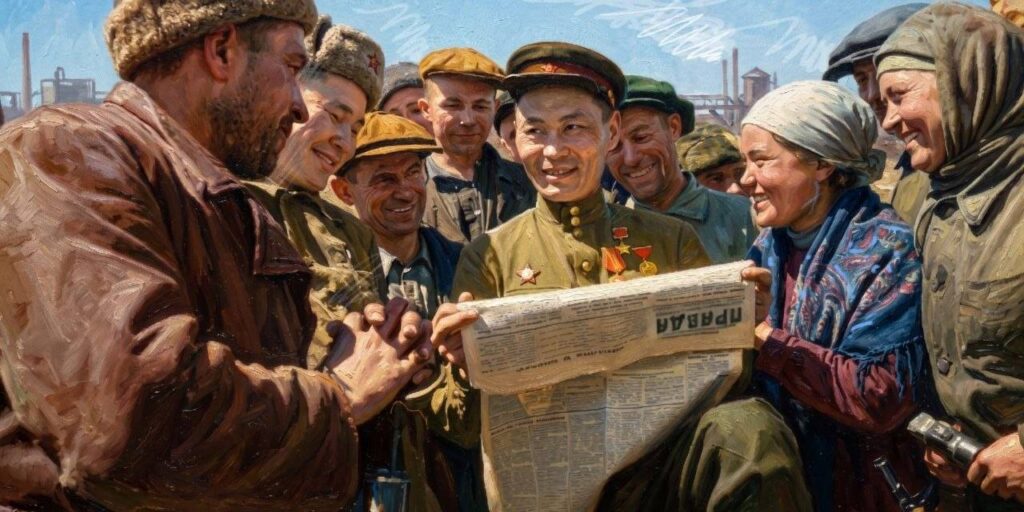
Opinion: The Specter Is Back – A Kazakh Warning to America
I was educated and began my career under Soviet communism in Kazakhstan. For many Americans, communism may sound like a policy argument. For us, it is also family memory — famine, confiscation, repression, camps and fear, all justified in the language of equality and justice. When communism returns to the American political debate, people from Kazakhstan listen carefully. “A specter is haunting Europe, the specter of communism.” That is how The Communist Manifesto by Karl Marx and Friedrich Engels began in 1848. Nearly two centuries later, the specter has not disappeared. It has changed its vocabulary, its political costumes and its geography. But the old temptation remains. It promises justice by concentrating power. In late June, U.S. President Donald Trump warned that communism was the greatest threat to the United States, greater, he said, than World War I, World War II, Pearl Harbor, or September 11. His language was characteristically blunt. Critics were right to say that democratic socialism is not the same thing as Soviet communism, and that the word “communist” should not be used carelessly in ordinary partisan debate. Still, the historical concern behind the warning should not be dismissed. Not every welfare program is communism. Not every democratic socialist is a Bolshevik. Every modern state helps its citizens in some form. The real question is when help becomes control. When does compassion become coercion? When does the state begin claiming the right to decide prices, property, production, speech and moral legitimacy in the name of “the people”? People who lived under communism know the danger. Why a Kazakh Voice Belongs in This Debate For an outside observer, it may seem strange that socialism and communism are again being debated in the United States, the stronghold of advanced capitalism, as Soviet theorists once described it. Yet the explanation is not mysterious. Congressional elections are approaching. Recent primary victories by candidates who identify with democratic socialism have brought these questions back into mainstream American politics. Of course, this does not mean the United States is on the eve of a Bolshevik revolution. America has elections, courts, private property, constitutional limits, and a free press. The Soviet Union had none of these in any meaningful sense. That distinction should be kept clear. But the first words of any political movement should be taken seriously. The early promises are usually humane. They speak of fairness, dignity, affordability, workers, tenants, food, and peace. Only later does society discover how much power must be handed to the state to make those promises real. The Democratic Socialists of America describes itself as the largest socialist organization in the United States and says working people should run “both the economy and society democratically” to meet human needs rather than profits. To many Americans, that may sound compassionate. To those of us trained in Marxist-Leninist doctrine, it also sounds familiar. I am not a political scientist or a specialist in party-building. I am simply a person who, because of my age, studied under the communists and...
