


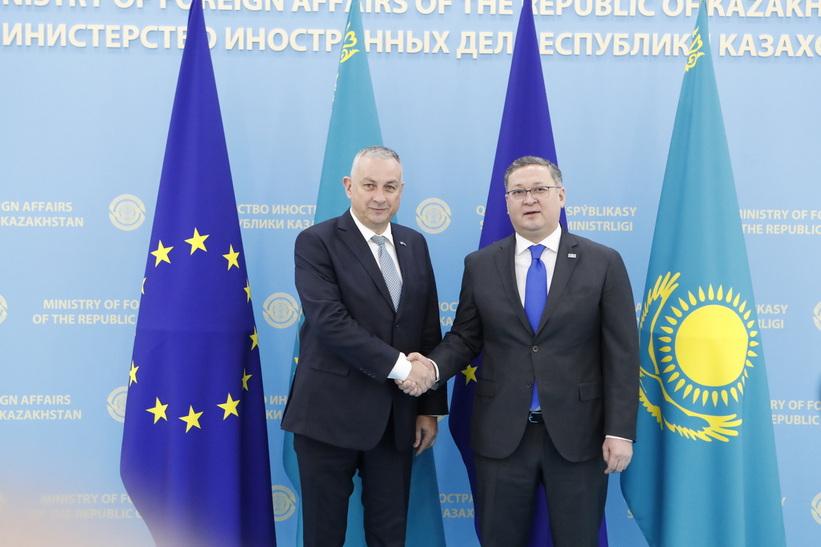
Kazakhstan-EU Cooperation Focuses on Critical Raw Materials and Regional Connectivity
On March 13, European Commissioner for International Partnerships Jozef Síkela visited Kazakhstan and held negotiations with Deputy Prime Minister and Minister of Foreign Affairs Murat Nurtleu. As a result of the visit, the European Union and Kazakhstan have taken steps to strengthen their partnership, signing key agreements to support sustainable economic growth and foster regional connectivity, according to the EU Delegation to Kazakhstan. Investments in Transport and Renewable Energy During the visit, Commissioner Síkela and Kazakh officials oversaw the signing of a €200 million framework loan agreement between the European Investment Bank (EIB) and the Development Bank of Kazakhstan (DBK). This loan, backed by an €18 million EU guarantee, will finance investments in sustainable transport and renewable energy. The initiative aligns with the EU’s Global Gateway strategy, particularly its programs on the Trans-Caspian Transport Corridor and the Team Europe Initiative on Water, Energy, and Climate Change. Síkela underscored the EU’s commitment to strengthening economic ties with Kazakhstan through sustainable investments. “This financing agreement will boost connectivity, enhance renewable energy infrastructure, and further integrate Kazakhstan into the Trans-Caspian Corridor, a key component of the Global Gateway strategy,” he stated. Critical Raw Materials Cooperation The visit also marked the signing of a €3 million contract to enhance cooperation between the EU and Central Asia in the critical raw materials (CRM) sector. The agreement, implemented by the European Bank for Reconstruction and Development (EBRD), will support the identification of joint projects and promote international best practices for sustainable and responsible supply chains. Síkela highlighted the importance of the agreement, stating: “The EU and Kazakhstan are natural partners. Europe needs reliable access to critical raw materials, which are essential for modernizing our economy. We are committed to advancing mutually beneficial cooperation with Kazakhstan on their extraction and development. This partnership will support all Central Asian countries, strengthen Kazakhstan’s industrial capacity, create new opportunities for Kazakh businesses, drive innovation, and generate high-quality jobs.” Kazakhstan-EU Trade and Investments Foreign Minister Nurtleu reaffirmed Kazakhstan’s commitment to expanding its partnership with the EU. “Astana and Brussels have built a strong political dialogue, established dynamic cooperation between executive bodies, and fostered productive cultural and humanitarian ties between our peoples,” he said. According to the Kazakh Foreign Ministry, the EU is Kazakhstan’s primary trade and investment partner. In 2024, bilateral trade between Kazakhstan and the EU totaled $49.7 billion, with Kazakhstan’s exports reaching $38.6 billion and imports totaling $11.1 billion. From 2005 to October 2024, the total foreign direct investment (FDI) inflow from EU countries reached $200.7 billion, accounting for 47.8% of Kazakhstan’s total FDI inflows ($419.5 billion).

