• KGS/USD = 0.01144 0%
  • KZT/USD = 0.00208 0%
  • TJS/USD = 0.10414 -0.29%
  • UZS/USD = 0.00008 0%
  • TMT/USD = 0.28571 0%
  • KGS/USD = 0.01144 0%
  • KZT/USD = 0.00208 0%
  • TJS/USD = 0.10414 -0.29%
  • UZS/USD = 0.00008 0%
  • TMT/USD = 0.28571 0%
  • KGS/USD = 0.01144 0%
  • KZT/USD = 0.00208 0%
  • TJS/USD = 0.10414 -0.29%
  • UZS/USD = 0.00008 0%
  • TMT/USD = 0.28571 0%
  • KGS/USD = 0.01144 0%
  • KZT/USD = 0.00208 0%
  • TJS/USD = 0.10414 -0.29%
  • UZS/USD = 0.00008 0%
  • TMT/USD = 0.28571 0%
  • KGS/USD = 0.01144 0%
  • KZT/USD = 0.00208 0%
  • TJS/USD = 0.10414 -0.29%
  • UZS/USD = 0.00008 0%
  • TMT/USD = 0.28571 0%
  • KGS/USD = 0.01144 0%
  • KZT/USD = 0.00208 0%
  • TJS/USD = 0.10414 -0.29%
  • UZS/USD = 0.00008 0%
  • TMT/USD = 0.28571 0%
  • KGS/USD = 0.01144 0%
  • KZT/USD = 0.00208 0%
  • TJS/USD = 0.10414 -0.29%
  • UZS/USD = 0.00008 0%
  • TMT/USD = 0.28571 0%
  • KGS/USD = 0.01144 0%
  • KZT/USD = 0.00208 0%
  • TJS/USD = 0.10414 -0.29%
  • UZS/USD = 0.00008 0%
  • TMT/USD = 0.28571 0%

Viewing results 1 - 6 of 11

Kyrgyzstan’s Crypto Market Generates More Tax Revenue Than Country’s Largest Bazaar

Kyrgyzstan’s virtual asset market has rapidly become one of the fastest-growing segments of the national economy. In the first nine months of 2025 alone, the country’s cryptocurrency turnover exceeded $7.9 billion, a figure that industry insiders believe could continue to rise substantially. Kyrgyz law currently permits fully legal cryptocurrency transactions, and the authorities are actively working to enhance regulation and oversight. According to official figures, the total volume of crypto transactions last year surpassed $20.5 billion, generating $22.8 million in tax revenue. Temir Kazybaev, Chairman of the Association of Virtual Asset Market Participants, told The Times of Central Asia that tax income from crypto turnover has already outpaced revenue collected from the Dordoi bazaar, Kyrgyzstan’s largest commodity trading hub, as well as the total from voluntary patent fees. “Just over $7.9 million in taxes was collected from the Dordoi bazaar over the year. Patent tax collection totaled $13.6 million. In other words, the entire market and all individuals in Kyrgyzstan working under a patent paid as much tax as was collected from cryptocurrency turnover,” Kazybaev explained. He noted a significant shift in public perception of the sector. “A few years ago, most Kyrgyz people saw the crypto market as a scam or a pyramid scheme. That perception is changing. People and businesses now see it as an opportunity. This is in large part because President Sadyr Japarov is personally invested in the topic,” Kazybaev said. He also highlighted recent developments in the market’s professional infrastructure. “The development of virtual assets is a critical area. As far as I know, the National Council on Virtual Assets has a dedicated secretariat, and our association is deeply involved in this work. Educational events are being held actively. We are training compliance officers, including those focused on crypto, and we’ve already trained two groups of accountants in crypto asset accounting,” he said. As of early 2026, more than 200 crypto exchanges and 11 mining companies are officially registered in Kyrgyzstan. The sector received a further boost with the launch of the USDTKG digital asset, a token said to be backed by Kyrgyz gold, which is gradually gaining domestic recognition.


Kazakhstan Seizes $16.7 Million in Virtual Assets in Crypto Crackdown

Kazakhstan has shut down 130 illegal cryptocurrency exchanges suspected of laundering criminal proceeds, seizing virtual assets worth $16.7 million, Deputy Chairman of the Financial Monitoring Agency (AFM) Kairat Bizhanov announced during a recent government meeting. Under Kazakh law, only crypto exchanges licensed by the Astana Financial Services Authority (AFSA) and integrated with local banks are permitted to operate. These licenses are granted under the Law on Digital Assets. Platforms operating without such authorization are deemed illegal. “The activities of 130 unlicensed crypto exchanges involved in laundering criminal proceeds have been terminated this year. Virtual assets worth $16.7 million were seized,” Bizhanov said. Targeting Cash-Out Schemes The AFM is also intensifying efforts to combat illegal cash-out operations. According to Bizhanov, 81 shadow groups with a combined turnover of 24 billion KZT (over $43 million) were uncovered in 2024. He emphasized that ATMs remain a critical vulnerability. “Despite the measures taken, the volume of cash withdrawals continues to grow. A total of 13.2 trillion KZT ($24.1 billion) has already been withdrawn, one trillion more than last year. The main risk is the ability to carry out anonymous transactions without identifying the sender or recipient. These operations are often conducted using bank cards issued to nominal owners,” he said. To curb these practices, the AFM and the National Bank of Kazakhstan have introduced new regulations. Card top-ups exceeding 500,000 KZT ($913) now require the input of an individual identification number (IIN) and confirmation via mobile applications. Since January 1, banks have also been required to retain ATM camera footage for at least 180 days. Authorities plan to expand biometric identification, including facial and fingerprint recognition for all cash transactions. New Rules to Curb Shell Companies In cooperation with the Ministry of Justice and the Ministry of Artificial Intelligence, the AFM has drafted amendments to tighten business registration protocols. “The main focus is on verifying company founders and executives based on risk criteria,” Bizhanov noted, pointing to a surge in fictitious companies used for money laundering and financial fraud. Over the past three years, tax authorities have annulled the registration of 3,600 shell firms linked to 30,000 fraudulent transactions totaling 280 billion KZT ($511 million). As The Times of Central Asia previously reported, Kazakhstan is positioning itself as a regional leader in blockchain innovation, aiming to become Central Asia’s hub for digital asset regulation and blockchain development.

Kazakhstan Sets Sights on Becoming Central Asia’s Blockchain Hub

Kazakhstan is accelerating its efforts to become a regional leader in blockchain and cryptocurrency. Among its latest initiatives is a proposal by the National Bank of Kazakhstan (NBK) to establish a state crypto reserve. National Strategy and Regulatory Evolution The NBK recently endorsed the idea of forming a national reserve of crypto assets. This was confirmed in an official response from NBK Chairman Timur Suleimenov to a parliamentary inquiry. The proposal includes creating the reserve through a subsidiary of the NBK focused on alternative investments. Mirroring practices in countries such as the United States, the reserve could be composed of confiscated crypto assets and cryptocurrencies mined with state involvement. Legislative amendments to support this move are expected. In January, President Kassym-Jomart Tokayev underscored the urgency of developing Kazakhstan’s crypto infrastructure, citing a global shift toward digital assets. Tokayev emphasized the need for a comprehensive national strategy to meet emerging challenges. Currently, legal cryptocurrency transactions in Kazakhstan can only occur via exchanges operating under the Astana International Financial Center (AIFC). Registered participants include major platforms such as Binance and Bybit. Expanding Infrastructure and Innovation The government is also considering the creation of crypto banks, which would regulate the digital asset market, facilitate storage and transactions, and boost the financial ecosystem. These institutions are seen as critical to fostering IT sector growth and blockchain compliance jobs. There are also plans to establish a licensed national cryptocurrency exchange that would operate nationwide beyond the AIFC. In May, Kazakhstan announced the launch of a special CryptoCity zone to pilot cryptocurrency-based payments for goods and services. The following month, five banks, Halyk Bank, Forte, Freedom, RBK, and Altyn, joined a NBK pilot program to introduce crypto cards. These cards, linked to wallets on AIFC-registered exchanges, allow for the real-time conversion of crypto into tenge for payments and cash withdrawals, including at physical retail terminals. Mining: Prospects and Pressure Kazakhstan has had a complex relationship with cryptocurrency mining. Between mid-2021 and early 2022, the country ranked third globally in Bitcoin mining, driven by low energy costs and an influx of miners from China. At its peak in January 2022, Kazakhstan accounted for 13.22% of global mining power. However, the surge in mining led to severe energy shortages. While enthusiasm for mining has returned, President Tokayev called in March 2025 for renewed investment in digital mining infrastructure. First Deputy Minister of Digital Development Kanysh Tuleushin has championed state-regulated mining as a potential revenue source and a catalyst for modernizing the energy grid. He pointed to models such as the U.S., where miners help balance grid loads, and to Kazakhstan’s “70/30” initiative, which allocates 30% of newly modernized thermal power plant capacity to miners and 70% to the national grid. Tuleushin also emphasized the potential for repurposing associated petroleum gas to generate mining power, thereby reducing emissions and monetizing a previously wasted resource. He argued that legalizing crypto activity nationwide could transform Kazakhstan into Central Asia’s crypto leader, on par with emerging markets in Uzbekistan and Kyrgyzstan. Energy...

Kazakh Lawmaker Proposes Stricter Controls on Cryptocurrency Market

Olzhas Kuspekov, a member of Kazakhstan’s Mazhilis (the lower house of parliament), has proposed tightening government regulation of cryptocurrency circulation and blocking access to unlicensed crypto exchange websites and mobile applications. Currently, cryptocurrency transactions in Kazakhstan are only permitted through licensed platforms operating under the Astana International Financial Center (AIFC). However, Kuspekov stated that in practice, these exchanges accounted for less than 14% of the country's total crypto transactions in 2023. Citing data from U.S.-based blockchain analytics firm Chainalysis, he said the illegal segment of Kazakhstan’s crypto market reached $3.5 billion last year out of a total market volume of $4.1 billion. In a parliamentary inquiry addressed to the chairman of the National Bank of Kazakhstan, Kuspekov expressed concern that unlicensed exchanges continue to operate openly. “Their applications remain available on the AppStore and PlayMarket, and they are widely advertised on social media,” he said. He called on the National Bank to initiate blocking of these digital platforms. Kuspekov also urged the government to audit money transfers and enhance internal controls among commercial banks to ensure compliance with cryptocurrency legislation. “Some banks are servicing crypto transactions that fall outside the legal framework. According to the Financial Monitoring Agency, more than KZT 4.2 billion ($8.2 million) in transactions were processed through accounts at ten financial institutions. In most cases, internal compliance mechanisms were not applied,” he stated. The lawmaker further warned of a growing trend among young Kazakhs becoming involved in the gray market, influenced by bloggers and self-styled financial “coaches.” As a countermeasure, he proposed the establishment of a state digital reserve, under the National Bank, for storing seized crypto assets. As previously reported by The Times of Central Asia, other deputies from the Ak Zhol faction have also called for the creation of a national cryptocurrency bank to further formalize and regulate the digital asset economy in Kazakhstan.

Binance Founder to Advise Kyrgyzstan President on Digital Assets

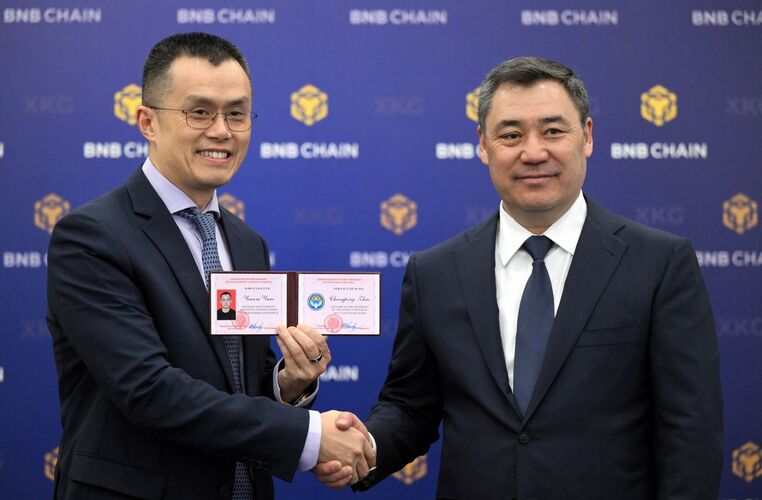
On May 3 in Cholpon-Ata, President Sadyr Japarov met with Changpeng Zhao, founder of Binance, the world’s largest cryptocurrency exchange, to discuss the future of digital assets and blockchain technologies in Kyrgyzstan. The meeting focused on the development of the country’s digital asset ecosystem, the introduction of blockchain technology into public administration, and measures to bolster cybersecurity. Japarov emphasized that Kyrgyzstan is actively promoting digital assets, particularly through the planned introduction of a national digital currency, the digital som. Changpeng Zhao expressed his readiness to support Kyrgyzstan’s digital transition by consulting and training local specialists involved in developing and implementing the digital som. During the meeting, Japarov presented Zhao with a certificate appointing him as a public adviser to the President of Kyrgyzstan on the development of digital assets. The following day, May 4, Japarov chaired the inaugural session of the National Council for the Development of Virtual Assets and Blockchain Technologies in Cholpon-Ata. Zhao was officially accepted as a member of the Council, which was established to formulate a unified state policy on virtual assets and promote their use in governance and key economic sectors. Japarov outlined the Council's main areas of focus: Enhancing financial literacy and supporting educational programs Strengthening cybersecurity and protecting users from digital fraud Integrating blockchain technologies into public administration systems “Interest in cryptocurrency is growing every year in Kyrgyzstan, and blockchain technologies and digital assets are becoming the basis of a new financial system,” Japarov stated. Earlier, the National Investment Agency of Kyrgyzstan signed a Memorandum of Cooperation with Zhao. Under the agreement, Binance will assist in developing blockchain infrastructure, creating a national cryptocurrency reserve, and training professionals in blockchain technology, virtual asset management, and cybersecurity.

Binance to Assist Kyrgyzstan in Developing Blockchain Infrastructure and Crypto Assets

Kyrgyzstan’s National Investment Agency has signed a Memorandum of Cooperation with Changpeng Zhao, founder of Binance, the world’s largest cryptocurrency exchange by trading volume. According to the agency, Binance will assist Kyrgyzstan in several key areas, including the development of blockchain infrastructure and the creation of a national cryptocurrency reserve. The partnership will also focus on training young professionals, government employees, and specialists in blockchain technologies, virtual asset management, and cybersecurity. In addition, Binance will provide support in establishing a management system for virtual assets and blockchain technology in Kyrgyzstan source. While public interest in cryptocurrencies continues to grow in Kyrgyzstan, the market remains poorly regulated. Earlier this year, the Ministry of Economy and Commerce proposed legislation to create licensed crypto banks that would offer regulated banking services related to digital assets. The ministry stressed the need to integrate crypto assets into the national financial system, citing the rapid advancement of digital technology and the economic potential of legalizing cryptocurrency transactions. The introduction of crypto banks is expected to increase transaction volumes, boost tax revenues, and create new jobs in the fintech sector, positioning Kyrgyzstan as a regional hub for financial innovation. In a separate move to stabilize the sector, Kyrgyzstan’s Cabinet of Ministers significantly raised the minimum authorized capital required for crypto exchanges, from 100 million KGS to 10 billion KGS, a hundredfold increase. The Ministry of Economy and Commerce, which initiated the reform, stated that the measure is designed to ensure the financial stability of crypto platforms, safeguard user interests, and foster a transparent and secure virtual assets market. Existing exchanges have until January 1, 2026, to comply with the new capital requirements.