• KGS/USD = 0.01144 0%
  • KZT/USD = 0.00203 0%
  • TJS/USD = 0.10563 -0.09%
  • UZS/USD = 0.00008 0%
  • TMT/USD = 0.28490 0%
  • KGS/USD = 0.01144 0%
  • KZT/USD = 0.00203 0%
  • TJS/USD = 0.10563 -0.09%
  • UZS/USD = 0.00008 0%
  • TMT/USD = 0.28490 0%
  • KGS/USD = 0.01144 0%
  • KZT/USD = 0.00203 0%
  • TJS/USD = 0.10563 -0.09%
  • UZS/USD = 0.00008 0%
  • TMT/USD = 0.28490 0%
  • KGS/USD = 0.01144 0%
  • KZT/USD = 0.00203 0%
  • TJS/USD = 0.10563 -0.09%
  • UZS/USD = 0.00008 0%
  • TMT/USD = 0.28490 0%
  • KGS/USD = 0.01144 0%
  • KZT/USD = 0.00203 0%
  • TJS/USD = 0.10563 -0.09%
  • UZS/USD = 0.00008 0%
  • TMT/USD = 0.28490 0%
  • KGS/USD = 0.01144 0%
  • KZT/USD = 0.00203 0%
  • TJS/USD = 0.10563 -0.09%
  • UZS/USD = 0.00008 0%
  • TMT/USD = 0.28490 0%
  • KGS/USD = 0.01144 0%
  • KZT/USD = 0.00203 0%
  • TJS/USD = 0.10563 -0.09%
  • UZS/USD = 0.00008 0%
  • TMT/USD = 0.28490 0%
  • KGS/USD = 0.01144 0%
  • KZT/USD = 0.00203 0%
  • TJS/USD = 0.10563 -0.09%
  • UZS/USD = 0.00008 0%
  • TMT/USD = 0.28490 0%
20 February 2026

Viewing results 1 - 6 of 9

Ashgabat to Host Regional Center for Combating Desertification in Central Asia

A regional center dedicated to combating desertification will be established in Turkmenistan's capital Ashgabat. The center aims to coordinate efforts among Central Asian nations to address environmental and water management challenges. According to Pirli Kepbanov, Director of the National Institute of Deserts, Flora and Fauna under Turkmenistan’s Ministry of Environmental Protection, the new institution will consolidate regional scientific and practical capacities to tackle transboundary issues affecting agriculture and water resources. “Based at the center, the region’s states will be able to cooperate on shared concerns related to agricultural production and water infrastructure,” Kepbanov said. Ashgabat’s selection as the host city is no coincidence. Turkmenistan has long been a regional hub for desert science, with established research institutions specializing in land degradation, desert ecosystems, and the adaptation of economic activity to arid conditions. “There are only four such scientific institutes worldwide, and one of them is the National Institute of Deserts, Flora and Fauna of Turkmenistan,” Kepbanov added. He also emphasized Turkmenistan’s historical role in developing desert science across Central Asia and beyond. “The first Chinese desert scientists trained here,” he said, adding that contemporary Chinese experts acknowledge Turkmenistan’s important contributions to their national school of desert research. Currently, the National Institute collaborates with the Xinjiang Institute of Ecology and Geography in China, the A.N. Kostyakov Federal Scientific Center for Hydrotechnics and Land Reclamation in Russia, and is receiving partnership proposals from universities across Central Asia.

Turkmenistan and Spain Eye Regional Center to Combat Desertification in Central Asia

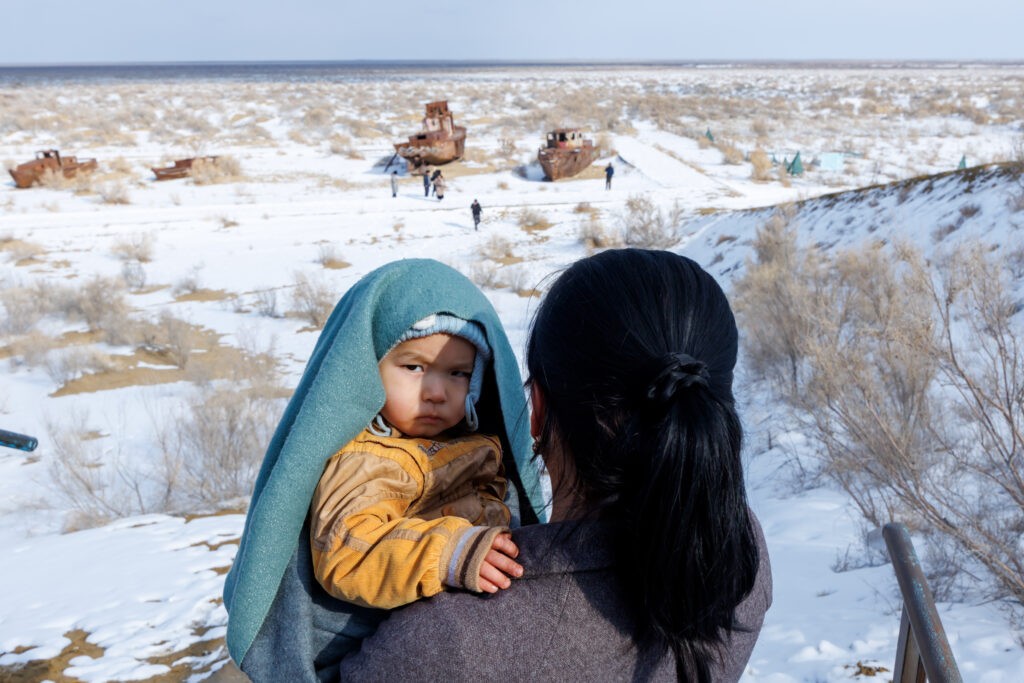
Turkmenistan and Spain have discussed closer cooperation to address desertification in Central Asia, including the possible creation of a regional center focused on land degradation. The talks took place in Ashgabat during a meeting between Turkmenistan’s Minister of Environmental Protection and Spain’s ambassador to Russia, Ricardo Martínez Vázquez, who is also accredited in Turkmenistan. The discussions followed Turkmen President Serdar Berdimuhamedov’s proposal at the United Nations General Assembly to establish a specialized regional center to combat desertification in Central Asia. The initiative is intended to strengthen cooperation among regional states and attract international expertise and funding. [caption id="attachment_41076" align="aligncenter" width="1000"] Image: mineco.gov.tm[/caption] Desertification is a growing concern across Central Asia, a region where arid and semi-arid landscapes dominate much of the territory. The United Nations Convention to Combat Desertification defines desertification as land degradation in dry areas caused by climatic variations and human activities. According to the UNCCD, more than 20% of land in Central Asia is already degraded, affecting around 30% of the population. Much of this damage is linked to unsustainable water use, intensive agriculture, overgrazing, and the long-term effects of climate change. Spain’s interest in desertification in Turkmenistan is rooted in their shared status as nations on the front lines of climate change. As one of the European countries most vulnerable to soil degradation, Spain co-launched the International Drought Resilience Alliance (IDRA) to export its expertise in "dryland" management and water conservation, which is directly applicable to the arid landscapes of Central Asia. This common challenge has fostered a diplomatic partnership focused on the United Nations Convention to Combat Desertification (UNCCD), where countries exchange strategies for land restoration and drought resilience. Beyond environmental solidarity, Spain views Turkmenistan as a critical emerging market for its advanced engineering and agricultural sectors. Major Spanish firms, such as TYPSA, are already active in the region, providing technical assistance for massive infrastructure projects, such as desalination plants on the Caspian Sea, and modernizing irrigation systems for thousands of hectares of farmland. This commercial engagement is bolstered by Spain's support for Turkmenistan’s proposal to host a Regional Center for Climate Change Technologies, which would serve as a hub for Spanish green tech in Central Asia. The bilateral relationship also aligns with the broader EU Strategy for Central Asia, which prioritizes environmental stability as a means of ensuring regional security. By helping Turkmenistan manage its dwindling water resources and combat the encroaching Karakum Desert, Spain contributes to the EU for a Green Turkmenistan initiative. This cooperation helps prevent resource-driven migration and instability, and strengthens trade ties in a region that is becoming increasingly vital for global energy and logistics. One of the most visible examples of desertification in the region is the collapse of the Aral Sea. Once the world’s fourth-largest inland lake, the Aral Sea began shrinking rapidly in the 1960s after its feeder rivers were diverted for large-scale irrigation projects. By the early 2000s, the sea had lost roughly 90% of its volume. [caption id="attachment_13621" align="aligncenter" width="2560"] Desert ships on the former...

Opinion: Turning Deserts Into Fields of Hope

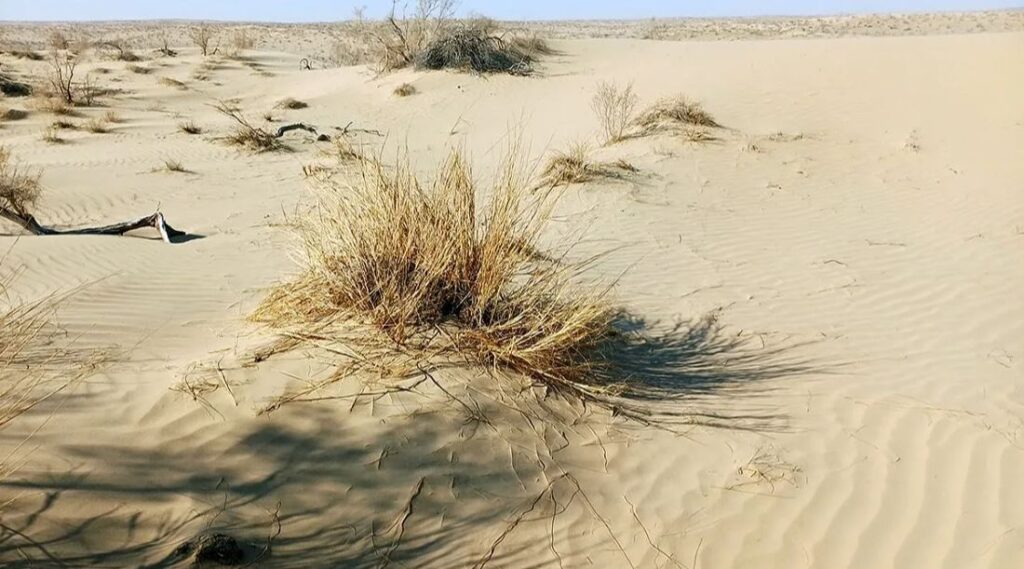
Desertification is a global crisis threatening the livelihoods of 3.2 billion people worldwide. From China’s vast green belt along its largest desert to Central Asia’s unified efforts to halt land degradation on arid plains, the fight against encroaching sand continues. These initiatives offer hopeful examples of human endeavor in restoring degraded lands and safeguarding the future of our planet. In the heart of southern Xinjiang lies the Taklamakan Desert, a vast expanse known as the “sea of death” for its extreme arid and inhospitable conditions. Covering 330,000 square kilometers - an area almost the size of Finland - it is China’s largest desert and the world’s second-largest shifting desert. Here, dunes stretch endlessly, and sandstorm days comprise one-third of the year. For generations, the Taklamakan Desert has threatened surrounding villages, farmlands, and transportation routes, squeezing the living space of those who dwell on its edges. Nearly 80% of the desert sands are in constant motion, while seasonal floods from melting snow on the mountains add further instability, leaving homes and livelihoods at risk. The danger is long-term: at one point, the Taklamakan risked merging with the nearby Kumtag Desert, placing even greater pressure on human settlements. How To Contain The Sands Faced with the challenge, China launched an ambitious initiative: building a shield of vegetation to encircle the Taklamakan Desert, planting desert-tolerant species such as desert poplar, red willow, saxaul, and even roses. This massive project took more than 40 years to complete. By the end of 2023, 2,761 kilometers (about 1,716 miles) of the belt had been established. A year later, the final 285 kilometers - the most challenging section - was closed through the dedicated efforts of 600,000 people. On November 28, 2024, in Yutian County on the desert’s southern edge, the last seedlings were planted into the sands, completing a 3,046-kilometer green belt. This vast ecological barrier stabilizes the Taklamakan Desert’s edge, prevents sandstorms, and protects the fragile ecology. In addition, the green belt provides wild animals in the desert with safe conditions for survival, breeding, and migration. A Bold Green Strategy Against Desertification The Taklamakan Desert control project is a part of China's Three-North Shelterbelt Forest Program, or TSFP, the world's largest afforestation program aimed at curbing desertification. Launched in 1978, this ambitious program seeks to slow the progress of desertification and reduce the frequency of sandstorms by planting vast stretches of trees and resilient plant species across the arid and semi-arid regions in northern China, where sandstorms pose a constant threat to local farmlands and residents. Official data shows that forest coverage in areas covered by the TSFP has risen from 5% in 1977 to 13.8% today. More than 60% of regions prone to soil erosion have been effectively controlled, and roughly 30 million hectares of farmland have been safeguarded from desert expansion. Turning Lands of Despair into Fields of Hope: A Shared Mission The challenges faced in northern China echo across the globe. From the Sahel in Africa to the Middle East and Central...

Culture, Climate, and Clean Water: Summit Outlines New Efforts to Restore the Aral Sea Region

From April 4 to 6, the first Aral Culture Summit took place in Karakalpakstan, bringing together local and international scientists, artists, and activists. Their goal: to find creative ways to support the social and environmental recovery of the Aral Sea region. The summit is the first in a series of global cultural initiatives taking place throughout 2025 and supported by Uzbekistan Art and Culture Development Foundation. Scheduled to be held every 18 months, the summit is designed to act as a space for exchanging ideas and building new solutions. This year’s program included panels, cultural events, and a pop-up market featuring local artists and businesses. It focused on how art, design, and science can help Karakalpakstan grow in sustainable ways and attract new eco-friendly businesses. [caption id="attachment_30519" align="aligncenter" width="1280"] Summit opening in Samarkand; image: ACDF[/caption] The first day of the summit was linked with the Samarkand International Climate Forum, which was attended by over 2,000 foreign guests, including top officials from the European Union, the United Nations, and Central Asian governments. They discussed urgent climate problems in the region, including desertification, water shortages, and rising temperatures. Uzbekistan’s President Shavkat Mirziyoyev spoke about steps being taken to slow land degradation. “To reduce the area of degraded lands and mitigate the consequences of climate change, Uzbekistan has been carrying out large-scale greening in the framework of the Yashil Makon project. Additionally, over two million hectares of the deserted Aral Sea region is now covered with drought-resistant plants,” he said. Mirziyoyev also warned that water shortages will increase in the region by 2040 and stressed the need for stronger cooperation, telling those assembled, “We urge our partners to join the efforts and launch a Regional Program for Implementation of Water Saving Technologies in Central Asia.” Kazakhstan’s President Kassym-Jomart Tokayev also shared concerns about climate challenges, pointing out that the "temperature in the region is rising twice as fast as the global average.” Tokayev highlighted joint efforts with Uzbekistan to green the dried bottom of the Aral Sea. “Central Asia is profoundly affected by the global climate crisis,” Gayane Umerova, Chairperson of the Uzbekistan Art and Culture Development Foundation (ACDF) told those in attendance. “Rising temperatures, altered rainfall patterns, and intensified droughts are severely impacting agriculture, water resources, and livelihoods across our region. No example illustrates this better than the tragedy of the Aral Sea. But healing the land goes hand in hand with healing communities.” [caption id="attachment_30521" align="aligncenter" width="2560"] Desert ship, Moynaq; image: TCA, Stephen M. Bland[/caption] A striking example of the shrinking of the Aral Sea is the forgotten hamlet of Moynaq. At its peak, the town was home to 60,000 people, mostly fishermen and their extended families, with the Aral Sea producing up to 30% of the Soviet catch and saving Russia from widespread famine in the 1920s. Accessible only by air and ferry well into the 1970s, Moynaq also served as a popular beach resort for well-heeled bureaucrats, its airport hosting fifty flights a day at its peak. By the...

Turkmenistan To Harness Technology and Algae to Combat Desertification

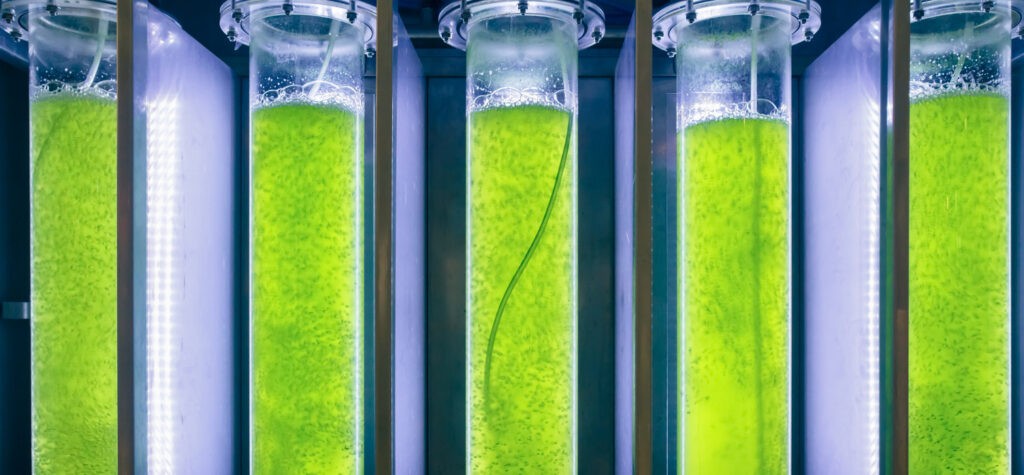
The International Scientific and Technological Park of the Academy of Sciences of Turkmenistan has received the copyright for the innovative development of nanocomposite material technologies based on blue-green algae (cyanobacteria). The development - which can improve eroded sandy and desert lands in dry steppe and desert zones - is designed to control desertification, wind erosion, and sand migration. This material can also be used as a raw material for producing construction materials and bio-products, which opens up a wide range of opportunities for its use. “Movable bare sands cause significant damage to the national economy, often covering agricultural lands, rivers, water bodies, canals, transportation highways, irrigation facilities and other objects. Therefore, controlling wind erosion and fixing sand are important tasks. We have proposed an effective way to combat desertification using blue-green algae (cyanobacteria),” said Altyn Rakhmanova, Head of the Biotechnology Department of ANT International Science and Technology Park. Cyanobacteria play a crucial role in soil improvement by participating in biochemical processes, accumulating substances and nitrogen, and destroying minerals. Their vital activity contributes to environmental changes and soil formation, especially by forming various overgrowths on its surface. Turkmenistan is actively combating land degradation following the UN Convention to Combat Desertification and the National Action Program to Combat Desertification (NAPCD), which includes reforestation. In May 2024, the State Program for Integrated Development of Biotechnology in the Country for 2024-2028 was approved; one of the plans is to study and apply algae. The application of biotechnology for the development of new materials offers a promising and effective solution.