• KGS/USD = 0.01144 0%
  • KZT/USD = 0.00208 0%
  • TJS/USD = 0.10516 0.77%
  • UZS/USD = 0.00008 0%
  • TMT/USD = 0.28571 0%
  • KGS/USD = 0.01144 0%
  • KZT/USD = 0.00208 0%
  • TJS/USD = 0.10516 0.77%
  • UZS/USD = 0.00008 0%
  • TMT/USD = 0.28571 0%
  • KGS/USD = 0.01144 0%
  • KZT/USD = 0.00208 0%
  • TJS/USD = 0.10516 0.77%
  • UZS/USD = 0.00008 0%
  • TMT/USD = 0.28571 0%
  • KGS/USD = 0.01144 0%
  • KZT/USD = 0.00208 0%
  • TJS/USD = 0.10516 0.77%
  • UZS/USD = 0.00008 0%
  • TMT/USD = 0.28571 0%
  • KGS/USD = 0.01144 0%
  • KZT/USD = 0.00208 0%
  • TJS/USD = 0.10516 0.77%
  • UZS/USD = 0.00008 0%
  • TMT/USD = 0.28571 0%
  • KGS/USD = 0.01144 0%
  • KZT/USD = 0.00208 0%
  • TJS/USD = 0.10516 0.77%
  • UZS/USD = 0.00008 0%
  • TMT/USD = 0.28571 0%
  • KGS/USD = 0.01144 0%
  • KZT/USD = 0.00208 0%
  • TJS/USD = 0.10516 0.77%
  • UZS/USD = 0.00008 0%
  • TMT/USD = 0.28571 0%
  • KGS/USD = 0.01144 0%
  • KZT/USD = 0.00208 0%
  • TJS/USD = 0.10516 0.77%
  • UZS/USD = 0.00008 0%
  • TMT/USD = 0.28571 0%

Viewing results 1 - 6 of 13

Wallet in Telegram Launches in Uzbekistan, Expanding Crypto Access to Millions

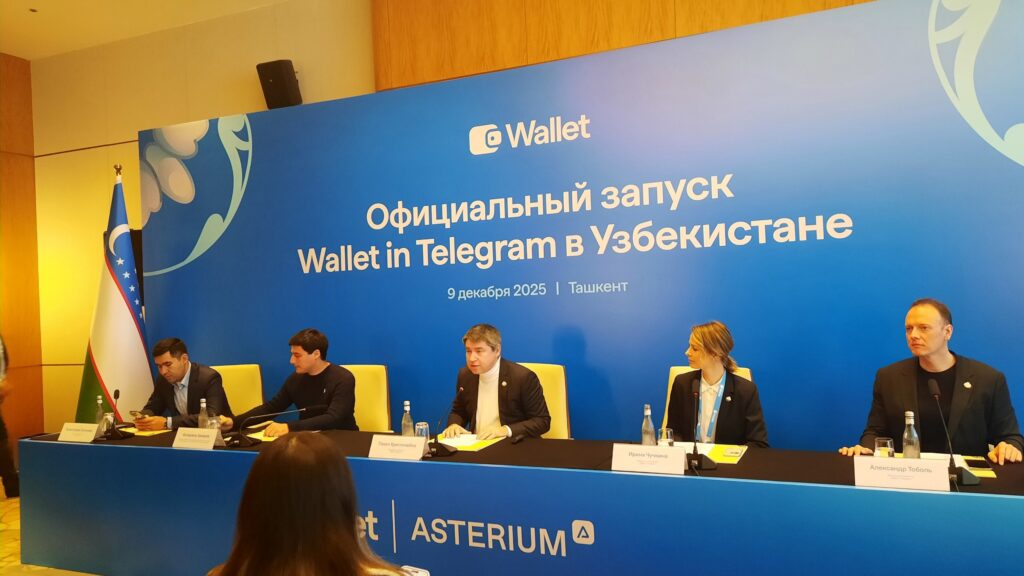
Wallet in Telegram, a global digital asset service integrated directly into the Telegram messaging app, officially launched in Uzbekistan on December 9, opening up crypto access to more than 27 million local users. The move marks a major expansion of Telegram’s financial ecosystem and reinforces Uzbekistan’s role as a regional leader in regulated digital finance. The service allows users to buy, store, and transfer cryptocurrencies without needing to install additional applications. Registration takes only seconds, and transactions can be completed using local payment systems such as Humo, Visa, and Mastercard. Wallet currently supports Bitcoin, Toncoin, USDT, and over 200 other digital assets. According to the company, the goal is to make crypto transactions as seamless as sending a message, an especially relevant approach in Uzbekistan, where Telegram usage exceeds 88% of the internet-connected population. By embedding financial tools into an everyday platform, Wallet aims to normalize digital asset use and broaden access to global financial technologies. The technical infrastructure for Wallet’s Uzbekistan launch is provided by Asterium, the country’s largest crypto ecosystem and a key fintech player. Asterium is responsible for ensuring secure transactions, identity verification, and data protection. “Our mission at Asterium is to make working with crypto assets simple and accessible for everyone. Wallet in Telegram reflects our product philosophy: it is convenient, transparent, and secure, meaning it is genuinely useful for people,” said Komilhodja Sultonov, CEO of Asterium. The service was licensed by Uzbekistan’s National Agency for Perspective Projects (NAPP), the regulatory body overseeing the digital asset sector. Uzbekistan has developed one of Central Asia’s most comprehensive legal frameworks for crypto, with a strong focus on user protection and structured innovation. In response to questions from The Times of Central Asia, NAPP clarified how Wallet aligns with current regulations. Askarjon Zakirov, Head of the Crypto-Assets Turnover Sphere Development Department, emphasized that Uzbekistan legally distinguishes crypto assets from fiat currency. “Firstly, we say that a crypto asset is not a means of payment or a monetary equivalent,” he said. [caption id="attachment_40689" align="aligncenter" width="300"] @TCA/Sadokat Jalolova[/caption] Zakirov explained that crypto is treated as a form of property under Uzbek law. As such, transferring cryptocurrency is regarded as a transfer of property rights rather than a financial transaction with monetary obligations. Pavel Khristolubov, COO of Fintech and Web3 at Wallet in Telegram, also underscored the platform’s commitment to regulatory compliance. “It’s very important for us to operate within the framework of our license. This means we don't compete with local payment systems,” he said. Khristolubov added that Wallet users can choose between custodial services and non-custodial, on-chain options, offering varying degrees of freedom and security. Andrew Rogozov, CEO of The Open Platform (TOP), the technology company behind Wallet, described Uzbekistan as one of the world’s most dynamic digital markets. “By combining Telegram’s scale with regulatory clarity and high mobile adoption, we see Uzbekistan as a model for how emerging markets can leapfrog into convenient, technology-driven finance,” he said. Globally, Wallet in Telegram has over 150 million registered users. Its launch...

Central Asia’s Digital Currency Ambitions: New Opportunities and Old Constraints

Central Asia is entering a period of accelerated financial transformation. Kyrgyzstan has launched one of the world’s first state-backed gold-backed stablecoin, USDKG, a digital asset fully backed by physical gold and issued under the direct supervision of the Ministry of Finance. Simultaneously, Kazakhstan is advancing one of the most mature central bank digital currency (CBDC) initiatives in the post-Soviet space: the digital tenge (national currency). Uzbekistan is developing its own digital economy framework, while Tajikistan and Turkmenistan are slowly initiating financial modernization. Amid these developments, Central Asia is emerging as a surprisingly bold laboratory for digital finance. This raises a pressing question: can the region develop a unified digital currency ecosystem that reduces dollar dependency, facilitates cross-border transactions, and enhances economic sovereignty? Strategic Logic of Digital Integration The idea of a regional digital currency is no longer utopian. Central Asia is one of the world's most significant hubs for cross-border remittances. In 2024 alone, migrants sent back a record $5.8 billion to Tajikistan (45% of GDP), approximately $15 billion to Uzbekistan, $2.9 billion to Kyrgyzstan, and $258 million to Kazakhstan. The current system is costly, slow, and heavily reliant on the dollar. Digital currencies could drastically reduce transaction costs for both migrant workers and businesses. In remote areas, where banking infrastructure is underdeveloped, cash still dominates. CBDCs could allow citizens to access state payment services directly, bypassing commercial banks. Digital finance also offers protection against external economic shocks, sanctions, and volatility. Coupled with the digitalization drives in Kazakhstan, Uzbekistan, and Kyrgyzstan, and regional integration ambitions, such as Uzbek President Shavkat Mirziyoyev’s proposal to create a Central Asian Community, conditions are forming for financial cooperation. Diverse National Models Approaches to digital currency vary significantly. Kazakhstan’s digital tenge, led by the National Bank, emphasizes institutional stability, security, and integration with existing banking systems. A full launch is expected by the end of 2025. Kyrgyzstan has taken a more unconventional route. Its USDKG stablecoin, built on the Tron blockchain and backed by gold, aims to assert financial autonomy. However, it raises concerns about transparency, sustainability, and the reaction of traditional banks. A gold-backed stablecoin also directly challenges dollar dominance. Crypto analysts such as Ryan Adams speculate that Washington may be monitoring Kyrgyzstan’s experiment closely, fearing it could inspire similar moves in India, China, and Brazil. Uzbekistan is advancing its digital economy cautiously. While its government maintains strict cryptocurrency controls, this regulatory clarity may lay groundwork for a CBDC, though it limits space for innovation. Tajikistan and Turkmenistan remain on the sidelines, but rising demographic pressures, migration, and logistics projects are nudging both toward digital finance. The lack of coordination among these models represents both an opportunity for experimentation and a barrier to integration. Key Challenges Despite growing momentum, the road to a unified digital architecture in Central Asia remains fraught. The first major obstacle is regulatory fragmentation. Digital currencies require legal reforms across currency legislation, taxation, customs, and anti-money laundering/counter-financing of terrorism (AML/CFT) protocols. At present, each state operates independently, making regional harmonization...

Kazakhstan to Establish National Register of Crypto Wallets Linked to Criminal Activity

Kazakhstan’s Financial Monitoring Agency (FMA) will create a national register of cryptocurrency wallets linked to criminal proceeds, according to Rashid Orazbek, Head of the agency’s operational analysis department. The announcement was made during a Senate session. Orazbek stated that the FMA is being granted new powers to maintain a centralized database of crypto wallets involved in illicit transactions and money laundering schemes. The system will enable authorities to apply advanced blockchain analytics, accelerate transaction risk assessments, and prioritize oversight of crypto-related activities. He added that the Financial Action Task Force (FATF) has recommended Kazakhstan implement licensing for cryptocurrency service providers. In response, new anti-money laundering (AML) regulations are being developed, and supervisory powers are being expanded to ensure compliance. A key requirement under the proposed framework is adherence to the “travel rule,” which mandates that crypto service providers identify both parties to a transaction and retain counterparty information. This data must be stored and made available to authorities upon request. Transactions lacking this information will be suspended, and failure to meet deadlines for disclosure will result in cancellation. The FMA expects these measures to substantially curb the criminal use of digital assets. Miras Zakiev, Deputy Chairman of the Committee on Digital Assets and Breakthrough Technologies, highlighted plans to integrate cryptocurrency into everyday financial operations. He said the "CryptoCity" initiative aims to create an ecosystem in which Kazakhstani citizens can pay for goods and services using cryptocurrency via bank terminals. According to Zakiev, the National Bank’s regulatory “sandbox” is currently testing the integration of crypto exchange tools and mechanisms developed by the Astana International Financial Centre into Kazakhstan’s banking infrastructure. At the same time, second-tier banks are upgrading their terminals to support crypto transactions. Zakiev also clarified Kazakhstan's mining regulations, noting that two categories of mining activities require licenses: data center owners and individuals or firms operating equipment housed in leased facilities. All miners must work through accredited domestic mining pools and are subject to corporate income tax, as well as capital gains tax for individuals. The digital asset sector has already generated significant fiscal returns. According to the State Revenue Committee, the industry contributed $14.8 million to the national budget in the first half of 2025. Zakiev said these figures reflect sustained positive momentum in the sector. Separately, Deputy Chairman of the National Bank Berik Sholpankulov told reporters that the government is exploring a potential investment of approximately $300 million in crypto assets. He described these instruments as comparable to securities and derivatives traded on global financial markets. If deemed profitable and viable, they may be included in Kazakhstan’s broader investment portfolio. Previously, The Times of Central Asia reported that the country is also considering converting part of the National Fund’s assets, as well as gold and foreign exchange reserves, into cryptocurrency.

Kyrgyzstan Advances Digital Asset Strategy with Support from Binance

The second meeting of Kyrgyzstan’s National Council for the Development of Virtual Assets and Blockchain Technologies was held in Bishkek on October 24, with the participation of President Sadyr Japarov and Changpeng Zhao, founder of Binance, the world’s largest cryptocurrency exchange. Following the meeting, Zhao, who serves as a public adviser to Japarov on digital asset development and is a member of the Council, announced on X that Kyrgyzstan’s national stablecoin, the KGST, has officially launched on @BNBChain. The KGST is pegged to the Kyrgyz som. Zhao also confirmed the creation of a National Cryptocurrency Reserve and the full localization of the Binance app for Kyrgyz-speaking users. Japarov and Zhao previously met in May to discuss the digital future of Kyrgyzstan. Their agenda included developing a national digital asset ecosystem, integrating blockchain into public administration, and strengthening cybersecurity. Zhao pledged Binance’s support through training and expertise for specialists working on the country’s digital currency initiative. As part of this collaboration, the National Council and Binance are preparing to launch an online educational platform in the Kyrgyz language, aimed at providing basic knowledge about virtual assets. The platform will be accessible to the general public. During the Council meeting, Japarov underscored Kyrgyzstan’s pioneering role in the region, highlighting that the country has enacted legislation to regulate virtual assets and is actively pursuing a coherent government policy in the sector. He noted the national market is expanding, with an increasing number of licensed participants, a stronger regulatory framework, and new infrastructure projects emerging. Japarov pointed to several national advantages, including a flexible institutional environment, a motivated and tech-savvy youth population, and the ongoing digitalization of public services, as key factors driving Kyrgyzstan’s ambition to become a regional hub for digital finance. “The combination of these factors makes the goal of transforming the country into a regional hub for virtual assets realistic and achievable,” he stated. Melis Turgunbaev, Chairman of the National Bank of Kyrgyzstan, announced that the digital som project has entered its practical implementation phase. The initiative aims to create a fully regulated blockchain-based payment system under the control of the National Bank, which will oversee the issuance and circulation of the digital currency.

Binance Founder to Advise Kyrgyzstan President on Digital Assets

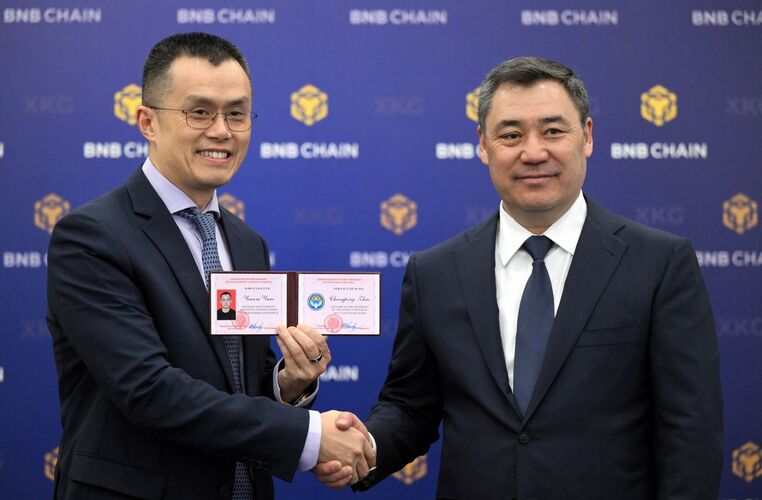
On May 3 in Cholpon-Ata, President Sadyr Japarov met with Changpeng Zhao, founder of Binance, the world’s largest cryptocurrency exchange, to discuss the future of digital assets and blockchain technologies in Kyrgyzstan. The meeting focused on the development of the country’s digital asset ecosystem, the introduction of blockchain technology into public administration, and measures to bolster cybersecurity. Japarov emphasized that Kyrgyzstan is actively promoting digital assets, particularly through the planned introduction of a national digital currency, the digital som. Changpeng Zhao expressed his readiness to support Kyrgyzstan’s digital transition by consulting and training local specialists involved in developing and implementing the digital som. During the meeting, Japarov presented Zhao with a certificate appointing him as a public adviser to the President of Kyrgyzstan on the development of digital assets. The following day, May 4, Japarov chaired the inaugural session of the National Council for the Development of Virtual Assets and Blockchain Technologies in Cholpon-Ata. Zhao was officially accepted as a member of the Council, which was established to formulate a unified state policy on virtual assets and promote their use in governance and key economic sectors. Japarov outlined the Council's main areas of focus: Enhancing financial literacy and supporting educational programs Strengthening cybersecurity and protecting users from digital fraud Integrating blockchain technologies into public administration systems “Interest in cryptocurrency is growing every year in Kyrgyzstan, and blockchain technologies and digital assets are becoming the basis of a new financial system,” Japarov stated. Earlier, the National Investment Agency of Kyrgyzstan signed a Memorandum of Cooperation with Zhao. Under the agreement, Binance will assist in developing blockchain infrastructure, creating a national cryptocurrency reserve, and training professionals in blockchain technology, virtual asset management, and cybersecurity.