
• KZT/USD = 0.00218
  • TJS/USD = 0.10800
  • UZS/USD = 0.00008
  • TMT/USD = 0.29850
  • KZT/USD = 0.00218
  • TJS/USD = 0.10800
  • UZS/USD = 0.00008
  • TMT/USD = 0.29850
  • KZT/USD = 0.00218
  • TJS/USD = 0.10800
  • UZS/USD = 0.00008
  • TMT/USD = 0.29850
  • KZT/USD = 0.00218
  • TJS/USD = 0.10800
  • UZS/USD = 0.00008
  • TMT/USD = 0.29850
  • KZT/USD = 0.00218
  • TJS/USD = 0.10800
  • UZS/USD = 0.00008
  • TMT/USD = 0.29850
  • KZT/USD = 0.00218
  • TJS/USD = 0.10800
  • UZS/USD = 0.00008
  • TMT/USD = 0.29850
  • KZT/USD = 0.00218
  • TJS/USD = 0.10800
  • UZS/USD = 0.00008
  • TMT/USD = 0.29850
  • KZT/USD = 0.00218
  • TJS/USD = 0.10800
  • UZS/USD = 0.00008
  • TMT/USD = 0.29850
27 November 2026

Viewing results 1 - 6 of 9

AIRUN CEO Chingiz Arziev on Building Kyrgyzstan’s Sovereign AI

The Times of Central Asia was delighted to interview Chingiz Arziev, CEO of AIRUN a Kyrgyzstan-based company developing AI infrastructure for the Kyrgyz language. AIRUN’s technology includes a large language model, speech recognition, text-to-speech tools, AI translation, and digital avatars designed for use in government, education, media, business, and public services. Chingiz Arziev spoke to TCA about the challenge of building AI for a low-resource language, why digital sovereignty matters for Kyrgyzstan, and how the company hopes to take its experience to other countries facing similar language and technology challenges. TCA: To begin with, can you tell us a little about yourself: where you grew up, what you studied, and how you first became interested in technology? Chingiz Arziev: I was born and raised in Bishkek, Kyrgyzstan. My interest in technology started very early. Around the age of nine, I discovered design software: Photoshop, Illustrator, and CorelDRAW. I was not only learning how to use them, but also comparing their interfaces and trying to understand what made one product more intuitive than another. At around 14, I became interested in motion design, 3D graphics, and digital sculpting. I studied Adobe After Effects, Blender, and ZBrush. Whatever software I was learning, I was always interested in the same thing: user experience. Already by the age of 16, I had started learning HTML and CSS to begin building websites and landing pages. Looking back, the common thread has always been understanding how technology works and how it can solve real problems for people. TCA: Was there a particular moment when you realized that artificial intelligence could become a serious field for you personally? Chingiz Arziev: I have always been drawn to advanced engineering and emerging technologies. In 2015, I became deeply involved in the blockchain space. The architectures, protocols, and decentralized systems being developed at the time felt completely new and inspiring. But even that did not compare to what happened during the AI boom of 2022. I still remember the day I sent my first prompt to ChatGPT. For me, that was the moment everything changed. I immediately saw the direction technology would take over the next 20 years. After that, I spoke about artificial intelligence everywhere. I talked about how AI would transform industries, reshape professions, automate routine work, and fundamentally change the labor market. Many friends and colleagues thought I was exaggerating. But I had spent years following companies such as Boston Dynamics, Tesla, Unitree, and DJI. Because of that, I saw a broader picture. Artificial intelligence would not develop in isolation. It would advance alongside robotics, autonomous systems, and automation. After sending that first prompt to ChatGPT, I knew I wanted to dedicate my career to artificial intelligence. TCA: How did the idea for AIRUN first come about, and what problem were you trying to solve? Chingiz Arziev: For countries with low-resource languages, the need for sovereign AI has existed for a long time. The challenge was never the idea itself. The challenge was execution, expertise, infrastructure, and...

Interview: Kazakhstan Turns to AI and Digital Platforms to Speed Eurasian Transit

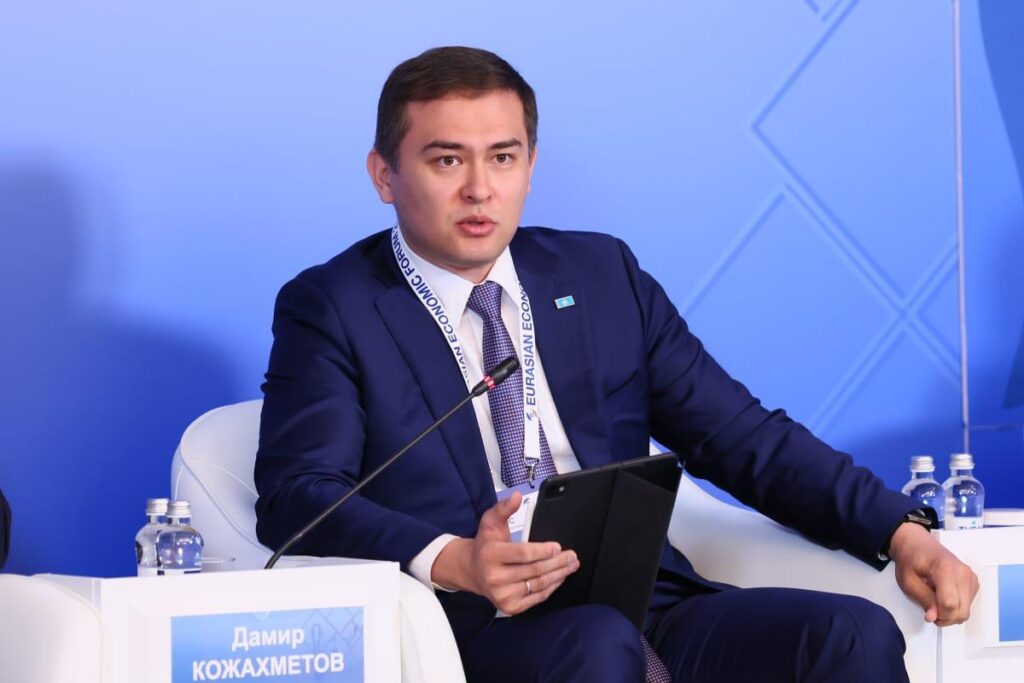
Kazakhstan is moving more of its transit system online as it tries to reduce border delays, track freight earlier, and strengthen its position on routes linking China, Central Asia, the Caspian, and Europe. Officials and industry participants say such tools could shorten processing times and reduce delays across transport corridors. These and other issues were discussed during a thematic session on “Digital Solutions in Transport and Logistics” at the Fifth Eurasian Economic Forum in Astana in late May. Kazakhstan’s practical experience in digitizing transport and logistics was presented by Deputy Minister of Transport Damir Kozhakhmetov, who also spoke with The Times of Central Asia about the country’s key priorities in transforming the sector. Key Areas of Transformation Situated at the crossroads of major international transport corridors, Kazakhstan is prioritizing seamless logistics, electronic document management, and intelligent monitoring systems. According to Kozhakhmetov, the goal is to simplify transit procedures and accelerate cargo processing through the introduction of unified electronic standards and integration with international platforms. “We connect major transit routes and serve as a link providing services along alternative transport corridors,” Kozhakhmetov told The Times of Central Asia. “Our current priority is to ensure that countries across the region continue working together to simplify electronic document exchange and harmonize digital procedures.” Practical Cases and Measurable Results One of Kazakhstan’s most successful initiatives has been the integration of its railway freight systems with major Chinese logistics platforms serving the Middle Corridor. “This allows us to see the composition of cargo shipments three to five days before they arrive at the border and complete transit declarations in advance,” Kozhakhmetov said. “As a result, processing times at key railway stations have been reduced to as little as 30 minutes. Similar integration has already been implemented with the electronic railway platforms of Azerbaijan and Georgia.” He noted that similar projects are being introduced across other transport sectors, including the electronic exchanges of international transport permits, paperless processing of cargo documentation, and the implementation of e-Freight systems for air cargo operations. Kazakhstan is also participating in the development of the Digital Trade Corridor, a global multimodal platform designed to simplify, automate, and accelerate transit and logistics operations. Other initiatives include the introduction of the electronic international consignment note, e-CMR, and the Smart Cargo single-window logistics platform, which integrates customs and logistics services. “We pay close attention to the development of digital infrastructure in every mode of transport,” Kozhakhmetov said. “These efforts cover four main areas: roads, road transport, aviation, and railways.” Digital Roads and AI Monitoring In the road sector, Kazakhstan is developing the e-Joldar system, a unified platform designed to monitor the lifecycle of the country’s road network. The system combines road inventories, technical assessments, laboratory testing, and lifecycle management tools, enabling more effective allocation of infrastructure funding. “We can now see when a road was repaired, when the next maintenance cycle is scheduled, and when future rehabilitation work should be carried out,” Kozhakhmetov explained. According to the Ministry of Transport, Kazakhstan’s public road network...

Opinion: How AI Is Reshaping the Global Image of Nations

Artificial intelligence is rapidly becoming one of the most powerful geopolitical and economic forces in the world. It is changing how countries compete, build influence, and attract investment. Until recently, discussions about Central Asia’s economic development were dominated by infrastructure, energy, logistics, and natural resources. Today, a new layer of competition is emerging: digital influence shaped by AI systems. According to McKinsey, AI could contribute up to $13 trillion to the global economy by 2030. For Central Asia and Kazakhstan, AI development is no longer just a digital transformation agenda; it is directly tied to technological sovereignty, economic resilience, and long-term competitiveness. Who Shapes a Country’s Image in the Age of AI? Digital influence is increasingly determined by how artificial intelligence systems interpret and represent countries. Consider a Singaporean investor asking Gemini about emerging technology markets in Central Asia. A European procurement manager using ChatGPT to identify logistics partners in the region. A journalist turning to Perplexity for insights on Kazakhstan’s fintech ecosystem before writing a report. In each case, AI generates answers based on the data it has been trained on and can access. This creates a new geopolitical reality: those who shape data and content structure ultimately shape how countries are represented globally. Generative AI is already used at a massive scale, with ChatGPT surpassing 900 million weekly active users as of early 2026. As these systems become default information interfaces, the visibility of countries within AI-generated responses is becoming increasingly important. When high-quality, structured, and authoritative content is missing, AI systems rely on outdated information, fragmented sources, and external narratives. In practice, this means that a lack of structured digital presence can directly influence international perception. How Other Countries Are Responding Several countries have already recognized this shift and are actively responding. According to Axios, Israel paid Brad Parscale’s firm $9 million as part of a campaign aimed at shaping how AI platforms portray the country. The United Arab Emirates and Saudi Arabia are investing heavily in AI infrastructure and Arabic-language models, including Gulf-backed data centers, sovereign AI initiatives, and Arabic-first large language models. These efforts go beyond technology development. They represent a broader competition for influence in an information environment where AI-generated responses increasingly shape global understanding. AI Momentum in Kazakhstan In 2025, Kazakhstan was listed among the region’s strongest performers in the Government AI Readiness Index published by Oxford Insights. Kazakh officials cited a ranking of 60th out of 195 countries, while Oxford Insights published a regional report that placed Kazakhstan 58th globally. In either case, it was the highest-ranked of the five Central Asian states and represented a sharp improvement from the previous year. Over the past two years, Kazakhstan has demonstrated rapid progress in artificial intelligence. Venture investment in AI has increased more than fivefold, from $14 million to $73 million. IT service exports surpassed $1 billion in 2025, with later ministry figures putting the total at about $1.14 billion. The Kazakh-linked AI startup Higgsfield AI has also been widely described as Kazakhstan’s...
