• KGS/USD = 0.01144 0%
  • KZT/USD = 0.00204 0%
  • TJS/USD = 0.10782 0%
  • UZS/USD = 0.00008 0%
  • TMT/USD = 0.28490 0%
  • KGS/USD = 0.01144 0%
  • KZT/USD = 0.00204 0%
  • TJS/USD = 0.10782 0%
  • UZS/USD = 0.00008 0%
  • TMT/USD = 0.28490 0%
  • KGS/USD = 0.01144 0%
  • KZT/USD = 0.00204 0%
  • TJS/USD = 0.10782 0%
  • UZS/USD = 0.00008 0%
  • TMT/USD = 0.28490 0%
  • KGS/USD = 0.01144 0%
  • KZT/USD = 0.00204 0%
  • TJS/USD = 0.10782 0%
  • UZS/USD = 0.00008 0%
  • TMT/USD = 0.28490 0%
  • KGS/USD = 0.01144 0%
  • KZT/USD = 0.00204 0%
  • TJS/USD = 0.10782 0%
  • UZS/USD = 0.00008 0%
  • TMT/USD = 0.28490 0%
  • KGS/USD = 0.01144 0%
  • KZT/USD = 0.00204 0%
  • TJS/USD = 0.10782 0%
  • UZS/USD = 0.00008 0%
  • TMT/USD = 0.28490 0%
  • KGS/USD = 0.01144 0%
  • KZT/USD = 0.00204 0%
  • TJS/USD = 0.10782 0%
  • UZS/USD = 0.00008 0%
  • TMT/USD = 0.28490 0%
  • KGS/USD = 0.01144 0%
  • KZT/USD = 0.00204 0%
  • TJS/USD = 0.10782 0%
  • UZS/USD = 0.00008 0%
  • TMT/USD = 0.28490 0%

Viewing results 1 - 6 of 94

Uzbekistan Emerges as One of Europe and Central Asia’s Fastest-Growing Economies

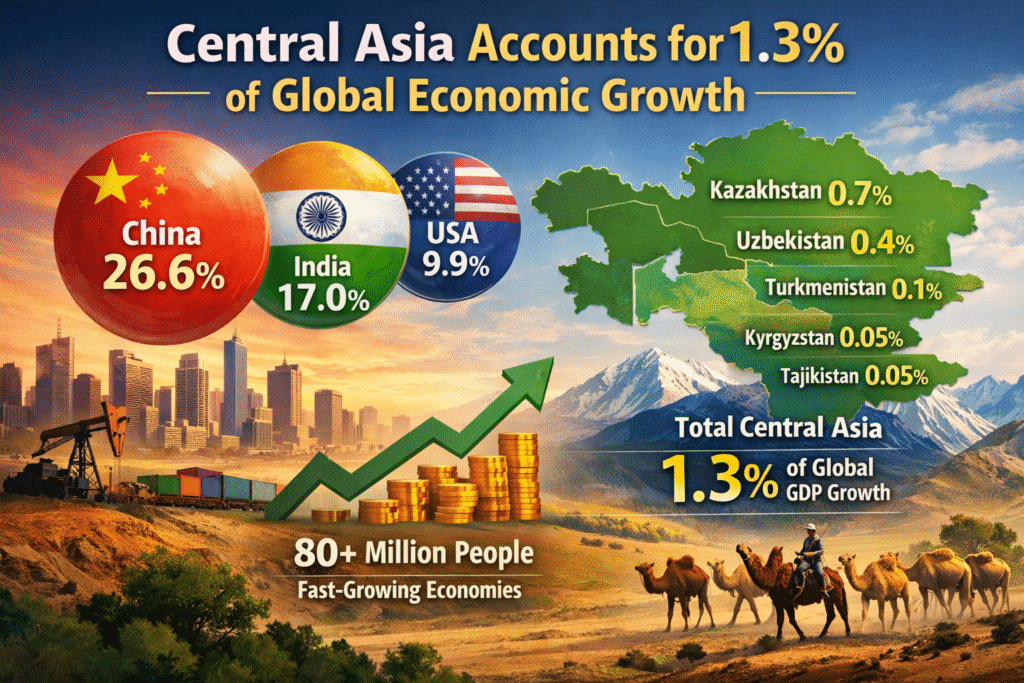
Uzbekistan is on track to be one of the five fastest-growing economies in the broader Europe and Central Asia region next year, according to the World Bank’s Europe and Central Asia Economic Update, Fall 2025. The report projects Uzbekistan’s gross domestic product will expand by about 6.2% in 2025 - well above the regional average amid an overall slowdown across emerging European and Central Asian markets. Overall regional GDP growth is expected to ease to roughly 2.4% in 2025, down from 3.7% in 2024, as weaker output in Russia drags on the aggregate. Central Asia as a whole continues to stand out. The World Bank notes that countries in the region are collectively growing around 5.9% - making it the fastest-growing part of Europe and Central Asia for the third straight year. Within that group, Tajikistan is also forecast to grow by 7%, Kyrgyzstan by 6.8%, and Kazakhstan by 5.5%. That performance keeps much of Central Asia well ahead of Europe’s advanced economies, which are expected to grow by just over 1% on average. Turkmenistan is excluded from the World Bank’s regional calculations because it does not publish internationally comparable economic data. For Uzbekistan, in particular, inclusion among the region’s top performers marks a sharp turnaround for a country that, less than a decade ago, was largely closed to global markets. By way of comparison, according to the World Bank, Uzbekistan’s economy is about eight times larger than Kyrgyzstan’s and roughly seven times larger than Tajikistan’s. In 2024, Uzbekistan’s gross domestic product was roughly $105 billion, compared with approximately $14 billion for Kyrgyzstan and $15 billion for Tajikistan. Remittances and Investment Fuel Expansion Rising income from abroad and expanding investment at home due to an increasingly investor-friendly climate are the twin engines of Uzbekistan’s boom. The World Bank attributes its upgraded forecast partly to stronger-than-expected remittances and higher capital spending. In the first half of 2025, remittances sent home by Uzbek workers - mainly from Russia, Turkey, and South Korea - jumped 27% year-on-year to reach around $8.2 billion, providing a surge in household consumption. At the same time, both public and private investment are climbing. Government spending on infrastructure and industrial projects remains high, and foreign capital is flowing in at record levels. According to Uzbekistan’s Ministry of Investment, Industry and Trade, foreign direct investment reached about $10 billion in 2024, the highest on record. Projects span energy, agriculture, and information technology, with investors from South Korea, China, the Gulf states, and Europe among the most active. The International Monetary Fund’s 2024 Article IV Consultation observed that “robust investment and resilient consumption” have kept growth well above the overall regional average. Reforms Since 2016 Have Laid the Groundwork This acceleration did not happen by chance. Since President Shavkat Mirziyoyev came to power in 2016, Uzbekistan has pursued a series of market-oriented reforms to dismantle decades of economic isolation and stagnation. The government unified the exchange rate, lifted currency restrictions, and simplified customs and tax rules. It began privatizing state...

World Bank: Central Asia to Lead Regional Growth in 2025 Despite Global Slowdown

Economic growth in Europe and Central Asia (ECA) is slowing but remains resilient amid global and regional challenges, according to the World Bank’s latest Europe and Central Asia Economic Update: Jobs and Prosperity, released on October 7, 2025. The report projects GDP growth in the region at 2.4% in real terms this year, down from 3.7% in 2024. The slowdown is primarily attributed to weaker growth in Russia. However, excluding Russia, which accounts for about 40% of the region’s total economic output, growth is expected to hold steady at approximately 3.3% in both 2025 and 2026. “Developing economies in the region need bold reforms to turn resilience into stronger growth in productivity, output, and jobs,” said Antonella Bassani, World Bank Vice President for Europe and Central Asia. She stressed the importance of strengthening the private sector, improving education systems, and attracting more private investment to generate quality employment and address demographic changes. Central Asia remains the fastest-growing subregion for the third consecutive year, with growth expected to rise from 5.7% in 2024 to 5.9% in 2025. The World Bank attributes this momentum to increased oil production in Kazakhstan, higher remittance inflows, and rising public and private investment. Turkey and Poland are also highlighted for their strong performance, with forecast growth rates of 3.5% and 3.2%, respectively, supported by solid consumer demand and capital investment. Despite these positive signals, the World Bank warns that sluggish growth and weak reform momentum are exacerbating challenges in the labor market. While employment across the ECA region has expanded by 12% over the past 15 years, particularly in the services sector, many of the new jobs are low-skilled and offer limited income potential. Demographic shifts pose another challenge. The region’s working-age population is projected to shrink by 17 million in the coming decades, especially in Eastern and Central Europe and the Western Balkans. In contrast, Central Asia and Turkey are expected to see population growth, intensifying the need to generate sufficient employment opportunities. The report recommends that countries invest in infrastructure, education, and private-sector development to improve productivity. “Each country can tailor its approach to best use its assets, human talent, physical infrastructure, institutions, and natural resources,” said Ivailo Izvorski, World Bank Chief Economist for Europe and Central Asia. In Central Asia, economic growth is expected to be driven by expansion in agrifood and livestock processing, transport and logistics along Eurasian trade corridors, renewable energy investment, and tourism development. The World Bank notes that these sectors, supported by the region’s cultural and natural heritage, could help position Central Asia as one of the world’s most dynamic emerging markets.

EBRD Projects Central Asia Economies 2025 Growth at 6.1%

The European Bank for Reconstruction and Development (EBRD) projects that the economies of Kazakhstan, the Kyrgyz Republic, Mongolia, Tajikistan, Turkmenistan, and Uzbekistan will grow by an average of 6.1% in 2025. According to the EBRD, the region’s momentum is being driven by strong industrial output, robust domestic demand, higher investment, rising wages, and continued remittance inflows. In 2026, growth is expected to remain positive but moderate to 5.2%. The report warns, however, that volatility in commodity prices, reliance on remittances, and dependence on Russian and Chinese markets pose ongoing risks to stability. Kazakhstan, Central Asia’s largest economy, is forecast to expand by 5.7% in 2025. Growth has been fueled by increased oil production at the Tengiz field, which boosted industrial activity and wholesale trade. The construction sector grew by 18.4% in the first half of the year, reflecting large infrastructure projects and residential development. Even so, the EBRD cautions that over-reliance on Russian transit routes and global commodity fluctuations could slow growth to 4.5% in 2026. The Kyrgyz Republic is projected to remain one of the region’s fastest-growing economies, with GDP expected to rise by 9.0% in 2025. The economy expanded by 11.4% in the first half of the year, supported by strong public investment, remittance inflows, and rising wages. Manufacturing, trade, and construction are key drivers, while tourism is growing through new investments. Growth is forecast to ease to 6.0% in 2026 but is expected to remain resilient unless remittance flows decline. Mongolia’s economy is expected to grow by 5.8% in 2025. A 35.6% rebound in agriculture after two difficult years helped offset slower mining activity and weaker coal prices, while copper production increased. Tajikistan’s economy grew by 8.1% in the first half of 2025, driven by trade, agriculture, transport, and a doubling of mining output. Remittances rose by 64%, and sharp wage growth boosted household consumption. The EBRD forecasts GDP growth of 7.5% in 2025, moderating to 5.7% in 2026. Continued support from international institutions such as the World Bank and IMF is expected to sustain growth, although reliance on remittances remains a structural vulnerability. Turkmenistan is projected to grow by 6.3% in both 2025 and 2026, supported by trade, transport, services, and construction. Official data show capital investment up 15.6% year on year. Uzbekistan’s economy is expected to expand by 6.7% in 2025, backed by strong domestic demand, rising wages, and a 28.7% increase in remittances. Services grew by more than 8%, while industrial output was buoyed by high gold prices and stronger manufacturing in food and metals. Growth is projected to ease slightly to 6.0% in 2026 but will remain supported by diversified manufacturing and stable foreign investment.

Experts Say Kazakhstan Must Boost Manufacturing to Tame Inflation

Inflation is steadily eroding incomes in Kazakhstan, depleting savings and undermining government efforts in the social sector. The Times of Central Asia previously noted that surging economic growth could be a contributing factor to Kazakhstan’s inflation problem. But despite rising prices, the government has no plans to apply the brakes. On the contrary, officials point to promising GDP growth driven by sectors beyond oil. Meanwhile, independent experts argue that only large-scale industrial development can provide a lasting solution to inflation. Persistent Price Pressures Inflation continues to outpace official projections. In August, annual inflation hit 12.2%, and by the end of 2025 it is expected to reach 14%, well above the National Bank of Kazakhstan’s target range of 5-6%. Economists say the country’s dependence on imports is a key driver. Kazakhstan imports large volumes of food, fuel, medicine, equipment, and consumer goods. Wage and pension increases are failing to keep pace with the surge in prices. President Kassym-Jomart Tokayev has acknowledged that high inflation poses a serious challenge, warning it is “eating away at economic growth and household incomes.” Government efforts to stabilize prices have yet to show meaningful results. On September 23, Minister of Trade and Integration Arman Shakkaliev announced that Kazakhstan will gradually phase out price controls on socially significant food products (SZPT) in favor of targeted digital support for consumers. The SZPT list currently includes 19 essential items. At the same time, Prime Minister Olzhas Bektenov instructed agencies to crack down on unjustified price hikes for basic goods, ordering strict enforcement of available price control tools. Growth at a Cost Inflation, according to Deputy Prime Minister and Minister of National Economy Serik Zhumangarin, is being fueled by economic expansion. He warned that efforts to restrain inflation could hinder growth. “Since 2023, GDP has grown by 5%, and in 2024 we grew without the contribution of oil. This year is a turning point. From 2026, oil will no longer influence GDP growth,” Zhumangarin said. Although Kazakhstan’s economy has long relied on oil revenues, the minister believes this trend is now shifting. “Economic growth is always accompanied by high inflation,” he said. “More than $12 billion in investments have already been attracted, and the target for the year is $24 billion. The government will soon announce a new strategy for economic growth. We must follow the path of Asian countries but with modern technologies.” Call for Industrialization Independent analysts argue that real progress against inflation requires mass domestic production across a wide range of goods. Political analyst Gaziz Abishev stressed the urgency of moving beyond megaprojects toward practical, infrastructure-linked industry. “Kazakhstan needs real production, not fairy-tale megaprojects. Industry tied to infrastructure, logistics, human resources, and markets solves many issues,” he wrote. “It creates well-paid jobs, stimulates small and medium-sized businesses, reduces reliance on imports, supports the tenge, and addresses budget deficits.” Abishev also called for openness to foreign industrial investment, regardless of origin. His comments appear to push back against public concerns over the influence of Russia, China, and Western...

Kazakhstan Factories Under Strain as Costs Bite, Economy Shows Mixed Signals

Kazakhstan’s manufacturing sector slipped further in August, with the latest Purchasing Managers’ Index (PMI) falling to 47.9. That was down from 49.9 in July and 49.7 in June, keeping the index below the neutral 50 mark for a third straight month. It also marked the sharpest deterioration in manufacturing activity since March 2022, according to S&P Global and Freedom Holding Corp. From Highs to Lows The striking downturn comes on the heels of a banner year. In December 2024, the PMI reached a record 53.9, capping 11 straight months of expansion. Buoyed by post-pandemic recovery and government support, manufacturing output grew by 6.8% in 2024, the fastest pace since 2011, helping push GDP growth to 5%. But momentum cooled as 2025 began. The PMI slipped to 51.5 in January, reflecting slower expansion after the year-end surge. By June and July, it hovered just under 50, signaling stagnation. Seasonal shutdowns for repairs in August contributed to weaker output, but analysts say the slide points to deeper structural pressures. [caption id="attachment_36026" align="aligncenter" width="1600"] Kazakhstan’s PMI peaked at 53.9 in December 2024 but slid steadily through 2025, falling into contraction territory below 50 by mid-year and hitting 47.9 in August — the sharpest deterioration since March 2022.[/caption] Orders Dry Up, Costs Rise The August report revealed broad-based weaknesses. New orders fell for the first time in 19 months, ending a growth streak that began in early 2024. The decline reflected lower demand from both domestic and export markets. With fewer orders, factories scaled back staffing and cut input purchases. At the same time, costs surged. A weak tenge and fuel inflation made imports more expensive, while logistics delays lengthened supplier delivery times. These pressures forced firms to raise output prices at a faster pace, risking competitiveness. “August saw another sharp decline in business activity in Kazakhstan’s manufacturing sector,” said Yerlan Abdikarimov of Freedom Finance Global, which partners with S&P on the survey. He cited weak demand, volatile commodity markets, rising costs, and currency and tax pressures. Taxes have indeed become a burden. A new code passed in mid-2025 raised the extraction royalties on metals, hitting downstream metallurgy. Inflation stood at 12.2% in August 2025, with the National Bank keeping its policy rate high at 16.5% in a bid to tame prices. That leaves financing costly for businesses, resulting in squeezed margins and thinning confidence. The August survey showed business confidence at its lowest since 2021. While firms still expect growth over the next year, their optimism is increasingly cautious. Industry Responses and Government Initiatives Some executives see hope in the government’s industrial policy. A $400 million cotton-to-textile cluster is under construction with Chinese partners in Turkestan, aiming to process domestic cotton into textiles at scale. Officials say the project, due to start production by late 2025, will create thousands of jobs and expand exports. Light industries, such as textiles and apparel, posted strong growth in the first half of 2025, with clothing up about 5.6% and textiles 5.7% according to official data. Chemicals...

Kyrgyzstan Seeks German Investment in Green Energy, Logistics, and Tourism

On August 26, the resort city of Cholpon-Ata on Lake Issyk-Kul hosted the Day of German Economy in Kyrgyzstan, alongside the 4th meeting of the Kyrgyz-German Business Council. Opening remarks were delivered by Adylbek Kasymaliyev, Chairman of the Cabinet of Ministers of Kyrgyzstan, and Professor Reinhold Krämmel, Honorary Consul of Kyrgyzstan in Bavaria and Thuringia and Deputy Co-Chairman of the Business Council. Calls for Green Investment and Innovation Kasymaliyev highlighted Kyrgyzstan’s interest in attracting German investment and advanced technologies to modernize its industries, create jobs, and strengthen export potential. He identified key areas for cooperation, including renewable energy, green technologies, transport and logistics infrastructure, and the financial sector. Environmental issues featured prominently in the discussions. Kasymaliyev further emphasized the threat of rapidly melting glaciers, which he said "requires the consolidation of efforts and joint initiatives." “We know Germany as one of the most active defenders of nature. Unfortunately, environmental problems are worsening each year. Glaciers in our mountains are melting and shrinking drastically. Addressing such critical issues requires joint efforts,” he said. Youth and Education as Bridges of Cooperation Kasymaliyev also underlined the importance of youth in Kyrgyzstan’s development and in strengthening bilateral ties. He noted a growing interest among young Kyrgyz citizens in the German language, culture, and vocational education, elements he described as forming the foundation for long-term partnership. While acknowledging current progress, Kasymaliyev stressed that Kyrgyz-German economic relations have significant untapped potential. New Agreements and Sectoral Priorities Following the meeting, a memorandum of cooperation was signed between Kyrgyz Temir Jolu, the national railway company, and Rhenus SE & Co. KG to jointly explore logistics and transit infrastructure opportunities. Kasymaliyev also held bilateral talks with Michael Harms, Executive Director of the Eastern Committee of the German Economy. He underscored Germany’s growing importance as a trade partner, noting that bilateral trade had nearly quadrupled between 2020 and 2024. The Kyrgyz side presented several promising areas for German investment, including the IT sector, data center and logistics hub development, renewable energy and green hydrogen production, and mining. “Kyrgyzstan is fully committed to supporting German companies interested in launching investment projects in our country,” Kasymaliyev stated. Tourism Growth Highlighted Tourism was also spotlighted as a rising sector of bilateral engagement. Germany is now among Kyrgyzstan’s top tourism partners, with more than 23,000 German visitors recorded in 2024, and over 10,000 arriving in the first half of 2025 alone.