Viewing results 1 - 6 of 2
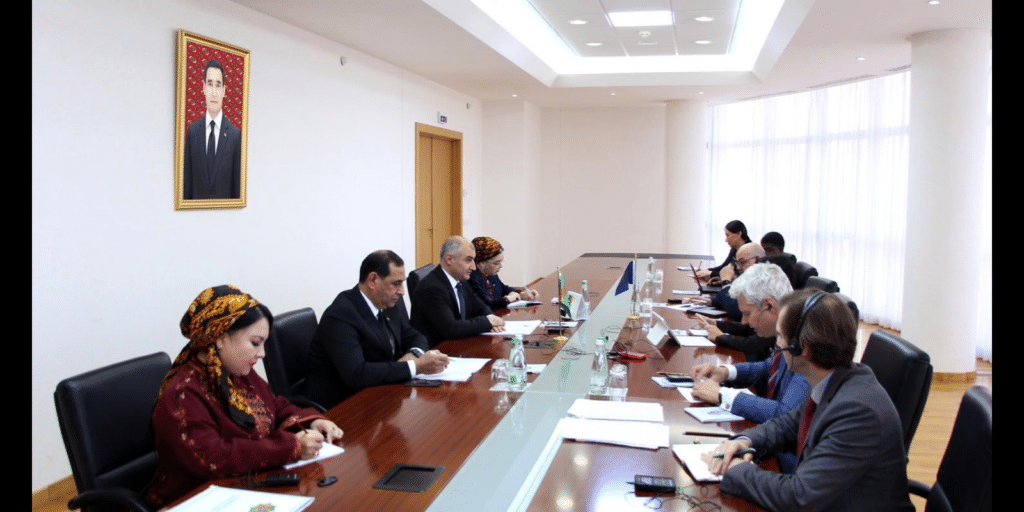
Turkmen officials and a representative from the International Monetary Fund met in Ashgabat, weeks after the IMF concluded that Turkmenistan breached its obligations as a member country by not providing key data. Turkmenistan’s Ministry of Foreign Affairs did not mention the IMF's September finding in a statement about the meeting on October 28, saying that the two sides discussed “prospects” for further cooperation. It said the lead participants in the meeting were Ahmet Gurbanov, deputy foreign minister, and Anna Bordon, head of the IMF’s mission for Azerbaijan and Turkmenistan. “The sides emphasized the importance of cooperation with international financial institutions in the context of strengthening macroeconomic stability, improving economic mechanisms and exploring modern approaches to addressing current economic challenges,” the Turkmen ministry said. On September 11, the IMF Executive Board said Turkmenistan had breached its obligations as a member country by failing to provide data “necessary for the IMF’s activities.” The board said “Turkmenistan has not provided key required data, including information on international reserve assets, official holdings of gold and foreign exchange, and a complete balance of payments.” It said the failure to provide the data “could not be explained by a lack of capacity” and that the board would meet within six months to review Turkmenistan’s progress in rectifying the situation. The Washington-based IMF requires its 191 member countries to provide such data for economic surveillance, policy analysis, and the assessment of potential vulnerabilities. Turkmenistan, which is estimated to have the world’s fourth-largest proven reserves of natural gas, does not have a loan program with the IMF. However, IMF technical experts have assisted the Ministry of Finance in areas including budgeting. The IMF said in June that it projected economic growth in Turkmenistan to moderate to about 2.4 percent this year, “reflecting capacity constraints in the hydrocarbon sector and persistent structural inefficiencies associated with the large state footprint in the economy.” Turkmenistan has sought to expand tourism and increase diplomatic and economic contacts. But it remains a highly controlled state, and it can be difficult for outsiders to obtain economic and other information about the country.
Kazakhstan’s government has approved a 2026–2028 Action Plan to reduce the shadow economy through greater use of artificial intelligence and the digital tenge. The plan also calls for further digitalization in sectors most vulnerable to informal economic activity. The government hopes that the measures will reduce the shadow economy's share of GDP from 16.7% in 2025 to 13.8% by 2028, a decline of nearly three percentage points over the next three years. According to the Prime Minister's Office, Kazakhstan has already modernized 20 government information systems in recent years, dismantled the financial infrastructure supporting illegal online casinos with a turnover of approximately $4.2 billion, and prevented unjustified public spending totaling around $765 million. Officials said these efforts helped reduce the shadow economy’s estimated share of GDP from 24% in 2019 to 16.7% in 2025. "The main objective of the Action Plan is to reduce the shadow economy, ensure fair competition, increase business transparency, and boost budget revenues without imposing new obligations on entrepreneurs," the government said. A unified AI-powered monitoring platform will be central to the strategy. The system will combine data from government agencies to identify signs of hidden economic activity and flag risks in real time. Officials say this will help prevent violations before they cause budget losses. The plan contains 53 measures focused on improving economic transparency and accelerating digitalization in sectors with elevated risks of informal activity. The government has identified trade, construction, transport, agriculture, healthcare, and education as priority sectors for the new system. Retail trade will be another focus. The government plans to continue developing the Digital Bazaar, an electronic platform launched in late 2024 to bring Kazakhstan’s traditional markets and trading venues online. More products will be added to the mandatory digital-labeling system, while the National Product Catalogue will be extended. These measures are intended to make supply chains more transparent and curb counterfeit goods. They are also expected to create fairer conditions for businesses. Controls over excise goods and socially important products will be further automated. The government also plans tighter oversight of e-commerce platforms and online marketplaces, along with closer integration of state information systems. In the social sector, digital tools will be used to monitor the quality of services and track prices. They will also help authorities oversee public spending. The government plans to increase the use of the digital tenge, Kazakhstan’s central bank digital currency. It is already being used in selected government programs to improve the traceability of public funds. As previously reported by The Times of Central Asia, the digital tenge officially became a legally recognized form of Kazakhstan's national currency on July 18, providing the legal foundation for its broader use in government payments and public finance.