
• KZT/USD = 0.00223
  • TJS/USD = 0.10810
  • UZS/USD = 0.00009
  • TMT/USD = 0.29850
  • KZT/USD = 0.00223
  • TJS/USD = 0.10810
  • UZS/USD = 0.00009
  • TMT/USD = 0.29850
  • KZT/USD = 0.00223
  • TJS/USD = 0.10810
  • UZS/USD = 0.00009
  • TMT/USD = 0.29850
  • KZT/USD = 0.00223
  • TJS/USD = 0.10810
  • UZS/USD = 0.00009
  • TMT/USD = 0.29850
  • KZT/USD = 0.00223
  • TJS/USD = 0.10810
  • UZS/USD = 0.00009
  • TMT/USD = 0.29850
  • KZT/USD = 0.00223
  • TJS/USD = 0.10810
  • UZS/USD = 0.00009
  • TMT/USD = 0.29850
  • KZT/USD = 0.00223
  • TJS/USD = 0.10810
  • UZS/USD = 0.00009
  • TMT/USD = 0.29850
  • KZT/USD = 0.00223
  • TJS/USD = 0.10810
  • UZS/USD = 0.00009
  • TMT/USD = 0.29850
23 September 2026

Viewing results 1 - 6 of 8

Kyrgyz Parliament Votes to Dissolve; Preparations for Early Elections Begin

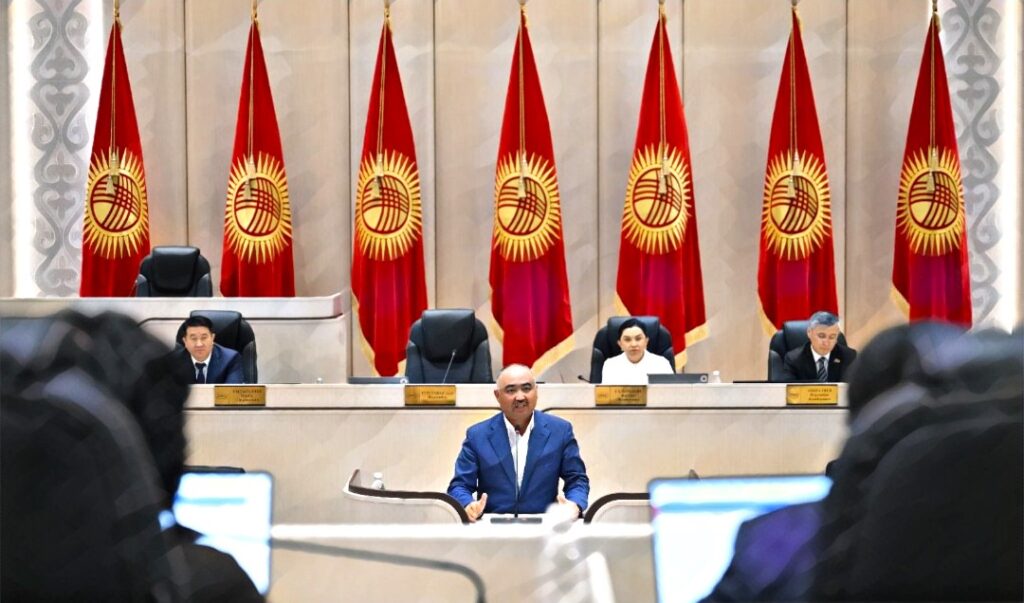
Deputies in Kyrgyzstan’s parliament voted on September 25 to dissolve parliament, paving the way for early elections that will be conducted under a revised electoral format later this year. Deputies voted 84-0 in favor of dissolving parliament. Five other deputies abstained from voting, and one MP was absent from the session. Kyrgyz President Sadyr Japarov now has five days to name the date for snap parliamentary elections, though speaker of parliament Nurlanbek Turgunbek uulu said he expects the date will be November 30. The move was expected as a group of deputies started collecting signatures earlier in September to introduce a motion on dissolving parliament. The chairman of Kyrgyzstan’s Central Election Commission (CEC), Tynchtykbek Shaynazarov, said in an interview on September 2 that the CEC is ready to conduct parliamentary elections this year, “if [parliament] takes the decision to dissolve itself.” Shaynazarov explained the reason for advancing elections by one year. “According to the law, and plans, the elections for deputies to the Jogorku Kenesh (Kyrgyzstan’s parliament) will take place in November 2026.”  However, Shaynazarov said, “According to the constitutional regulations, the next presidential election is set for January 2027. If we have (parliamentary) elections… in November 2026, the CEC must release an official tally (of votes) within 20 days.” Shaynazarov continued, “Then there will be those who are dissatisfied with the elections and will file a lawsuit. Thus, the campaign for the election of deputies may drag on until December.” Shaynazarov pointed out this would overlap with campaigning for the presidential election. Member of Parliament Janar Akayev agreed the proximity of the two elections according to the current schedule could negatively impact the work of the CEC. Akayev also noted that Japarov signed a new law on procedures for electing parliamentary deputies in June this year.  That law changed the mixed system of electing deputies Kyrgyzstan used in 2021, whereby 36 MPs were elected in single-mandate districts and 54 by party lists. In the next elections, all 90 deputies will be chosen in single-mandate districts. “Since current MPs support the transition to a new system, new elections should be held,” Akayev said. Kyrgyzstan’s early parliamentary elections, in 1995, 2000, and 2005, were conducted via single-mandate districts. Election by party lists was first used in the 2007 snap elections, and continued to be used in the 2010, 2015, and 2020 elections. The new regulations for parliamentary elections have negative and positive aspects. The non-refundable fee to seek a seat in parliament favors the wealthy. The fee for independent candidates to run remains at 100,000 Kyrgyz som (about $1,115), which is still a high price in a country where the average monthly salary is just a bit over 41,000 som. Political parties can still participate in elections but must pay 9 million som (almost $103,000). Currently six parties have seats in parliament, but 21 parties fielded candidates in the 2021 elections. The prohibitively high cost of registering will make it difficult for many people who aspire to a seat in parliament...


Back to the Old System for Kyrgyzstan’s Future Parliamentary Elections

On June 9, Kyrgyz President Sadyr Japarov signed the law on amendments to the procedures on electing members of parliament. There are some positive and some controversial changes, one of the most significant of which is the diminished role for political parties. Structurally, the new legislation creates 30 electoral districts in Kyrgyzstan. Each district will elect three parliamentary deputies, with the three candidates receiving the most votes becoming the deputies from their district. Currently, there are 90 seats in Kyrgyzstan’s parliament. That number will remain. According to the new law, one of the three candidates from each territorial constituency must be a woman. Kyrgyzstan has had a gender quota rule in place since 2007 whereby at least 30% of the members of parliament should be women. However, in reality that percentage has never been reached. Currently, only 20 of the 90 of the deputies in Kyrgyzstan’s parliament are women. Under the new legislation, a minimum 33% quota for women is guaranteed. Another change dispenses with by-elections in the event an elected deputy steps down from their post. If a seat is vacated, the candidate from that district who received the fourth most votes in elections will receive the empty seat. If the deputy vacating their seat is a woman, the female candidate who received the next highest number of votes in that electoral district will fill the seat. MP Ulan Primov, one of the authors of the amendments, said Kyrgyzstan has spent nearly 200 million som (about $2.29 million) on by-elections since the 2021 parliamentary elections. One of the most controversial changes is the decision to revert entirely to a single-mandate selection of candidates. Kyrgyzstan elected all its deputies via the single-mandate system in the 1995, 2000, and 2005 parliamentary elections. Parties also ran candidates, but in the 1995 elections, 67 of the 105 seats went to independents, in 2000, 73 of the 105 seats were won by independents, and in 2005, after changes to parliament’s structure, 47 of the 75 places in parliament went to independents. In 2007, the system changed, and deputies were elected by party lists. This led to the first-ever ruling party in Kyrgyzstan’s history, the Ak Jol party of then-President Kurmanbek Bakiyev which took 71 of the 90 seats in parliament in the 2007 elections. Parliament’s structure was changed to 120 seats in 2010. The parliamentary elections that year, and in 2015 and 2020 were conducted using party lists. In the last parliamentary elections in November 2021, Kyrgyzstan had introduced a split system whereby 36 deputies were elected in single-mandate districts and the remaining 54 deputies by party lists. In an interview with state media outlet Kabar in February 2025, President Japarov spoke about the coming changes to election legislation, saying, “Perhaps in 40-50 years, if our people and politicians are ready, we will move to a party system of government.” It is a curious comment considering the other Central Asian countries, Kazakhstan, Tajikistan, Turkmenistan, and Uzbekistan, all use party lists to elect deputies in...