


Kazakhstan’s Energy Sector Without Local Business: The Anatomy of Major Projects
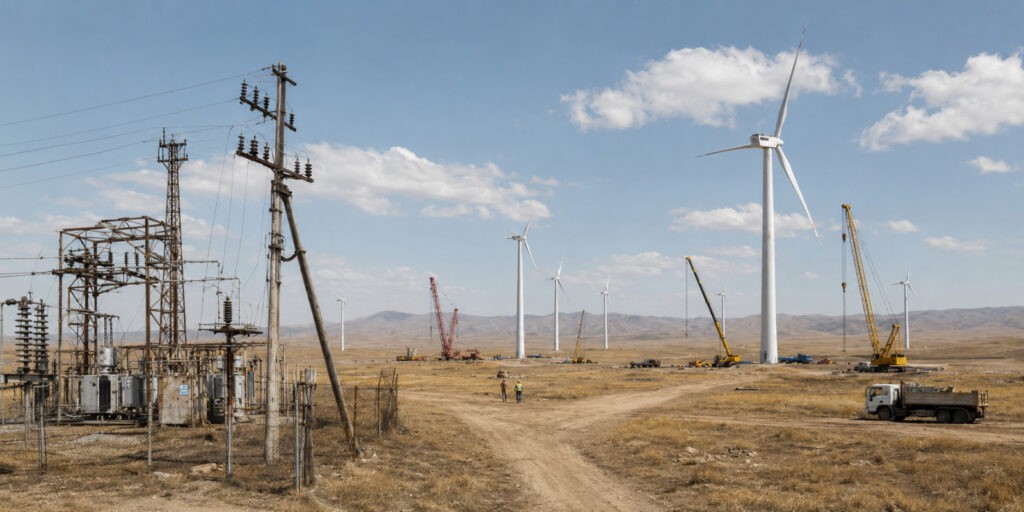
In late June 2026, construction began on a 1 GW wind power plant in Kazakhstan’s Zhambyl Region. The project is valued at $1.4 billion. Companies based in the United Arab Emirates, Masdar and W Solar, hold 80% of the project, while Kazakhstan’s quasi-state sector holds the remaining 20% through Qazaq Green Power and the Kazakhstan Investment Development Fund. This ownership model has become typical across Kazakhstan’s energy industry. Nearly all major new energy infrastructure projects rely on foreign capital. The country’s largest renewable energy developments involve international investors, including France’s TotalEnergies and Saudi Arabia’s ACWA Power. Even when agreements collapse, the government continues to rely on foreign partners. After financing problems ended cooperation with Russia’s Inter RAO, construction of new thermal power plants in Semey and Ust-Kamenogorsk was quickly reassigned to a Kazakh-Singapore consortium. A similar pattern appears across the sector: foreign investors provide most of the capital and technology, while Kazakhstan’s state-linked companies take minority stakes through Samruk-Kazyna or its subsidiaries This has created an unusual situation. Despite an acute shortage of generating capacity and guaranteed long-term demand, Kazakhstan’s largest private businesses have largely stayed away from electricity generation. Instead, domestic capital continues to favor sectors with greater liquidity and shorter investment horizons, ranging from finance to residential real estate. The reasons lie in straightforward economics, where financing costs and regulatory conditions outweigh the sector’s potential returns. The Financial Equation Power generation is one of the most capital-intensive infrastructure industries, with investment payback periods typically ranging from 10 to 15 years. Such projects require access to long-term financing at low interest rates. For Kazakhstan’s private sector, those financing instruments are largely unavailable. Under the National Bank’s tight monetary policy, with the benchmark interest rate standing at 17%, commercial borrowing costs for businesses routinely exceed 20% annually. Financing the construction of a power plant with local-currency loans at those rates is, mathematically, unviable. Such projects are virtually guaranteed to become unprofitable. Rather than engaging in complex, long-term infrastructure financing, Kazakhstan’s banking sector has increasingly concentrated on faster and more profitable lending. Official statistics from the National Bank of Kazakhstan illustrate this imbalance. As of May 2026, banks’ claims on households had reached approximately $60 billion, while lending to non-financial private enterprises, the real economy,stood at about $29 billion, less than half that amount. In practice, commercial banks have largely withdrawn from financing major industrial investment projects, preferring consumer lending with higher liquidity and quicker returns. Foreign corporations, meanwhile, enter Kazakhstan with access to international capital markets. They secure financing from global development institutions or sovereign wealth funds in their home countries at significantly lower borrowing costs. As a result, domestic private investors often lose the competitive race before projects even reach the investment decision stage. Unequal Conditions for Investors A second obstacle for domestic investors lies in Kazakhstan’s regulatory framework. Electricity tariffs have historically been kept under government control to limit inflationary pressures and avoid sharp increases in household utility bills and production costs. To attract major international energy companies,...
