

U.S. Backs New Routes for Turkmen Gas Exports and Caspian Trade
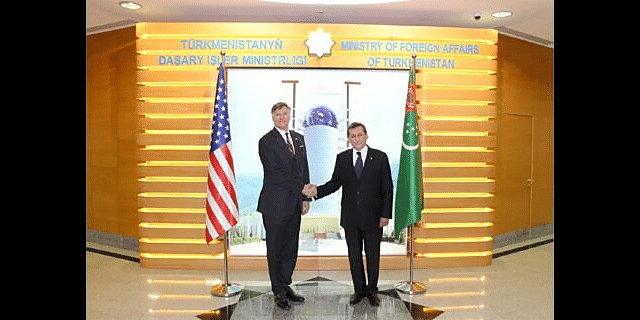
The United States is seeking to help Turkmenistan diversify its energy exports and expand trade across the Caspian Sea. U.S. Deputy Secretary of State Christopher Landau and Turkmen Foreign Minister Rashid Meredov discussed both priorities at talks in Ashgabat on November 23. Landau also met with President Serdar Berdimuhamedov that day. In addition to energy and transportation, they discussed trade and investment. Berdimuhamedov expressed interest in joint renewable energy projects. Turkmenistan depends heavily on China, its largest natural gas customer. In October, Maksat Babayev, chairman of the state-owned gas company Türkmengaz, said Turkmenistan had supplied China with more than 477 billion cubic meters of gas between the opening of the export pipeline in December 2009 and October 1, 2026. Ashgabat also hopes to reach South Asian markets. Babayev said Türkmengaz was building a section of the Turkmenistan-Afghanistan-Pakistan-India (TAPI) gas pipeline from the Turkmen border town of Serhetabat to the Afghan city of Herat. TAPI is designed to supply the three importing countries with up to 33 billion cubic meters of gas a year. The proposed Trans-Caspian Gas Pipeline would run beneath the Caspian Sea, connecting Turkmenistan’s gas network to Azerbaijan. From there, gas could reach European markets through existing pipelines in Georgia and Turkey. Construction of the subsea link has yet to begin. Ferries already carry trucks and trailers between the port of Turkmenbashi and the Azerbaijani port at Alat, near Baku. Cargo can then continue overland through the South Caucasus. Turkmenistan was one of nine countries covered by a September World Bank study of the Trans-Caspian Transport Corridor, also known as the Middle Corridor, which links Asia and Europe. To reduce delays, the bank recommended a single digital system for transport and trade documents. It called for rail operators to coordinate more closely with ports and shipping companies. Washington is also backing the Trump Route for International Peace and Prosperity (TRIPP), which would connect mainland Azerbaijan to its Nakhchivan exclave through southern Armenia. It would give Central Asian freight another route through the South Caucasus toward Turkey and Europe. In a November 7 joint statement, Armenia and Azerbaijan agreed with the United States to form two working groups for the project, one on transportation and the other on electricity transmission. Ahead of Landau’s visit, the State Department identified TRIPP and the Middle Corridor as areas for cooperation with Turkmenistan. On the day of the Ashgabat talks, Armenian Prime Minister Nikol Pashinyan announced that preparatory construction work had begun in southern Armenia.
