


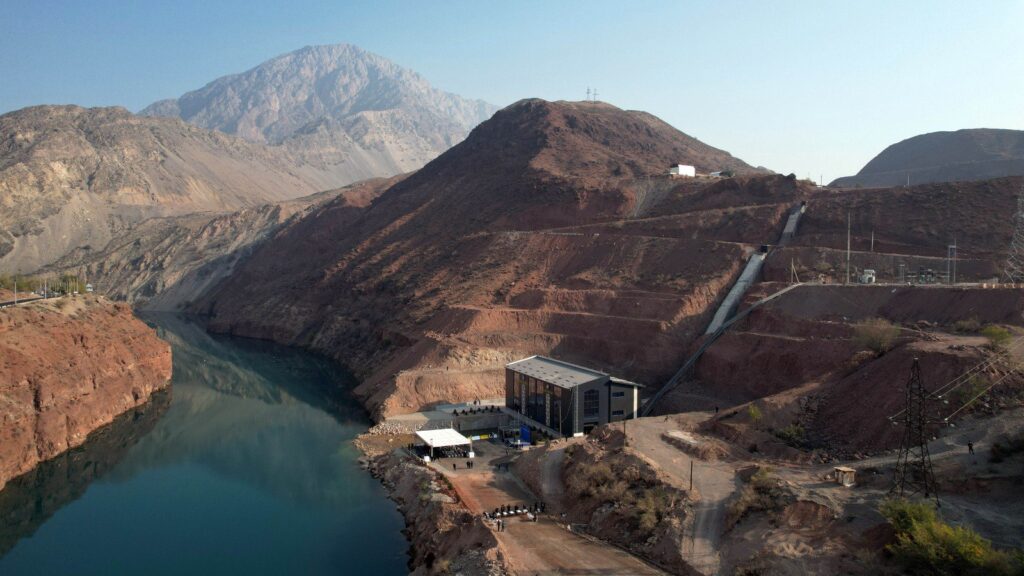
Japarov Pledges Energy Independence Within 2.5 Years
Kyrgyzstan will meet its domestic electricity needs during the winter months within the next two and a half years, President Sadyr Japarov announced during the inauguration of the Kara-Kul Hydropower Plant (HPP) on October 27. The shift will be made possible by the completion of nearly 40 new hydropower plants and a coal-fired power station at the Kara-Keche deposit. “In two and a half years, we will no longer import electricity during winter. We will have enough domestically produced power,” Japarov stated, urging citizens to remain patient amid ongoing seasonal shortages. Energy Minister Taalaibek Ibraev recently warned that the upcoming winter could be one of the most challenging in recent memory due to critically low water levels in the Toktogul Reservoir, which supplies around 40% of the country’s electricity. Kyrgyzstan has long struggled with chronic electricity deficits in winter, as many households rely heavily on electric heating. In 2024, electricity consumption reached 18.3 billion kWh, an increase of 1.1 billion kWh from the previous year. To bridge the shortfall, Kyrgyzstan imported 3.6 billion kWh from Kazakhstan, Turkmenistan, Uzbekistan, and Russia. Additional volumes have been secured for the 2025-2026 winter period. The newly commissioned Kara-Kul HPP, located on the Kara-Suu River in the southern Jalal-Abad region, is part of a broader national energy strategy. Built at a cost of $25 million, the facility has two generating units with a combined capacity of 18 MW and is expected to produce 104 million kWh annually, offsetting roughly 2.5% of the current winter shortfall. Japarov emphasized that the project is one component of Kyrgyzstan’s drive for energy independence. Preparations are also underway for the construction of the Kambarata-1 HPP, set to be the largest hydropower plant in both Kyrgyzstan and Central Asia. The plant will have an installed capacity of 1,860 MW and is expected to generate 5.6 billion kWh annually. The Kambarata-1 project is being developed in cooperation with Kazakhstan and Uzbekistan, with technical and financial support from the European Union. During the Global Gateway Forum held in Brussels on October 9-10, Kyrgyz Energy Minister Taalaibek Ibraev met with regional counterparts and EU institutions. Key outcomes from the forum included the signing of €900 million in Memoranda of Understanding between the EU, European Investment Bank (EIB), and the three Central Asian states. A feasibility study, co-financed by the EU and implemented by the World Bank, is also underway. Additionally, the European Bank for Reconstruction and Development (EBRD) signed MoUs with Kyrgyzstan, Kazakhstan, and Uzbekistan, and is considering an overall financing package of €1.3 billion to support the project.
