
• KGS/USD = 0.01144 0%
  • KZT/USD = 0.00206 0%
  • TJS/USD = 0.10806 0.19%
  • UZS/USD = 0.00008 0%
  • TMT/USD = 0.28490 0%
  • KGS/USD = 0.01144 0%
  • KZT/USD = 0.00206 0%
  • TJS/USD = 0.10806 0.19%
  • UZS/USD = 0.00008 0%
  • TMT/USD = 0.28490 0%
  • KGS/USD = 0.01144 0%
  • KZT/USD = 0.00206 0%
  • TJS/USD = 0.10806 0.19%
  • UZS/USD = 0.00008 0%
  • TMT/USD = 0.28490 0%
  • KGS/USD = 0.01144 0%
  • KZT/USD = 0.00206 0%
  • TJS/USD = 0.10806 0.19%
  • UZS/USD = 0.00008 0%
  • TMT/USD = 0.28490 0%
  • KGS/USD = 0.01144 0%
  • KZT/USD = 0.00206 0%
  • TJS/USD = 0.10806 0.19%
  • UZS/USD = 0.00008 0%
  • TMT/USD = 0.28490 0%
  • KGS/USD = 0.01144 0%
  • KZT/USD = 0.00206 0%
  • TJS/USD = 0.10806 0.19%
  • UZS/USD = 0.00008 0%
  • TMT/USD = 0.28490 0%
  • KGS/USD = 0.01144 0%
  • KZT/USD = 0.00206 0%
  • TJS/USD = 0.10806 0.19%
  • UZS/USD = 0.00008 0%
  • TMT/USD = 0.28490 0%
  • KGS/USD = 0.01144 0%
  • KZT/USD = 0.00206 0%
  • TJS/USD = 0.10806 0.19%
  • UZS/USD = 0.00008 0%
  • TMT/USD = 0.28490 0%

Viewing results 1 - 6 of 2

Uzbekistan and BRICS New Development Bank Agree on $4.5 Billion Joint Project Portfolio

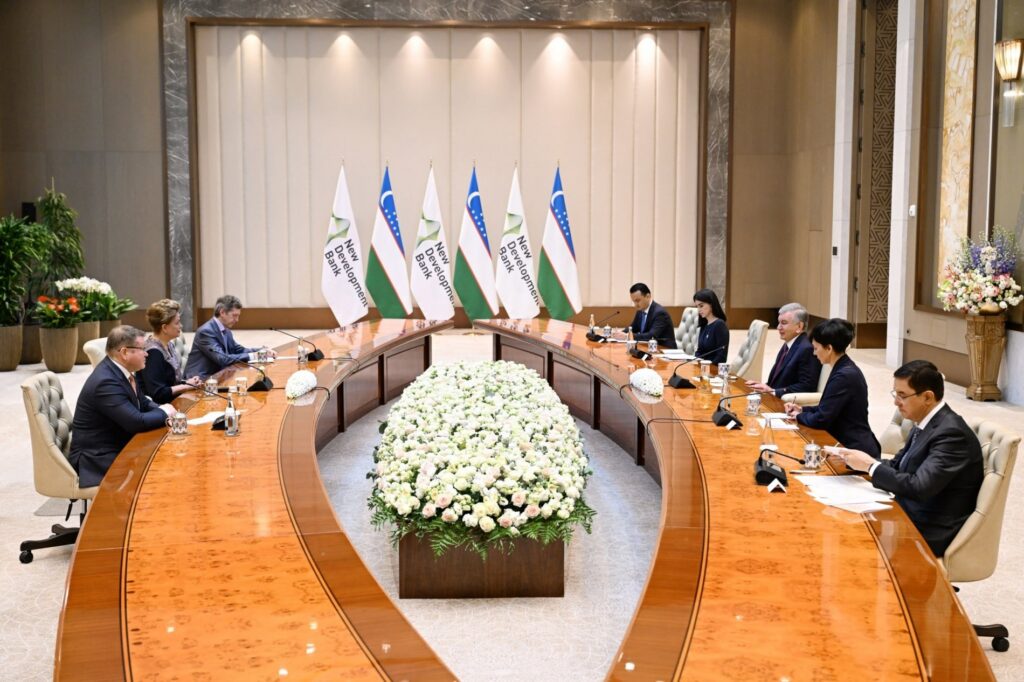
Uzbekistan’s President Shavkat Mirziyoyev has held talks with Dilma Rousseff, president of the New Development Bank (NDB), who arrived in Tashkent to take part in the Tashkent International Investment Forum. According to Uzbekistan’s presidential press service, Mirziyoyev and Rousseff discussed prospects for expanding cooperation with the NDB, including the implementation of agreements reached during previous negotiations. Rousseff praised Uzbekistan’s economic reforms and said the bank was ready to support the country’s priority socioeconomic development goals. The meeting also covered Uzbekistan’s recent accession to the NDB. Uzbekistan officially became the bank’s 10th shareholder in June 2026 and the first Central Asian country to join the institution. Mirziyoyev and Rousseff agreed to form a medium-term portfolio of joint projects in energy, water management, transport and engineering infrastructure, and support for the private and social sectors. NDB expert missions will help implement the initiatives. In May, Uzbekistan’s Ministry of Investment, Industry and Trade said a project portfolio worth $4.5 billion had been prepared for financing through the NDB. It includes projects in transport, energy, construction, and industry. In particular, the possibility of attracting funds for the construction of a nuclear power plant is under consideration. The meeting also covered the NDB’s participation in major regional transport and logistics projects, as well as Uzbekistan’s environmental transformation programs. The NDB was created by BRICS countries in 2014. It is one of the main financial institutions of the Global South. The bank holds an AA+ credit rating and is developing alternative financial mechanisms, including settlements in national currencies. According to the presidential press service, Uzbekistan’s accession to the NDB will help diversify sources of external financing and attract concessional investment for economic modernization.


Kazakhstan Plans Diesel Fuel Production from Coal

Two projects to produce diesel fuel from coal are underway in Kazakhstan, Energy Minister Yerlan Akkenzhenov said at a government meeting. According to the minister, the projects, each with a capacity of 100,000 tons of diesel fuel per year, are being implemented in the Pavlodar and Karaganda regions. Their costs are estimated at $63 million and $65 million, respectively. As part of efforts to develop the coal chemical industry, a $132 million project is also underway in the Karaganda region to produce metallurgical coke, with a capacity of 1 million tons per year. The minister said the three projects will create about 3,000 jobs. Currently, around 32,000 people are employed in the coal industry. Three additional projects are in the planning stage. These include a coke-chemical production facility in the Karaganda region with coal tar processing capacity of up to 200,000 tons per year, benzene production of up to 35,000 tons, and coke oven gas purification. Authorities are also considering the construction of a plant in the Abai region to produce ammonia and urea from coal (300,000 tons per year of each product), as well as a project to produce up to 2 billion cubic meters of gas from coal. The minister noted that the development of the coal chemical industry faces several challenges, including high capital intensity, technological complexity, and the need to establish an appropriate regulatory framework. He added that developing this sector would reduce dependence on imported petroleum products and increase exports of higher value-added products. The coal industry remains strategically important to the country’s economy. In 2025, coal production reached 115.9 million tons, an increase of 7% compared to the previous year. Domestic consumption totaled 85.9 million tons, while exports stood at 30 million tons. In 2026, coal production is projected to reach 128.9 million tons. Investment in the sector amounted to approximately $655 million in 2025 and is expected to rise to $1.1 billion in 2026. The Times of Central Asia previously reported that Kazakhstan’s coal reserves could meet the country’s energy needs for 200-300 years. The authorities have also approved a coal-fired power generation development program that involves the construction of eight new power plants and the modernization of 11 existing ones.