


How Central Asian Small Businesses Are Earning More From Local Products
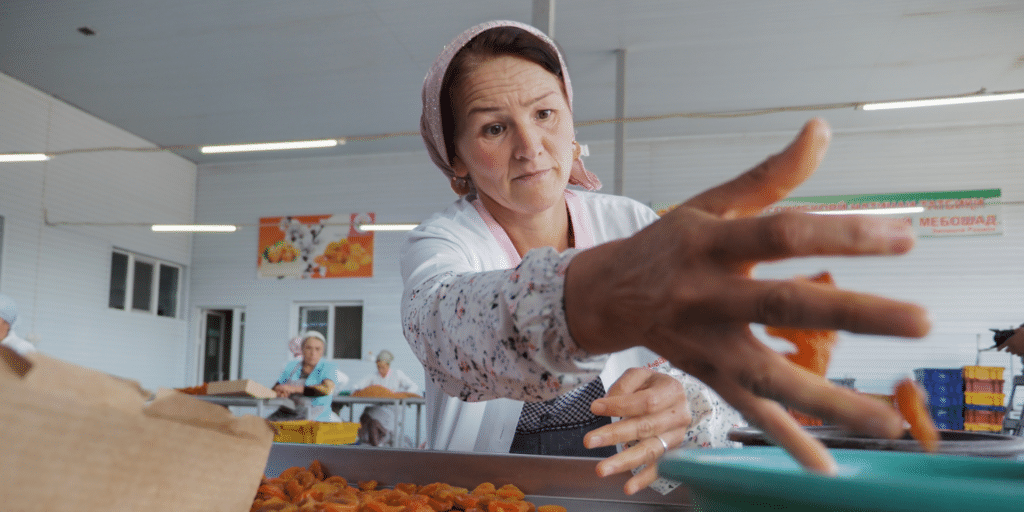
For Ikhtiyor Alimov, finding foreign buyers was only part of the challenge. His dried-fruit business in northern Tajikistan also needed enough equipment to fill its orders. Alimov founded Mevai Zarrin in Isfara with eight workers and handmade machinery. Its processing capacity eventually reached 200 kilograms a day, but manual production limited further growth. With the support of the United Nations Development Programme (UNDP), the company upgraded its equipment and packaging. It can now process 600–650 kilograms daily, according to the organization’s account of its development. “We were able to reduce our product waste by 20%,” Alimov said in UNDP’s regional account of the program. Across Central Asia, small producers face similar difficulties. Processing a harvest before selling it can increase producers’ earnings, but expansion requires investment that many family businesses struggle to afford. The Finland-funded Aid for Trade initiative, implemented by the UNDP, is closing after more than 15 years of work across Kyrgyzstan, Tajikistan, and Uzbekistan. UNDP and Kyrgyzstan’s Ministry of the Economy presented results in Bishkek on September 24, discussing which forms of support should continue beyond 2026. In Tajikistan, UNDP reported that the initiative helped create 147 jobs, including 90 for women since 2022. At Mevai Zarrin, support depended partly on buying fruit from local farmers and connecting producers in southern Tajikistan with processors in the north. The company signed contracts with ten farming households in Khatlon, securing supplies while giving growers another outlet for their harvests. Pooling smaller harvests can make deliveries large enough for a processor to buy. For farmers, those arrangements offer a route beyond nearby markets without requiring each household to become an exporter. Mevai Zarrin also obtained FSSC 22000 food safety certification to help it pursue new customers. In UNDP’s September profile, Alimov said the company had sent samples to prospective buyers in Germany and was awaiting their response. Processing the Harvest In Uzbekistan’s Andijan region, Dildora Nurmatova’s family business, ErElDi, has increased its profits by processing peanuts. Nurmatova began investigating the crop during her agricultural studies. By 2024, her enterprise was harvesting five metric tons from one hectare. According to UNDP’s regional retrospective, selling processed snacks rather than raw peanuts tripled her profits. [caption id="attachment_57615" align="aligncenter" width="1920"] Dildora Nurmatova in her peanut field in Uzbekistan’s Andijan region. Image: Elyor Nemat, UNDP Uzbekistan[/caption] Aid for Trade supplied processing and packaging equipment, alongside a separate workshop and a three-phase electricity connection. Business advice helped the family develop products and organize production. The company supplies packaged peanuts to Andijan’s wholesale market. Lower-grade kernels go into milled products for bakeries and ice-cream producers, giving the family a market for material that cannot be sold as premium snacks. ErElDi’s customers are close to home. The family can earn more from its harvest by doing the processing itself, before it considers the costs of finding buyers abroad. In Kyrgyzstan, UNDP reported that the project contributed to 837 new jobs, including 548 for women, and supported export contracts worth $17.1 million since 2022. [caption id="attachment_57610" align="aligncenter" width="2400"] Beekeepers...

