• KGS/USD = 0.01144 0%
  • KZT/USD = 0.00205 0%
  • TJS/USD = 0.10608 0.19%
  • UZS/USD = 0.00008 0%
  • TMT/USD = 0.28490 0%
  • KGS/USD = 0.01144 0%
  • KZT/USD = 0.00205 0%
  • TJS/USD = 0.10608 0.19%
  • UZS/USD = 0.00008 0%
  • TMT/USD = 0.28490 0%
  • KGS/USD = 0.01144 0%
  • KZT/USD = 0.00205 0%
  • TJS/USD = 0.10608 0.19%
  • UZS/USD = 0.00008 0%
  • TMT/USD = 0.28490 0%
  • KGS/USD = 0.01144 0%
  • KZT/USD = 0.00205 0%
  • TJS/USD = 0.10608 0.19%
  • UZS/USD = 0.00008 0%
  • TMT/USD = 0.28490 0%
  • KGS/USD = 0.01144 0%
  • KZT/USD = 0.00205 0%
  • TJS/USD = 0.10608 0.19%
  • UZS/USD = 0.00008 0%
  • TMT/USD = 0.28490 0%
  • KGS/USD = 0.01144 0%
  • KZT/USD = 0.00205 0%
  • TJS/USD = 0.10608 0.19%
  • UZS/USD = 0.00008 0%
  • TMT/USD = 0.28490 0%
  • KGS/USD = 0.01144 0%
  • KZT/USD = 0.00205 0%
  • TJS/USD = 0.10608 0.19%
  • UZS/USD = 0.00008 0%
  • TMT/USD = 0.28490 0%
  • KGS/USD = 0.01144 0%
  • KZT/USD = 0.00205 0%
  • TJS/USD = 0.10608 0.19%
  • UZS/USD = 0.00008 0%
  • TMT/USD = 0.28490 0%
18 February 2026

Viewing results 1 - 6 of 13

EDB Forecasts Strong Economic Growth in 2026 for Kazakhstan, Kyrgyzstan, Tajikistan, and Uzbekistan

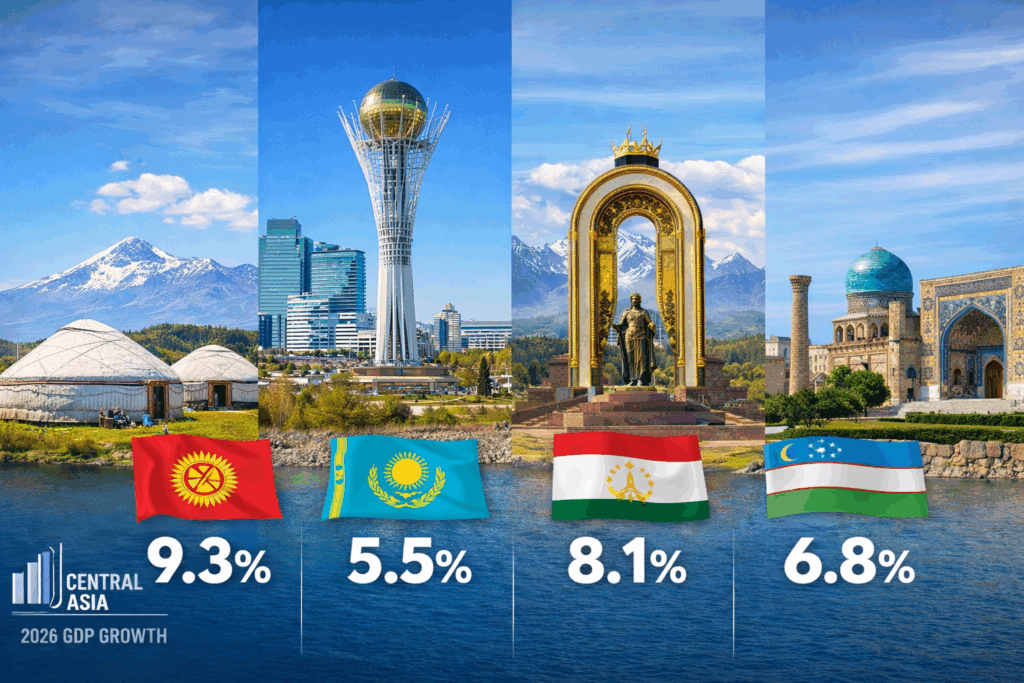
On December 18, the Eurasian Development Bank (EDB) published its Macroeconomic Outlook for 2026-2028, reviewing recent economic developments and offering projections for its seven member states: Armenia, Belarus, Kazakhstan, Kyrgyzstan, Russia, Tajikistan, and Uzbekistan. According to the report, aggregate GDP growth across the EDB region is forecast to reach 2.3% in 2026. Kyrgyzstan (9.3%), Tajikistan (8.1%), Uzbekistan (6.8%), and Kazakhstan (5.5%) are expected to remain the region’s fastest-growing economies. After two years of rapid expansion, the region’s GDP growth is set to moderate to 1.9% in 2025, down from 4.5% in 2024, mainly due to a slowdown in Russia’s economy. Although lower oil prices are expected to reduce export revenues for energy exporters such as Kazakhstan and Russia, the impact on overall growth will be limited. Meanwhile, net oil importers, including Armenia, Belarus, Kyrgyzstan, Tajikistan, and Uzbekistan, will benefit from improved terms of trade and reduced inflationary pressure. High global gold prices will support foreign exchange earnings for key regional exporters, including Kyrgyzstan, Tajikistan, and Uzbekistan. The report also notes a gradual decline in the U.S. dollar’s share in central bank reserves across the region, though its role in international settlements remains stable. Kazakhstan Kazakhstan’s economy is projected to grow by 5.5% in 2026, supported by the implementation of the National Infrastructure Plan and the state program “Order for Investment,” which are expected to cushion the effects of lower oil prices. Growth in non-commodity exports will also play a stabilizing role. Inflation is forecast to decline to 9.7% by the end of 2026, after peaking early in the year due to a value-added tax (VAT) increase. The average tenge exchange rate is expected to be KZT 535 per U.S. dollar, underpinned by a high base interest rate and rising export revenues. Kyrgyzstan Kyrgyzstan is forecast to lead the region in GDP growth at 9.3% in 2026, driven by higher investment in transport, energy, water infrastructure, and housing construction. Inflation is expected to ease to 8.3%, although further declines will be constrained by higher tariffs and excise taxes. The average exchange rate is projected at KGS 89.2 per U.S. dollar, supported by robust remittance inflows and high global gold prices, gold being the country’s main export commodity. Tajikistan Tajikistan is projected to maintain high GDP growth of 8.1% in 2026, fueled by capacity expansion in the energy and manufacturing sectors, along with rising prices for gold and non-ferrous metals. Inflation is expected to reach 4.5% by year-end. The somoni is expected to remain stable, with an average exchange rate of TJS 9.8 per U.S. dollar, supported by growth in exports and remittances. Uzbekistan Uzbekistan’s economy is forecast to expand by 6.8% in 2026, sustained by strong investment activity and favorable gold prices. Inflation is projected to decline to 6.7%, helped by tight monetary policy and a stable exchange rate. The average soum exchange rate is expected to be UZS 12,800 per U.S. dollar, supported by high remittances and increased metal exports.

ACRA Raises Kazakhstan Economic Growth Forecast

The Analytical Credit Rating Agency (ACRA) has released its updated forecast for Kazakhstan’s economy for 2026-2028, projecting annual growth of 5.3-5.9%. These figures exceed the government’s recent targets. According to the published report, the next three years will mark a period of accelerated expansion, driven by industry and construction, alongside strengthening value chains in services and agribusiness. The government's earlier forecast projected GDP growth of 5.4% in 2026, followed by stabilization at 5.3%. While ACRA offers a more optimistic outlook, it notes that achieving the targeted 6% growth will require a sharp increase in investment activity and a boost in foreign exchange earnings from exports. The agency also warns that accelerating growth may carry the risk of economic overheating and a new wave of inflation. Investment remains the weak link in Kazakhstan’s growth model. From 2021 to 2025, investment accounted for only 15% of GDP, significantly lower than in comparable economies and previous periods of rapid expansion. For example, during 2010-2014, investment levels held at 18%, and in earlier years, they reached as high as 20-22%. Without restoring higher investment levels, sustaining growth above 5.5% could prove difficult. Inflation risks also remain elevated. Contributing factors include household inflation expectations, imported inflation from neighboring countries, accelerated lending, and rising global food prices. Nevertheless, ACRA forecasts inflation to decline from 11.8% in 2025 to 8% in 2026, 6.2% in 2027, and 5.1% in 2028. The tenge is expected to gradually weaken to 555 per $ in 2026, 574 in 2027, and 594 in 2028. ACRA highlights three major risks over the next three years. The first is export and logistics vulnerabilities. Kazakhstan’s primary oil export route continues to run through Novorossiysk, and any disruption along this corridor would quickly impact the current account and put downward pressure on the tenge. The second risk concerns fiscal discipline. Rising expenditures are increasing reliance on transfers from the National Fund, which could reignite inflationary pressures if not managed prudently. The third is the depreciation of the Russian ruble. A weaker ruble boosts imports, reduces exports, and worsens Kazakhstan’s trade balance. While ACRA considers the likelihood of these risks occurring simultaneously to be low, their combined impact could seriously challenge Kazakhstan’s growth outlook. As previously reported by The Times of Central Asia, President Kassym-Jomart Tokayev expects Kazakhstan’s GDP to grow by 6% in 2025, surpassing the $300 billion threshold for the first time.

IMF: Uzbekistan’s Economy Strong but Reforms Needed to Sustain Momentum

Uzbekistan’s economy remains robust, supported by strong domestic demand, high gold prices, and rising investment, according to the International Monetary Fund (IMF). The assessment was released in an end-of-mission statement following an IMF staff visit to Tashkent from November 17 to 25, led by Yasser Abdih. The IMF reported that real GDP grew by 7.6% year-on-year in the first nine months of 2025, driven by buoyant household consumption and increased investment. Despite sustained demand, inflation has moderated. Headline inflation fell to 7.8% in October, while core inflation eased to 6.6%. This slowdown, the IMF noted, reflects the diminishing impact of last year’s administrative energy price adjustments, a firmer exchange rate, and continued tight monetary policy. Household lending grew rapidly, up 23% in September, though business lending rose more modestly. The external current account deficit narrowed significantly in the first half of 2025, bolstered by high global gold prices, a strong performance in non-gold exports, and steady remittance inflows. International reserves remain “ample,” covering roughly 12 months of projected imports. The IMF forecasts GDP growth to exceed 7% in 2025, tapering to around 6% in 2026. Inflation is expected to gradually decline toward the Central Bank of Uzbekistan’s 5% target by the end of 2027. Overall, the economic outlook is “broadly positive,” with risks described as “largely balanced.” However, the IMF cautioned that stronger-than-expected revenues, particularly from gold exports, could lead to excessive government spending. To avoid overheating the economy, it advised limiting new expenditures, curbing real exchange rate appreciation, and reducing exposure to gold price volatility. The Uzbek government has reaffirmed its commitment to keeping the fiscal deficit below 3% of GDP in both 2025 and 2026. The mission urged authorities to broaden the tax base and raise the tax-to-GDP ratio. It welcomed the government’s planned medium-term revenue strategy and ongoing reforms to reduce the shadow economy and modernize the Tax Committee. Key recommendations include restricting new tax incentives, enhancing audit systems, and publishing annual tax expenditure reports to improve transparency. On monetary policy, the IMF stressed the need to maintain a tight stance to drive inflation down. The Central Bank of Uzbekistan has held its policy rate at 14% since March. The IMF welcomed the country’s move toward greater exchange rate flexibility, introduced in April. The Fund also called for acceleration of financial sector reforms, including phasing out directed and preferential lending programs. It urged the finalization of a comprehensive roadmap to implement the 2025 Financial Sector Assessment Program recommendations. Structural reforms remain critical to sustaining long-term growth. The IMF emphasized the need to continue privatizing and restructuring major state-owned enterprises, improve governance, strengthen market competition, and prepare for World Trade Organization accession, targeted for March 2026. The IMF concluded the mission by thanking Uzbek authorities for their cooperation, noting that the visit will not result in a formal Board discussion. A year earlier, the IMF delivered similarly upbeat projections for Uzbekistan, citing 6.4% GDP growth in the first half of 2024, rising remittances, and solid reserves. However, it...

Kazakhstan Factories Under Strain as Costs Bite, Economy Shows Mixed Signals

Kazakhstan’s manufacturing sector slipped further in August, with the latest Purchasing Managers’ Index (PMI) falling to 47.9. That was down from 49.9 in July and 49.7 in June, keeping the index below the neutral 50 mark for a third straight month. It also marked the sharpest deterioration in manufacturing activity since March 2022, according to S&P Global and Freedom Holding Corp. From Highs to Lows The striking downturn comes on the heels of a banner year. In December 2024, the PMI reached a record 53.9, capping 11 straight months of expansion. Buoyed by post-pandemic recovery and government support, manufacturing output grew by 6.8% in 2024, the fastest pace since 2011, helping push GDP growth to 5%. But momentum cooled as 2025 began. The PMI slipped to 51.5 in January, reflecting slower expansion after the year-end surge. By June and July, it hovered just under 50, signaling stagnation. Seasonal shutdowns for repairs in August contributed to weaker output, but analysts say the slide points to deeper structural pressures. [caption id="attachment_36026" align="aligncenter" width="1600"] Kazakhstan’s PMI peaked at 53.9 in December 2024 but slid steadily through 2025, falling into contraction territory below 50 by mid-year and hitting 47.9 in August — the sharpest deterioration since March 2022.[/caption] Orders Dry Up, Costs Rise The August report revealed broad-based weaknesses. New orders fell for the first time in 19 months, ending a growth streak that began in early 2024. The decline reflected lower demand from both domestic and export markets. With fewer orders, factories scaled back staffing and cut input purchases. At the same time, costs surged. A weak tenge and fuel inflation made imports more expensive, while logistics delays lengthened supplier delivery times. These pressures forced firms to raise output prices at a faster pace, risking competitiveness. “August saw another sharp decline in business activity in Kazakhstan’s manufacturing sector,” said Yerlan Abdikarimov of Freedom Finance Global, which partners with S&P on the survey. He cited weak demand, volatile commodity markets, rising costs, and currency and tax pressures. Taxes have indeed become a burden. A new code passed in mid-2025 raised the extraction royalties on metals, hitting downstream metallurgy. Inflation stood at 12.2% in August 2025, with the National Bank keeping its policy rate high at 16.5% in a bid to tame prices. That leaves financing costly for businesses, resulting in squeezed margins and thinning confidence. The August survey showed business confidence at its lowest since 2021. While firms still expect growth over the next year, their optimism is increasingly cautious. Industry Responses and Government Initiatives Some executives see hope in the government’s industrial policy. A $400 million cotton-to-textile cluster is under construction with Chinese partners in Turkestan, aiming to process domestic cotton into textiles at scale. Officials say the project, due to start production by late 2025, will create thousands of jobs and expand exports. Light industries, such as textiles and apparel, posted strong growth in the first half of 2025, with clothing up about 5.6% and textiles 5.7% according to official data. Chemicals...

Climate Study’s Dire Forecast Undermined by Faulty Uzbekistan Data

A widely publicized climate study predicting severe global economic losses from climate change is under scrutiny following the discovery of a critical data error involving Uzbekistan. As reported by The Washington Post on August 7, the error significantly skewed the study’s projections, prompting renewed debate over the reliability of economic modeling in climate science. Published in Nature in 2023, the original study warned that unchecked climate change could reduce global GDP by 19% by 2050 and by an alarming 62% by 2100, nearly three times higher than earlier forecasts. The study attracted substantial media attention and became the second-most-cited climate paper in 2024, according to CarbonBrief. Its projections were used by U.S. government agencies and the World Bank in financial planning. However, a new commentary in Nature, led by Solomon Hsiang, director of Stanford University’s Global Policy Laboratory, revealed that the study’s extreme forecasts were largely driven by distorted GDP data from Uzbekistan. Once researchers excluded Uzbekistan from the model, the projected global GDP losses dropped sharply from 62% to 23% by 2100, and from 19% to 6% by 2050. The flawed dataset suggested that Uzbekistan’s GDP plummeted by nearly 90% in 2000, then rebounded by over 90% in certain regions by 2010, figures inconsistent with historical records. According to the World Bank, Uzbekistan’s actual annual growth between 1980 and 2020 ranged between -0.2% and +7.7%. “These extreme swings warped the study’s model, creating the illusion that global GDP was far more sensitive to climate than it really is,” Hsiang told The Washington Post. The original study’s authors, based at Germany’s Potsdam Institute for Climate Impact Research, acknowledged the error but stood by their conclusions. After revising the Uzbekistan data and adjusting the model, they reduced their 2050 forecast from a 19% to a 17% GDP loss. “We’re grateful for the scrutiny,” said co-author Leonie Wenz of the Technical University of Berlin. “But the main conclusions still hold.” Still, critics argue that retroactive methodological adjustments raise concerns about scientific integrity. “Science doesn’t work by adjusting experiments to get the answer you want,” Hsiang cautioned. The incident highlights both the power and the fragility of large-scale climate modeling and the importance of validating every data point, regardless of a country's size.