
• KZT/USD = 0.00225
  • TJS/USD = 0.10820
  • UZS/USD = 0.00009
  • TMT/USD = 0.29760
  • KZT/USD = 0.00225
  • TJS/USD = 0.10820
  • UZS/USD = 0.00009
  • TMT/USD = 0.29760
  • KZT/USD = 0.00225
  • TJS/USD = 0.10820
  • UZS/USD = 0.00009
  • TMT/USD = 0.29760
  • KZT/USD = 0.00225
  • TJS/USD = 0.10820
  • UZS/USD = 0.00009
  • TMT/USD = 0.29760
  • KZT/USD = 0.00225
  • TJS/USD = 0.10820
  • UZS/USD = 0.00009
  • TMT/USD = 0.29760
  • KZT/USD = 0.00225
  • TJS/USD = 0.10820
  • UZS/USD = 0.00009
  • TMT/USD = 0.29760
  • KZT/USD = 0.00225
  • TJS/USD = 0.10820
  • UZS/USD = 0.00009
  • TMT/USD = 0.29760
  • KZT/USD = 0.00225
  • TJS/USD = 0.10820
  • UZS/USD = 0.00009
  • TMT/USD = 0.29760
28 September 2026

Viewing results 1 - 6 of 2

In Search of Immortality: A Journey Through the Land of Korkyt Ata

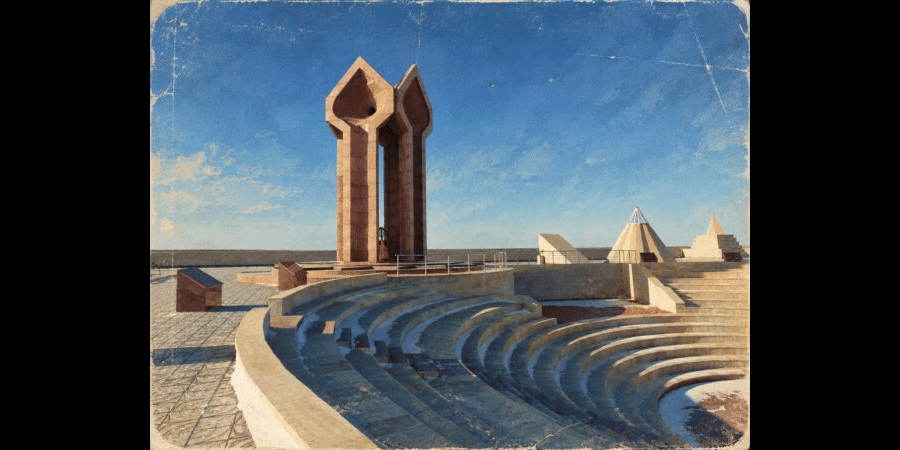
On the steppe near the Syr Darya, the wind itself plays the Korkyt Ata Memorial Complex. Passing through 40 metal pipes inside the monument, it produces a long, haunting sound intended to evoke the kobyz, a traditional bowed instrument closely associated with Korkyt Ata. The memorial stands in Karmakshy District of Kyzylorda Region, 18 kilometers northwest of the village of Zhosaly. Built in 1980 by architect Bek Ibrayev and physicist and acoustician Sovet Isatayev, the complex was extensively reconstructed in 2014. [caption id="attachment_56742" align="aligncenter" width="1538"] Korkyt Ata Memorial Complex[/caption] Korkyt Ata, known in other Turkic traditions as Dede Qorqud or Dede Korkut, is a legendary sage, musician, and storyteller. In Kazakh tradition, he is closely associated with the kobyz. [caption id="attachment_56777" align="aligncenter" width="1536"] The kobyz, a traditional bowed instrument associated with Korkyt Ata[/caption] In 2018, the epic culture, folk tales, and music associated with Korkyt Ata were added to UNESCO’s Representative List of the Intangible Cultural Heritage of Humanity following a joint nomination by Kazakhstan, Azerbaijan, and Turkey. UNESCO describes the tradition as comprising 12 heroic legends and 13 traditional musical compositions passed down through generations. The Kazakh version of this story has its own landscape: the banks of the Syr Darya. “According to legend, Korkyt learned that he was destined to die at the age of 40 and set out in search of a place where death could not reach him. He traveled through different lands, but wherever he went, he saw graves,” says journalist and tour guide Mira Zhakibayeva. [caption id="attachment_56751" align="aligncenter" width="1536"] Mira Zhakibayeva[/caption] Korkyt returned to the Syr Darya and made a kobyz from wood, camel skin, and horsehair. When he played, the world around him seemed to stand still. In folk memory, music became his answer to death: a person cannot live forever, but what they create can outlive them. The memorial’s architects translated the legend into metal and stone. Four vertical steles resemble a kobyz, while the metal pipes inside sound in the wind, making the monument seem to change its voice with the weather. Nearby are a museum, an amphitheater, and the so-called Pyramid of Wishes. Visitors circle the structure before entering to make a wish. The museum offers a closer look at the tradition of the kui. In Kazakh culture, a kui is an instrumental composition traditionally associated with a story, mood, or image. Korkyt is considered one of the earliest figures in the kobyz kui tradition. The landscape around the memorial preserves much older layers of history. [caption id="attachment_56774" align="aligncenter" width="1774"] Archaeological finds from ancient Zhankent[/caption] Not far away lies Zhankent, also known as Yangikent, a medieval city in the lower reaches of the Syr Darya. It is closely connected with the history of the Oghuz, a confederation of Turkic tribes that played an important role in Central Asia in the early Middle Ages. Zhankent stood along routes connecting Central Asia’s agricultural oases with the Eurasian steppe. Archaeological excavations have uncovered residential quarters and evidence of irrigation and metalworking. “It is...


The Taliban’s Border Rhetoric: Pashtun Frontiers, Not Central Asian Borders

Two incidents in mid-October reignited debate over Afghanistan’s borders, particularly its long-disputed frontier with Pakistan. On October 18, Mohammad Nabi Omari, Afghanistan’s first deputy minister for interior affairs, suggested that Afghanistan’s “historical lands” now in Pakistan could one day return to Afghan control. The next day, Qatar’s Ministry of Foreign Affairs referred to “ending tensions on the Afghanistan–Pakistan border” in a ceasefire statement, prompting Taliban objections and a quick retraction. These remarks revived a longstanding Afghan grievance: the Durand Line, a frontier drawn in 1893 by the British between Afghanistan and British India. No Afghan government has ever recognized it as an international border, and the Taliban refers to it as an “imaginary line.” The Taliban’s language may alarm some observers who wonder whether such rhetoric could extend beyond Pakistan to Afghanistan’s northern borders with Central Asia. Those frontiers were defined in the 19th century by treaties between the Russian and British empires, with little Afghan involvement. Yet despite the heated language and recent armed clashes with Pakistan, the Taliban’s stance appears more ideological than expansionist. The Durand Agreement of 1893 established the boundary between Afghanistan and British India as a line separating their respective spheres of influence. When Pakistan gained independence in 1947, that line became an international border, recognized by all states except Afghanistan. The 2,600-kilometer frontier divided Pashtun and Baloch communities between two countries, leaving deep resentment that continues to shape tensions in the region. Pashtuns still move relatively freely across this rugged border, which has served as a haven for militants for decades. Afghanistan’s northern borders tell a slightly different story. They were drawn not by Afghan rulers but under the Anglo-Russian Agreement of 1873, which set the Amu Darya River as the boundary between the Russian and British spheres of influence. This arrangement confirmed Afghanistan’s authority over the lands south of the river, including Balkh, Kunduz, and Badakhshan, reinforcing both its territorial control and its legitimacy. In essence, the demarcation of Afghanistan’s northern boundary was a political gain. While the Durand Line came to represent partition and loss, the 1873 agreement brought Afghanistan new territory and legitimacy as a buffer state between the Russian and British empires. The north is largely inhabited by Uzbeks, Tajiks, and Turkmen, with few Pashtuns. This distinction helps explain why the Taliban’s references to “historic lands” focus on the Durand Line rather than Afghanistan’s borders with Central Asian states. Afghanistan’s acting defense minister, Mawlawi Mohammad Yaqoob Mujahid, the son of the Taliban’s late founder Mullah Mohammad Omar, recently reiterated that “[the Durand Line] has never been recognized as an official border, and no agreement has been made on this issue.… This is not a decision any government can make; it is a matter for the people.” Deputy Interior Minister Mohammad Nabi Omari’s call for the “return” of historic lands reflects the same ideological stance: a vision of Pashtun unity shaped by popular will rather than a call for military action or unilateral political moves. The Taliban, a Pashtun-led movement, uses...