
• KZT/USD = 0.00222
  • TJS/USD = 0.10830
  • UZS/USD = 0.00008
  • TMT/USD = 0.29760
  • KZT/USD = 0.00222
  • TJS/USD = 0.10830
  • UZS/USD = 0.00008
  • TMT/USD = 0.29760
  • KZT/USD = 0.00222
  • TJS/USD = 0.10830
  • UZS/USD = 0.00008
  • TMT/USD = 0.29760
  • KZT/USD = 0.00222
  • TJS/USD = 0.10830
  • UZS/USD = 0.00008
  • TMT/USD = 0.29760
  • KZT/USD = 0.00222
  • TJS/USD = 0.10830
  • UZS/USD = 0.00008
  • TMT/USD = 0.29760
  • KZT/USD = 0.00222
  • TJS/USD = 0.10830
  • UZS/USD = 0.00008
  • TMT/USD = 0.29760
  • KZT/USD = 0.00222
  • TJS/USD = 0.10830
  • UZS/USD = 0.00008
  • TMT/USD = 0.29760
  • KZT/USD = 0.00222
  • TJS/USD = 0.10830
  • UZS/USD = 0.00008
  • TMT/USD = 0.29760
13 October 2026

Viewing results 1 - 6 of 2

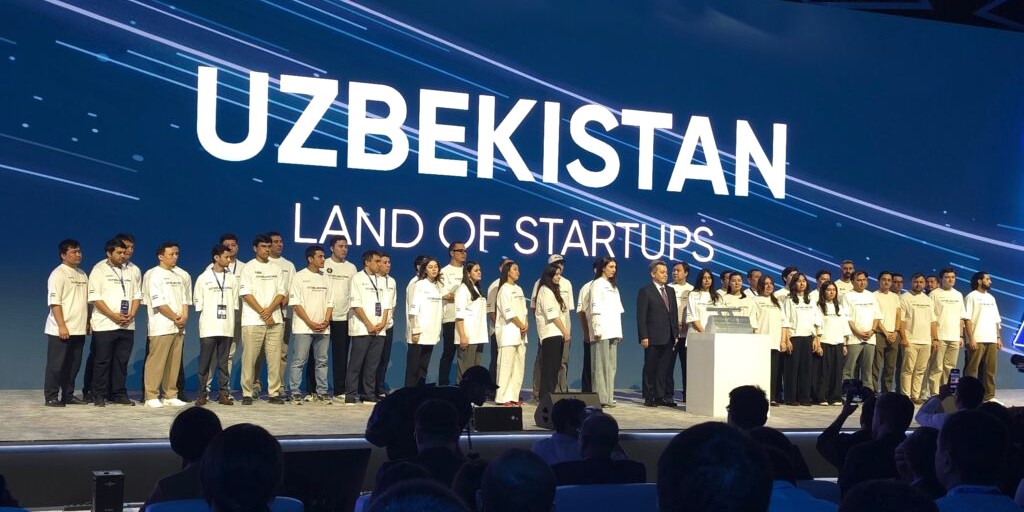
ICTWEEK Opens in Tashkent With Focus on AI and Foreign Investment

Thousands of technology executives, investors, startup founders, and government representatives have gathered in Tashkent for ICTWEEK Uzbekistan 2026, as Uzbekistan seeks to expand its technology sector and attract more foreign companies. The four-day event opened on September 22 at the Central Asian Expo Uzbekistan (CAEx) exhibition center and runs through September 25 under the theme “Land of Startups.” Organizers expect around 25,000 visitors. More than 2,000 participants from abroad, representing 70 countries, have already arrived in Uzbekistan to attend the event, according to Rustamjon Ozodjonov, head of global marketing at IT Park, Uzbekistan’s national technology hub, which supports startups and operates a residency program for IT companies. [video width="3840" height="2160" mp4="https://timesca.com/wp-content/uploads/2026/09/document_5303121082444720559.mp4"][/video] “As part of ICTWEEK, we expect B2B meetings, international forums, agreements, and strategic panel sessions,” Ozodjonov told The Times of Central Asia. Ozodjonov said young companies are presenting their projects to potential investors and partners at a dedicated Startup Alley. Artificial intelligence was one of the themes of the opening ceremony. The Bravo Orchestra first performed under the direction of an AI conductor named Timur, before conductor Alibek Kabdurakhmanov took over. Uzbekistan’s Minister of Digital Technologies Sherzod Shermatov used the experiment to question the role humans will play in the economy as AI develops. “Everyone is thinking about what will happen with AI. What will we humans do? I hope this conversation will be real and that people will still remain in demand,” Shermatov told the audience. He linked the issue to Uzbekistan’s young and growing population. The minister said he could not imagine a future in which “everything will be AI” and people are no longer needed. “The most important asset we have is human capital,” he added. Shermatov pointed to the expansion of higher education and digital skills programs, including One Million Coders and training in Python and artificial intelligence. He said Uzbekistan is also sending more young people to study at leading universities abroad. Another goal of ICTWEEK is to connect young professionals and startups directly with international companies and investors. Shermatov encouraged participants to learn foreign languages, particularly English, and use the event to find international partners. Uzbekistan is also seeking to attract more foreign technology companies. “More than a thousand foreign-owned companies are already residents of IT Park,” the minister said. IT Park is also expanding its network of overseas offices and representatives, including in the United States, Germany, South Korea, Saudi Arabia, and China. ICTWEEK also featured Enterprise Uzbekistan, a special legal jurisdiction for international technology companies. “Enterprise Uzbekistan is a territory based on the common law of England and Wales and provides a special jurisdiction for global technology companies,” Sultonmurod Rasulov, head of strategic partnerships at Enterprise Uzbekistan, told The Times of Central Asia. “Our goal is to create one of the best jurisdictions in the world, modeled on international financial centers but designed specifically for global technology.” According to Rasulov, Enterprise Uzbekistan aims to create a predictable legal environment for international technology companies and allow them to conduct business from Uzbekistan...


Uzbekistan Opens AI Data Centers and Signs Amazon Satellite Internet Deal

Uzbekistan’s state telecoms operator Uztelecom is expanding the country’s digital infrastructure with two new data centers, a satellite internet deal with Amazon, and a high-speed network designed to move large amounts of data between computing facilities. The projects were presented on September 22, the first day of ICTWEEK Uzbekistan 2026, the country’s largest technology week, which runs in Tashkent through September 25. [video width="1920" height="1080" mp4="https://timesca.com/wp-content/uploads/2026/09/document_5303308046666082166.mp4"][/video] The new data centers have opened in Bukhara and Kokand. They operate as part of the UzCloud platform and provide computing capacity to both government agencies and businesses. The facilities have servers with graphics processing units (GPUs) for training and running artificial intelligence models, machine learning, processing large datasets, and video analytics. Bukhara and Kokand are both more than 300 kilometers from Tashkent. Distributing computing capacity across different regions makes it possible to shift workloads to another site in the event of a failure. The designs of both data centers have received Tier III certification from the Uptime Institute. This confirms that the designs allow maintenance without interrupting operations. “We are expanding access to computing resources and artificial intelligence capabilities for the government and businesses,” Umar Izbasarov, Director of Uztelecom’s Department for Advanced Development and Investment Projects, said at ICTWEEK. Uztelecom has also signed an agreement with Amazon Leo, Amazon’s satellite internet network. UZ-SAT, a subsidiary of the Uzbek operator, will act as an authorized distributor of its services in Uzbekistan. Amazon Leo is a low-Earth-orbit satellite network being built out to include more than 3,000 satellites and designed to provide connectivity in areas where terrestrial networks are difficult or expensive to build. According to Uztelecom, its infrastructure currently covers 96% of Uzbekistan’s settlements, while its fiber-optic network extends for more than 378,000 kilometers. The satellite network is expected to complement it in remote areas and at industrial sites. “The partnership with Amazon Leo will allow us to expand connectivity in areas of the country where the use of traditional terrestrial infrastructure is limited,” UZ-SAT CEO Bakhrom Azimov said. Amazon’s satellite network would add another connectivity option for remote areas alongside fiber-optic and mobile networks. The announcement does not specify when services will become widely available to customers in Uzbekistan. The third project concerns how data is transferred between data centers. Uztelecom, together with Japan’s Toyota Tsusho, NTT DOCOMO BUSINESS, and NEC, is launching a pilot All-Photonics Network, or APN. The technology keeps data traveling as light for more of its journey, rather than repeatedly converting it into electrical signals. This can make connections faster and more energy-efficient. In the first phase, APN is expected to connect two Uztelecom data centers in the Tashkent region. The planned link is designed to provide bandwidth of up to 800 Gbps and latency of less than one millisecond. In 2027-2028, the network is expected to expand to the data centers in Bukhara and Kokand. “The growing needs of Uzbekistan’s economy require new data centers and network technologies capable of connecting them into a single high-performance system,” Izbasarov...