


How the Golden Horde Changed Eurasia: An Interview With Marie Favereau
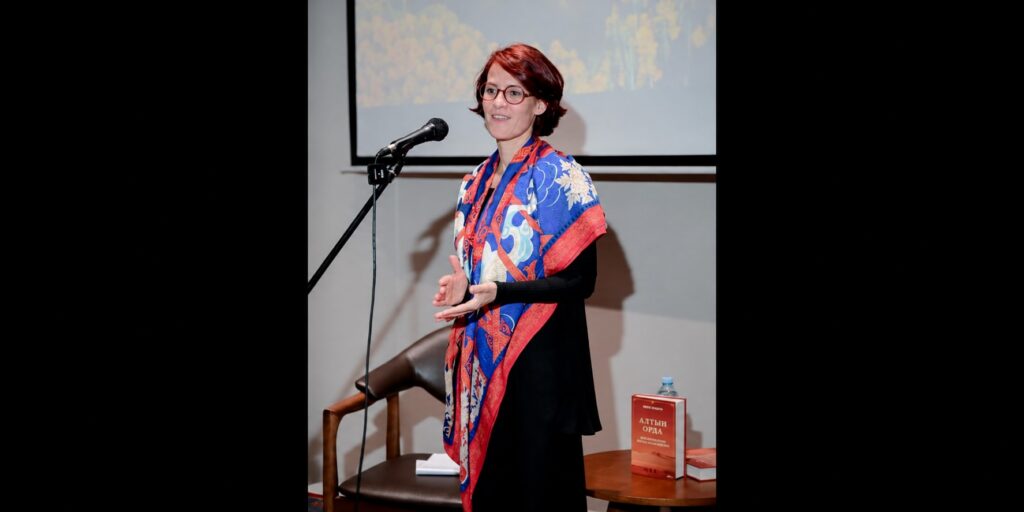
French historian Marie Favereau, a professor of medieval history at Paris Nanterre University, has spent more than two decades studying the Golden Horde and its place in Eurasian history. The Horde developed from territories assigned to Jochi, Genghis Khan’s eldest son. Her book, The Horde: How the Mongols Changed the World, challenges the familiar image of nomadic societies as forces of destruction. It describes a sophisticated political system in which nomadic rulers built and restored cities while maintaining complex economic and diplomatic relations. Favereau visited Kazakhstan for the launch of the book’s Kazakh translation, published by Steppe & World Publishing with support from the French Embassy. The 1,000-copy edition was presented at the National Academy of Sciences in Almaty and at Maqsut Narikbayev University in Astana. At Cassackia Art Space in Astana, Favereau spoke with The Times of Central Asia about why she views the movement of the Horde’s political center toward Central Asia as adaptation rather than decline and how new research is changing perceptions of its legacy in Kazakhstan. She describes Jochi as a figure who changed the Mongol Empire’s geopolitical order, while portraying the relationship between Golden Horde ruler Tokhtamysh and the Central Asian conqueror Timur, also known as Tamerlane, as more complicated than a simple conflict. TCA: How did you begin researching the Golden Horde? Marie Favereau: I started in Paris when I was a student. I was preparing my master’s thesis during my third year at the Sorbonne, one of the main universities in Paris. At that time, I suddenly learned about the Golden Horde, and it immediately caught my interest. I was studying several languages. I was learning Arabic, I already knew some Russian, and I had also started learning Turkish. So I thought, “Wow, this is a topic for me.” However, there were very few books available in French, so it was quite difficult to conduct research. My supervisor told me that I needed to travel to other countries because there was not enough material available in France. For my master’s thesis, I studied the sources of the Golden Horde, as well as Soviet scholarship and the way the Golden Horde was presented in Soviet historical works. That was the very beginning. It was more than twenty years ago. Since then, I have continued to discover new research interests, new sources, and new questions, and I am still working on the subject today. TCA: What difficulties did you encounter when working with historical sources? Favereau: There were several difficulties. One was language, and another was the different writing systems and scripts used in the sources. There was also a lack of academic supervision. When I was doing my master’s degree, I did not have someone who could consistently guide me in this field. Another challenge was that I had never been to Central Asia. I knew very little about the region. At that time, I did not have a clear image of the area in my mind, so I felt that I needed to travel there. But...
