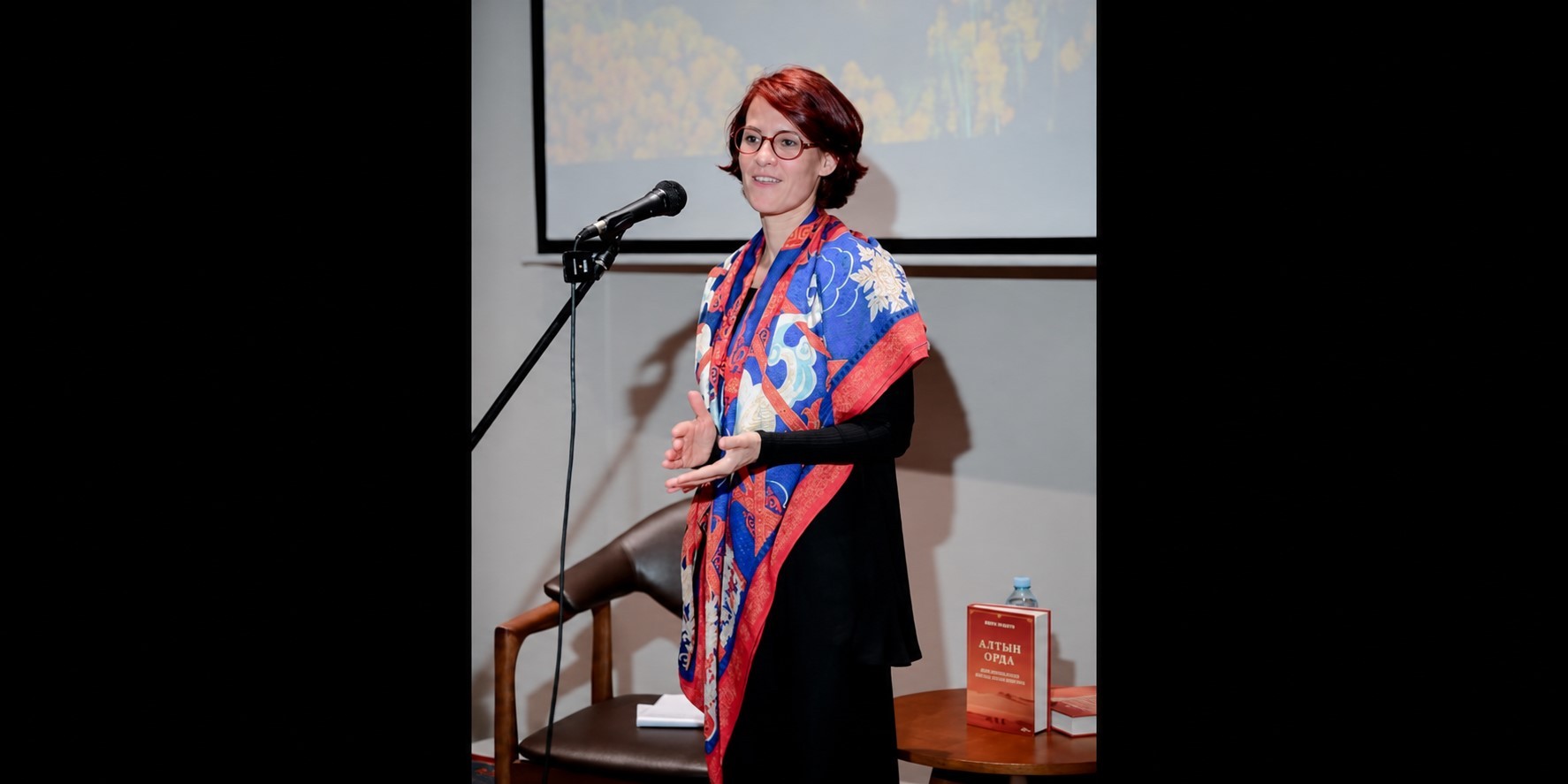
French historian Marie Favereau, a professor of medieval history at Paris Nanterre University, has spent more than two decades studying the Golden Horde and its place in Eurasian history. The Horde developed from territories assigned to Jochi, Genghis Khan’s eldest son. Her book, The Horde: How the Mongols Changed the World, challenges the familiar image of nomadic societies as forces of destruction. It describes a sophisticated political system in which nomadic rulers built and restored cities while maintaining complex economic and diplomatic relations.
Favereau visited Kazakhstan for the launch of the book’s Kazakh translation, published by Steppe & World Publishing with support from the French Embassy. The 1,000-copy edition was presented at the National Academy of Sciences in Almaty and at Maqsut Narikbayev University in Astana.
At Cassackia Art Space in Astana, Favereau spoke with The Times of Central Asia about why she views the movement of the Horde’s political center toward Central Asia as adaptation rather than decline and how new research is changing perceptions of its legacy in Kazakhstan. She describes Jochi as a figure who changed the Mongol Empire’s geopolitical order, while portraying the relationship between Golden Horde ruler Tokhtamysh and the Central Asian conqueror Timur, also known as Tamerlane, as more complicated than a simple conflict.
TCA: How did you begin researching the Golden Horde?
Marie Favereau: I started in Paris when I was a student. I was preparing my master’s thesis during my third year at the Sorbonne, one of the main universities in Paris. At that time, I suddenly learned about the Golden Horde, and it immediately caught my interest.
I was studying several languages. I was learning Arabic, I already knew some Russian, and I had also started learning Turkish. So I thought, “Wow, this is a topic for me.” However, there were very few books available in French, so it was quite difficult to conduct research.
My supervisor told me that I needed to travel to other countries because there was not enough material available in France. For my master’s thesis, I studied the sources of the Golden Horde, as well as Soviet scholarship and the way the Golden Horde was presented in Soviet historical works.
That was the very beginning. It was more than twenty years ago. Since then, I have continued to discover new research interests, new sources, and new questions, and I am still working on the subject today.
TCA: What difficulties did you encounter when working with historical sources?
Favereau: There were several difficulties. One was language, and another was the different writing systems and scripts used in the sources. There was also a lack of academic supervision. When I was doing my master’s degree, I did not have someone who could consistently guide me in this field.
Another challenge was that I had never been to Central Asia. I knew very little about the region. At that time, I did not have a clear image of the area in my mind, so I felt that I needed to travel there.
But in the end, this was also a very positive experience. I was lucky because traveling allowed me to develop a much better understanding of the region.
TCA: In your book, you discuss the concept of steppe organization. What does it mean?
Favereau: What is interesting is that people in the steppe were nomads, including people who held political power. The khan himself was a nomad. He did not necessarily choose to live permanently in cities.
At the same time, however, these rulers built cities and restored existing ones. We often have this image of nomads as people who simply conquered and destroyed cities. But the historical evidence shows that they also established and developed many settlements.
This is why I became interested in the relationship between nomadic societies and cities. They were interested in cities without necessarily becoming urban societies themselves.
There is also something very particular about cities built in the steppe. In Europe, cities developed in relatively limited spaces, often becoming densely concentrated. Central Asia, by contrast, is incredibly open and vast. As a result, steppe cities could be much more spacious and have very different sizes and structures.
TCA: How did the steppe environment shape Jochi’s leadership and his geopolitical role?
Favereau: We do not have a great deal of information about him, especially about his early life. He is sometimes presented positively in the sources, but the evidence is limited.
What we do know is that Jochi fundamentally changed the geopolitical structure of the Chinggisid Empire. He received a very important part of the empire: the northern territories, including northern Siberia and the vast lands extending toward Europe.
In my book, I also discuss the question of whether Jochi was or was not supposed to become the heir of Genghis Khan. But it is clear that, at least initially, Genghis Khan seems to have considered Jochi extremely important. He gave him significant territories, important populations, major responsibilities, and political leadership.
Today, historians are in a sense rehabilitating Jochi as a major historical figure. Batu Khan was already well known, but Jochi himself has become much better known through recent research. We increasingly recognize him as a key figure in the history of the Mongol and Jochid worlds.
TCA: European historiography has often portrayed the Golden Horde as barbaric. How does your book challenge this image?
Favereau: This was a problem I encountered at the beginning of my research. What I try to do in my book, and also in my lectures, is to present records and facts. It is not about having a personal opinion or simply saying that I like or appreciate the Golden Horde. Instead, we should look at the sources and the historical evidence.
When we do that, we can see that we are not dealing with barbarians. We are dealing with sophisticated states that had written documentation, complex economic relations, and developed systems of diplomacy.
When you present this evidence to people in Europe, they can understand the complexity of these societies. The important thing is to emphasize that these are historical facts, not simply personal opinions.
TCA: How important were the formation of Jochi’s realm and the organization of the steppe for the later history of Central Asia and the Kazakh steppe?
Favereau: One of the questions I faced while writing the final chapters of the book was how to explain the end of Mongol political power: the end of the Yuan dynasty, the end of the Ilkhanate state, and eventually the end of the Golden Horde.
But Jochid political traditions actually lasted much longer. In Crimea, they continued until the eighteenth century, and they also remained important in Central Asia.
My main point in the book is that we should understand this process as a shift rather than a decline.
The political center moved. It became more focused on Central Asia and less centered on the Volga region. This reflects a very nomadic understanding of geopolitics. The people of the steppe understood that the world around them was changing, and they adapted their own political organization accordingly. They left some cities behind, including Sarai in the Lower Volga region, while becoming increasingly active in territories that are part of Kazakhstan today.
There were many reasons for this transformation, including political, economic, geographical, and possibly climatic factors. But what I really wanted to emphasize in my book is that this should not necessarily be interpreted as a decline. Change is not necessarily decline.
TCA: Are you currently the only professor in France specializing specifically in the history of the Golden Horde?
Favereau: In France, there are several researchers who are interested in this broader area. We have very good scholars working on modern Kazakhstan, Central Asia, and Chagatai sources. But specifically in the history of the Golden Horde, particularly in teaching and research, I am currently the only professor specializing in the field.
I have students, and I am sure that in the future they will become better specialists than I am. But for the moment, yes, I am the only professor teaching the Golden Horde in France.
However, my book and my other publications also help my colleagues teach the subject. When you are a professor, you need teaching materials, so I can provide articles, PowerPoint presentations, and other resources. More and more scholars are now talking about the Golden Horde in their classrooms.
For me, that is probably the most important thing: the transmission of knowledge.
TCA: Does your book examine the Blue Horde and White Horde and the idea of conflict between them?
Favereau: Yes, of course. I discuss the Blue and White Horde, and I will also talk about it today. One important point is that we are talking about several different “horses,” not just one. We often have the idea that there was simply one Blue Horde and one White Horde, but the historical sources are more complicated. These terms were used over a long period of time, and their meanings could change.
I also wanted to show that these divisions do not necessarily represent conflicts or wars. They could also reflect a practical and intelligent way of living together.
The steppe is enormous. There is a lot of space, and there is space for everybody. So we should not automatically interpret these distinctions as evidence of constant fighting.
TCA: Historians continue to debate whether Genghis Khan was Jochi’s biological father. How do you approach this question?
Favereau: Yes, but I do not spend too much time on it. When I examine the sources, what I see is that Genghis Khan considered Jochi to be his eldest son.
Whatever questions there may have been about Jochi’s biological paternity, Genghis Khan never said, “This is not my son.” On the contrary, he consistently referred to Jochi as his eldest son. For me, that is the most important point.
And we should also remember that we do not have DNA evidence from that period. Perhaps one day we will know more through genetic research. But ideas of adoption, family, legitimacy, and respect were also important in that society.
So I take these aspects into consideration in my book rather than reducing the question simply to biological paternity.
TCA: What did you learn about the relationship between Tokhtamysh and Timur, two figures whose conflict reshaped Central Asia?
Favereau: Yes. I devoted an entire chapter to their relationship. I also studied this subject when I was a student because I found it fascinating.
At first, they seem to be allies, with Timur supporting Tokhtamysh. Then the relationship changes, and eventually they become opponents. Yet, toward the end of his life, Tokhtamysh returned to Timur.
For me, their relationship is very interesting. In some ways, it resembles a complicated relationship between a father and son, or perhaps between brothers. There are tensions and conflicts, but there is also a certain connection between them.
One thing I demonstrate in my book is that Timur did not simply destroy the Golden Horde. He attacked some important trading centers because he wanted to control trade and obtain revenues and resources. But he did not necessarily seek to destroy the Golden Horde completely. There was still a certain degree of respect.
This is particularly interesting in relation to Tokhtamysh. The fact that Tokhtamysh eventually went to Timur shows that their relationship was more complicated than simply being a conflict between two violent rulers.
There are still many things we do not know because so much of the evidence has been lost to the past. But I think we should understand their relationship as much more complex than simply “two men fighting.”
TCA: What can your book contribute to the study of Kazakh history and to Kazakh society?
Favereau: I think my book is one contribution among many others. Today, together with our colleagues in Kazakhstan, we are all working on the history of Ulus Jochi, and we are making progress. My book is just one step on a staircase. It is the result of my own research, but the research will continue.
I also learn a great deal from my Kazakh colleagues and from their new publications. They are currently publishing a major multi-volume history of Ulus Jochi, and this will certainly contribute to changing the field.
Archaeology is also extremely important. Archaeological discoveries can change our understanding of history completely. That is why research remains open. I see my book as just one small stone in a much larger building.
TCA: The book has been translated into several languages. Is that correct?
Favereau: Yes. The original book was written in English, and it has since been translated into more than ten languages. The first translation was into Chinese, and later it was also translated into Japanese, among other languages.
TCA: What does it mean to be a historian?
Favereau: Being a historian means having an important role in society because historians connect the past, the present, and the future. Of course, I study the past, but I am here today talking with you and with students, so that is the present. At the same time, we are thinking about future generations and about the future of our societies, whether in Kazakhstan, France, or elsewhere.
As historians, we connect all these different layers of time. I think that is something very specific to our profession.
We also have a responsibility toward society: the responsibility to transmit knowledge and to search for the truth. We have to work toward the truth, even when we do not like what we discover. If it is supported by the evidence, then it is the truth. We are scholars, and that is our responsibility.
It is hard work, but it is also very rewarding, especially in terms of human and intellectual fulfillment.
TCA: The French ambassador mentioned the nomadic postal service described in your book. How did it work?
Favereau: Yes. They developed what was called the yam, or jam, a postal and relay system connecting different parts of the empire. These relay stations were located between cities and across different territories, allowing people to travel and communicate over enormous distances.
Sometimes the stations were about thirty kilometers apart. This was particularly important in desert regions, where access to water was limited. At these stations, travelers could obtain fresh horses, food, and a place to rest.
However, the system was not open to everyone. You had to be an official, or perhaps a diplomat, and you needed some kind of authorization something comparable to a passport. The service was essentially provided free of charge to those who were authorized to use it.
This system was crucial for communication across such a vast territory. People often ask: “The empire was so enormous how did they communicate?” They did not have telephones, Google, or email. They had very good horses.