
• KGS/USD = 0.01143 0%
  • KZT/USD = 0.00205 0%
  • TJS/USD = 0.10433 0.1%
  • UZS/USD = 0.00008 0%
  • TMT/USD = 0.28577 0%
  • KGS/USD = 0.01143 0%
  • KZT/USD = 0.00205 0%
  • TJS/USD = 0.10433 0.1%
  • UZS/USD = 0.00008 0%
  • TMT/USD = 0.28577 0%
  • KGS/USD = 0.01143 0%
  • KZT/USD = 0.00205 0%
  • TJS/USD = 0.10433 0.1%
  • UZS/USD = 0.00008 0%
  • TMT/USD = 0.28577 0%
  • KGS/USD = 0.01143 0%
  • KZT/USD = 0.00205 0%
  • TJS/USD = 0.10433 0.1%
  • UZS/USD = 0.00008 0%
  • TMT/USD = 0.28577 0%
  • KGS/USD = 0.01143 0%
  • KZT/USD = 0.00205 0%
  • TJS/USD = 0.10433 0.1%
  • UZS/USD = 0.00008 0%
  • TMT/USD = 0.28577 0%
  • KGS/USD = 0.01143 0%
  • KZT/USD = 0.00205 0%
  • TJS/USD = 0.10433 0.1%
  • UZS/USD = 0.00008 0%
  • TMT/USD = 0.28577 0%
  • KGS/USD = 0.01143 0%
  • KZT/USD = 0.00205 0%
  • TJS/USD = 0.10433 0.1%
  • UZS/USD = 0.00008 0%
  • TMT/USD = 0.28577 0%
  • KGS/USD = 0.01143 0%
  • KZT/USD = 0.00205 0%
  • TJS/USD = 0.10433 0.1%
  • UZS/USD = 0.00008 0%
  • TMT/USD = 0.28577 0%

Viewing results 1 - 6 of 7

Kazakh Archaeologists Contribute to Landmark Discovery on the Origins of Dog Domestication

A groundbreaking study co-authored by Kazakh archaeologists has challenged long-held assumptions about the history of dog domestication. The research, titled “Wide Diversity of Dogs Thousands of Years Before Modern Breeding Methods,” was published in Science, the oldest scientific journal in the U.S. The study was led by researchers from the University of Exeter (UK) and France’s National Center for Scientific Research and included contributions from 40 institutions worldwide. Kazakh scientists V.K. Merz and I.V. Merz of Toraygyrov University, along with E.R. Usmanova and V.V. Varfolomeev of the E.A. Buketov Karaganda National Research University, were among the co-authors. The international team conducted a comprehensive comparative analysis of 643 dog and wolf skulls spanning the last 50,000 years from the Pleistocene to the present day. Using high-resolution 3D scanning, they analyzed over 600 specimens, revealing that dogs already displayed significant morphological diversity during the early Holocene epoch. This diversity, previously believed to be the result of 19th-century selective breeding, was shown to have originated far earlier. The analysis traced the emergence of distinct dog types, including variations in size and skull structure, as early as 11,000 years ago. By the Mesolithic and Neolithic periods, dogs had already begun to differ in form, likely reflecting specialized roles such as hunting, guarding, and herding within human societies. The researchers concluded that functional differentiation was a key driver in the development of what would eventually become distinct breeds. Their findings refute the common belief that modern breed variation is a relatively recent phenomenon. In fact, many differences in skull shape and size long predate the advent of formal breeding practices. Kazakhstan’s archaeological collections and local expertise played a significant role in the project, underscoring the country’s growing contributions to global archaeozoological research. Kazakhstan’s Broader Scientific Advances In addition to this landmark discovery, Kazakh scientists continue to make technological strides across disciplines. Researchers at the Institute of Combustion Problems have developed a device capable of converting hydrocarbon gases into 98.9% pure hydrogen and technical carbon in a single stage. Operating at plasma temperatures of up to 2,700°C, the unit requires no catalysts and consumes less energy than traditional methods. It also produces giant nanotubes with diameters reaching 100 nanometres. Meanwhile, scientists at Al-Farabi Kazakh National University have introduced a mobile preservation unit capable of drying and storing a wide range of food products from fruit to fish for up to 10 to 50 years using specialized packaging. These developments signal Kazakhstan’s expanding role in cutting-edge research and innovation across multiple scientific domains.
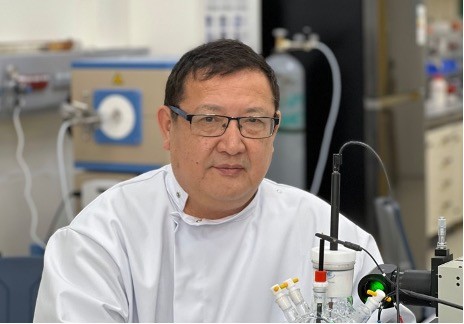
Meet Nurxat Nuraje, One of Kazakhstan’s Most Impressive Scientists

Nurxat Nuraje is a Kazakh scientist who is now well known in the global scientific community. He has spent more than two decades studying and conducting research in the United States. Drawn to science from an early age, he earned his PhD in chemistry from the City University of New York in 2008, successfully launching his research career. His main field of research is nanotechnology and its applications. At a time when nanoscience was still emerging, his bold approach to the subject quickly gained recognition. His first major publication was in the Journal of the American Chemical Society – one of the world’s leading chemistry journals. The paper introduced innovative ideas about nanocircuit fabrication, methods and challenges in their development, computational power, and potential applications. This paper was considered a major contribution to the field at the time. Soon after, he joined the Massachusetts Institute of Technology (MIT), one of the world’s foremost technology universities, as a postdoctoral researcher. There, he succeeded in finding ways to increase computer storage capacity, which is a crucial question for modern computing. His research on the development and application of specific nanoparticles was published in Advanced Materials, once again establishing his name in global science. His work was later awarded a silver medal at the International Materials Research Society conference in San Francisco. “Science doesn’t deliver results overnight. It evolves gradually,” says Nuraje. “The true mission of a scientist is to reshape the world’s thinking through discovery. In the future, we must move from oil to hydrogen energy. That is the energy of tomorrow.” Since 2013, Nuraje has worked as a research scientist at MIT. He is also credited with developing conductive polymer nanoparticles, which are now widely used. Together with his students, he continues to design and create practical, everyday-use technologies. In 2015 he received the Joseph Award for his outstanding contribution to nanotechnology. He became the first Kazakh scientist to win this American honor. Why did MIT invite him to join their team? The answer lies in his PhD dissertation, which was recognized by experts as one of the best in the field. Harvard University, the University of California, and MIT each offered him postdoctoral positions. One of Nuraje's remarkable achievements was the development of anti-fogging materials – the kind used on smartphone screens today. Working with MIT professor Angela Belcher, he co-created a new type of photocatalytic material through genetic engineering of the M13 virus. This groundbreaking work was published in Advanced Materials in 2012 and resulted in five international patents. This is a true testament to the Kazakh proverb: “Knowledge conquers all.” In 2015, he joined Texas Tech University as a professor of chemical engineering, where he established his own research laboratory, The Nurxat Nuraje Lab. There, his team developed solar-powered water-splitting technology to produce hydrogen. His breakthroughs in conductive polymers earned him the American Chemical Society’s Petroleum Research Award in 2016. In the following years, he was named “Most Distinguished Scientist” at Texas Tech University, and in 2018, the...

Kazakh Scientists Unveil Facility Capable of Preserving Agricultural Products for 50 Years

Researchers at Al-Farabi Kazakh National University have developed a mobile unit capable of processing and storing agricultural products for up to 50 years. The unit, named “Dayar 20,” utilizes freeze-drying technology and is designed to be transported directly to fields and orchards, an essential advantage for remote agricultural operations. Takeaway Food with a Half-Century Shelf Life The underlying technology is lyophilization, which involves removing water from frozen products by evaporation under low pressure. The process allows food to retain its taste, color, aroma, shape, and nutritional content. “Products dried using the Dayar 20 unit remain usable for a long time, retaining their taste, color, smell, shape, and vitamins,” said project manager Yerbol Ikhsanov, PhD in chemistry. The unit can process a variety of goods, including fruits, vegetables, meat, dairy products, and ready-to-eat meals. Shelf life ranges from three years at room temperature to 10 to 50 years when vacuum-sealed. The innovation is expected to improve the sustainability of Kazakhstan’s agricultural sector and enhance its export potential. Breakthrough in Hydrogen Production This is not the only recent scientific achievement in Kazakhstan. Researchers at the Institute of Combustion Problems have developed a reactor that decomposes hydrocarbon gases into hydrogen and carbon using low-temperature plasma, without the need for catalysts and with minimal energy input. Inside the plasma reactor, gases are heated to temperatures between 1,800 and 2,700°C, triggering pyrolysis. The result is hydrogen with a purity of up to 98.9% and technical carbon. Notably, scientists also identified giant carbon nanotubes, up to 100 nanometers in diameter, within the by-product. These nanotubes are considered a promising material for super-strong fibers and composites, far exceeding typical size expectations under normal conditions. The method offers nearly 100% efficiency in hydrocarbon recycling and significantly accelerates hydrogen production. Kazakh Anti-Cancer Drug Shows Early Promise In another separate development, Kazakh scientists have made progress on an anti-cancer drug that has yielded promising results in early clinical trials. Dos Sarbasov, Vice President of the National Academy of Sciences, reported that tumor growth had ceased in six patients and shrunk by 30% in one case. “After the first dose of the drug, the condition of fifteen cancer patients stabilized, and in six of them, the tumor stopped growing,” Sarbasov said. The drug targets cells that actively absorb glucose and has shown no signs of toxicity. Clinical testing began two years ago and has already passed two phases. The trials, conducted at the Kazakh Institute of Oncology and Radiology, are expected to conclude within the next two to three years. The drug has received international patent protection.
