


In Search of Immortality: A Journey Through the Land of Korkyt Ata
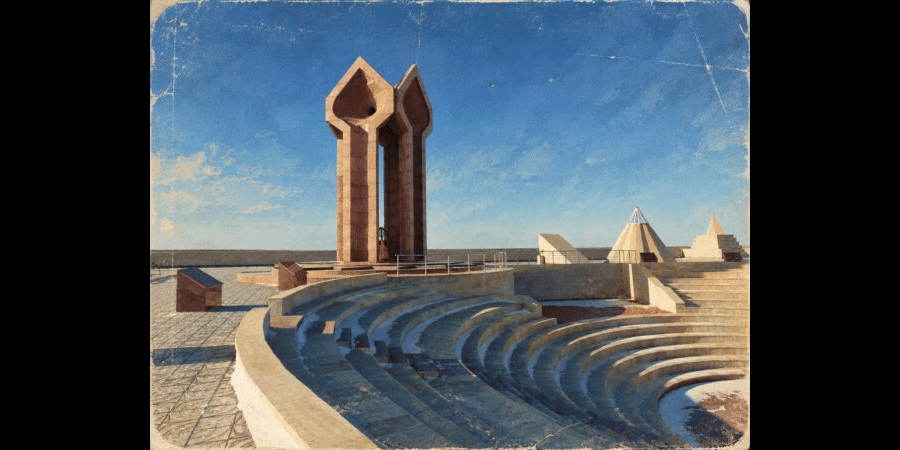
On the steppe near the Syr Darya, the wind itself plays the Korkyt Ata Memorial Complex. Passing through 40 metal pipes inside the monument, it produces a long, haunting sound intended to evoke the kobyz, a traditional bowed instrument closely associated with Korkyt Ata. The memorial stands in Karmakshy District of Kyzylorda Region, 18 kilometers northwest of the village of Zhosaly. Built in 1980 by architect Bek Ibrayev and physicist and acoustician Sovet Isatayev, the complex was extensively reconstructed in 2014. [caption id="attachment_56742" align="aligncenter" width="1538"] Korkyt Ata Memorial Complex[/caption] Korkyt Ata, known in other Turkic traditions as Dede Qorqud or Dede Korkut, is a legendary sage, musician, and storyteller. In Kazakh tradition, he is closely associated with the kobyz. [caption id="attachment_56777" align="aligncenter" width="1536"] The kobyz, a traditional bowed instrument associated with Korkyt Ata[/caption] In 2018, the epic culture, folk tales, and music associated with Korkyt Ata were added to UNESCO’s Representative List of the Intangible Cultural Heritage of Humanity following a joint nomination by Kazakhstan, Azerbaijan, and Turkey. UNESCO describes the tradition as comprising 12 heroic legends and 13 traditional musical compositions passed down through generations. The Kazakh version of this story has its own landscape: the banks of the Syr Darya. “According to legend, Korkyt learned that he was destined to die at the age of 40 and set out in search of a place where death could not reach him. He traveled through different lands, but wherever he went, he saw graves,” says journalist and tour guide Mira Zhakibayeva. [caption id="attachment_56751" align="aligncenter" width="1536"] Mira Zhakibayeva[/caption] Korkyt returned to the Syr Darya and made a kobyz from wood, camel skin, and horsehair. When he played, the world around him seemed to stand still. In folk memory, music became his answer to death: a person cannot live forever, but what they create can outlive them. The memorial’s architects translated the legend into metal and stone. Four vertical steles resemble a kobyz, while the metal pipes inside sound in the wind, making the monument seem to change its voice with the weather. Nearby are a museum, an amphitheater, and the so-called Pyramid of Wishes. Visitors circle the structure before entering to make a wish. The museum offers a closer look at the tradition of the kui. In Kazakh culture, a kui is an instrumental composition traditionally associated with a story, mood, or image. Korkyt is considered one of the earliest figures in the kobyz kui tradition. The landscape around the memorial preserves much older layers of history. [caption id="attachment_56774" align="aligncenter" width="1774"] Archaeological finds from ancient Zhankent[/caption] Not far away lies Zhankent, also known as Yangikent, a medieval city in the lower reaches of the Syr Darya. It is closely connected with the history of the Oghuz, a confederation of Turkic tribes that played an important role in Central Asia in the early Middle Ages. Zhankent stood along routes connecting Central Asia’s agricultural oases with the Eurasian steppe. Archaeological excavations have uncovered residential quarters and evidence of irrigation and metalworking. “It is...
