Inside a Universe of Culture at the World Nomad Games
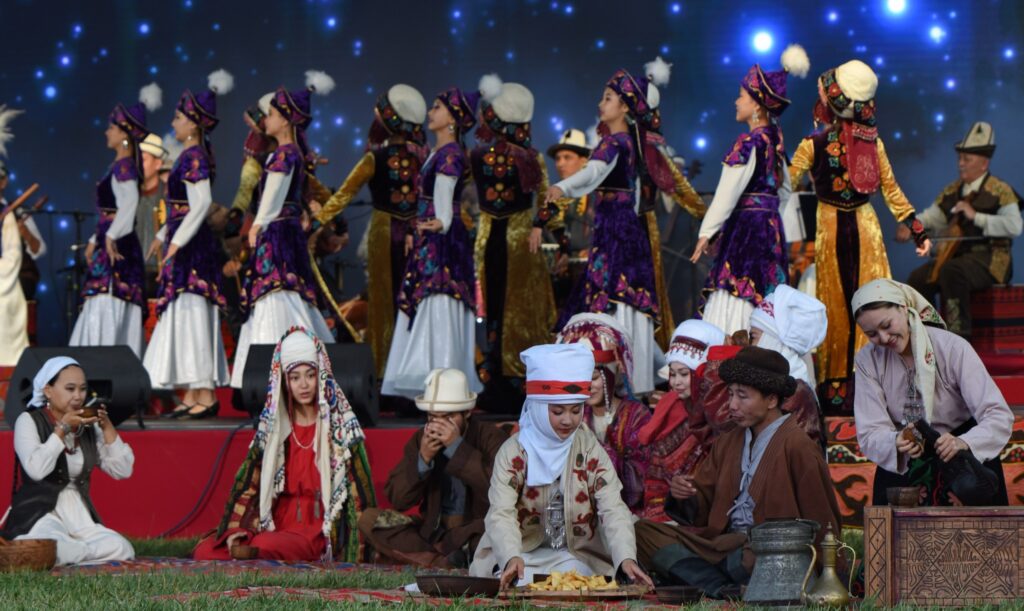
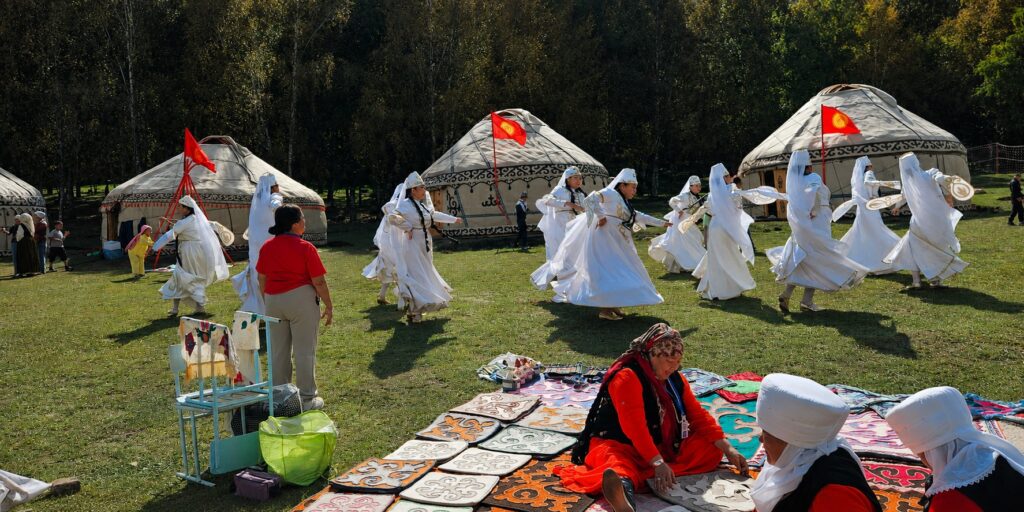
Of all the sites at the 6th World Nomad Games in Kyrgyzstan, the “Universe of Nomads” ethno-town is arguably the most interesting. Its setting is Kyrchyn jailoo, a large summer pasture in Semenov Gorge, where the forested slopes of the Kungey Ala-Too Mountains rise around it. The location feels far removed from the largely sports-specific venues in Cholpon-Ata, including the Kok Boru Arena, the Hippodrome, and the Gazprom Sports and Recreation Complex. Getting there takes around an hour from Cholpon-Ata on marshrutkas, minivans used as tourist shuttles, and the journey is often chaotic, with passengers packed head-to-hip. Those who make the journey find stunning scenery, an abundance of culture, and indeed sport, including some of the event’s more unusual tournaments. Among them is spine-bone breaking, a very literal nomadic sport in which competitors use their bare hands to break apart cattle spinal bones with a single strike. Other sports at the ethno-town range from Kyrgyz-style mounted archery and Turkish-style archery to golden eagle hunting and races featuring taigans, a breed of sighthound from Kyrgyzstan. The pure spectacle and traditional regalia keep visitors enthralled, as does the sheer number of animals with which they can pose for photographs. Built partly from clay and modeled on the fortifications of a medieval Central Asian shahristan, or walled inner city, the walls enclose two large spaces. The Ethno Bazaar combines souvenirs and crafts with regular street performances featuring comedy, clowns, acrobatics, and traditional music, while the Nomadic Cuisine area offers samples of national dishes on a try-before-you-buy basis. For Western tourists so inclined, the few vegetarian options include kattama, a layered, flaky flatbread made with onion and accompanied by sour cream, and boorsok, small pieces of deep-fried dough. The practical difficulties of the ethno-town come with the territory. Visitors reluctant to navigate the uneven ground and muddy slopes on foot can hire a “horse taxi” from the scrum of young men and boys on horseback looking for business. At the muddy squat-toilet setups dotted around the site, women clamber into the comparatively empty men’s facilities next door, where a smattering of men merely shrug when faced with the laughing female stampede. The sprawling site features around 500 traditional yurts organized into regional sections such as Issyk-Kul, Bishkek, Osh, and Naryn. Clusters on the outskirts appear to be used for their traditional purpose as temporary homes for sellers and exhibitors, since hotels and other accommodation are far from the site. [video width="1920" height="1080" mp4="https://timesca.com/wp-content/uploads/2026/09/WhatsApp-Video-2026-09-04-at-18.24.43.mp4"][/video] Further afield, on the main stage and in a clearing beside the thematic and cultural-exchange yurts, dramatic theater, nomadic music, improvised poetry (aitysh), contemporary music threaded with history, and dancers twirling in brightly colored costumes follow one another in a hypnotically dizzying procession. [video width="1920" height="1080" mp4="https://timesca.com/wp-content/uploads/2026/09/WhatsApp-Video-2026-09-04-at-18.24.25.mp4"][/video] Among those taking part are members of Yr Kerben, or “Song Caravan,” a cultural project that brings together women from Kyrgyzstan’s seven regions. Known as the ak elechek apalary, or “mothers in white elecheks,” they promote a headdress traditionally associated with married women, with...