


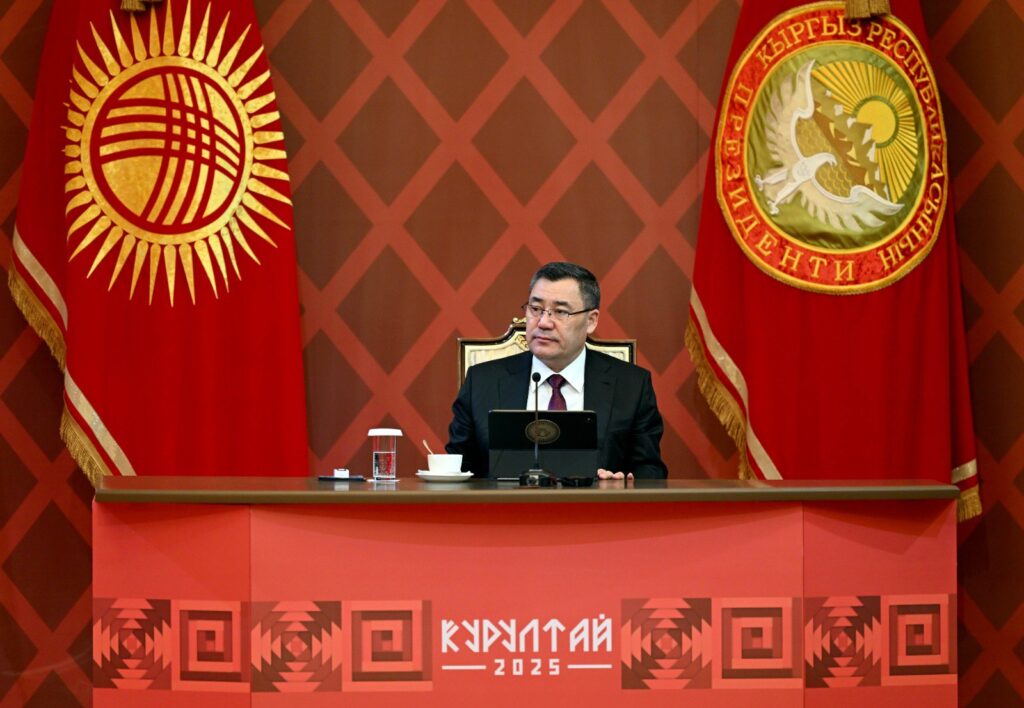
Japarov Outlines Development Priorities at Fourth People’s Kurultai
Kyrgyzstan’s fourth People’s Kurultai, a national forum for direct dialogue between citizens and state leadership, was held in Bishkek on December 25-26. Addressing delegates, President Sadyr Japarov outlined the government's economic, social, and environmental priorities for the coming years. Sustained Economic Growth Japarov described the past three years as a period of strong economic performance, with average annual GDP growth of 9.8%. Real GDP grew by 10.2% in the first 11 months of 2025. GDP per capita in 2024 reached approximately $2,513. Unemployment dropped to 3.7%, while the poverty rate declined from 29.8% to 25.7% year-on-year. Small and medium-sized enterprises (SMEs) have emerged as the backbone of the economy, with their contribution to GDP rising from 42.6% to 51.7% during the first nine months of 2025. National Development Program Through 2030 Japarov presented the government’s National Development Program through 2030, which is centered on four key pillars: industrialization, transformation into a regional transport and logistics hub, agricultural and tourism development, and expansion of green energy. The industrialization strategy includes the creation of industrial and technology zones and the construction of new production facilities to double industrial output by 2030. Large-scale investments in railways, highways, logistics centers, and warehouses are expected to bolster Kyrgyzstan’s role as a regional transit corridor. Tourism is also a major focus. Japarov emphasized efforts to modernize the sector in line with international standards, citing the construction of new hotels, roads, airports, tourist routes, and recreational infrastructure. By 2030, the tourism sector is projected to contribute 7% to GDP. Agricultural Development and Food Security With nearly 58% of the population living in rural areas, agriculture remains a strategic priority. Japarov stated that Kyrgyzstan is currently self-sufficient in six of nine key food products, milk, potatoes, vegetables, meat, eggs, and sugar. Agricultural reform centers on the development of agro-industrial clusters that bring together farmers, processors, logistics providers, and financial institutions to create integrated value chains. The goal is to shift from raw-material exports toward higher-value-added production. Climate Change and Water Resources Japarov also warned of worsening climate-related challenges, particularly declining water resources. Over the past 70 years, Kyrgyzstan has lost around 16% of its glacier area, endangering river flows, irrigation systems, and hydropower production. Lake Issyk-Kul is of particular concern. Since the mid-19th century, the lake’s water level has dropped by nearly 14 meters. The number of rivers feeding into the lake has declined from more than 100 to approximately 30-35. The president cautioned that continued degradation could have serious environmental and socioeconomic consequences. Water scarcity, he noted, also threatens food security, with 95% of national water consumption tied to agriculture. He called for more efficient irrigation, glacier protection, and expanded reforestation efforts. From Social Spending to Development Focus Japarov’s remarks were echoed by Chairman of the Cabinet of Ministers Adylbek Kasymaliev, who addressed parliament a day earlier. Kasymaliev stated that the state has shifted from a “social economy” to a “development economy.” In 2025, 35% of government spending was allocated to the production sector, compared to 23%...

