• KGS/USD = 0.01144 0%
  • KZT/USD = 0.00205 0%
  • TJS/USD = 0.10813 -0.18%
  • UZS/USD = 0.00008 0%
  • TMT/USD = 0.28571 0.28%
  • KGS/USD = 0.01144 0%
  • KZT/USD = 0.00205 0%
  • TJS/USD = 0.10813 -0.18%
  • UZS/USD = 0.00008 0%
  • TMT/USD = 0.28571 0.28%
  • KGS/USD = 0.01144 0%
  • KZT/USD = 0.00205 0%
  • TJS/USD = 0.10813 -0.18%
  • UZS/USD = 0.00008 0%
  • TMT/USD = 0.28571 0.28%
  • KGS/USD = 0.01144 0%
  • KZT/USD = 0.00205 0%
  • TJS/USD = 0.10813 -0.18%
  • UZS/USD = 0.00008 0%
  • TMT/USD = 0.28571 0.28%
  • KGS/USD = 0.01144 0%
  • KZT/USD = 0.00205 0%
  • TJS/USD = 0.10813 -0.18%
  • UZS/USD = 0.00008 0%
  • TMT/USD = 0.28571 0.28%
  • KGS/USD = 0.01144 0%
  • KZT/USD = 0.00205 0%
  • TJS/USD = 0.10813 -0.18%
  • UZS/USD = 0.00008 0%
  • TMT/USD = 0.28571 0.28%
  • KGS/USD = 0.01144 0%
  • KZT/USD = 0.00205 0%
  • TJS/USD = 0.10813 -0.18%
  • UZS/USD = 0.00008 0%
  • TMT/USD = 0.28571 0.28%
  • KGS/USD = 0.01144 0%
  • KZT/USD = 0.00205 0%
  • TJS/USD = 0.10813 -0.18%
  • UZS/USD = 0.00008 0%
  • TMT/USD = 0.28571 0.28%

Viewing results 1 - 6 of 34

Kazakhstan Rules Out Fines for Not Voting in Elections

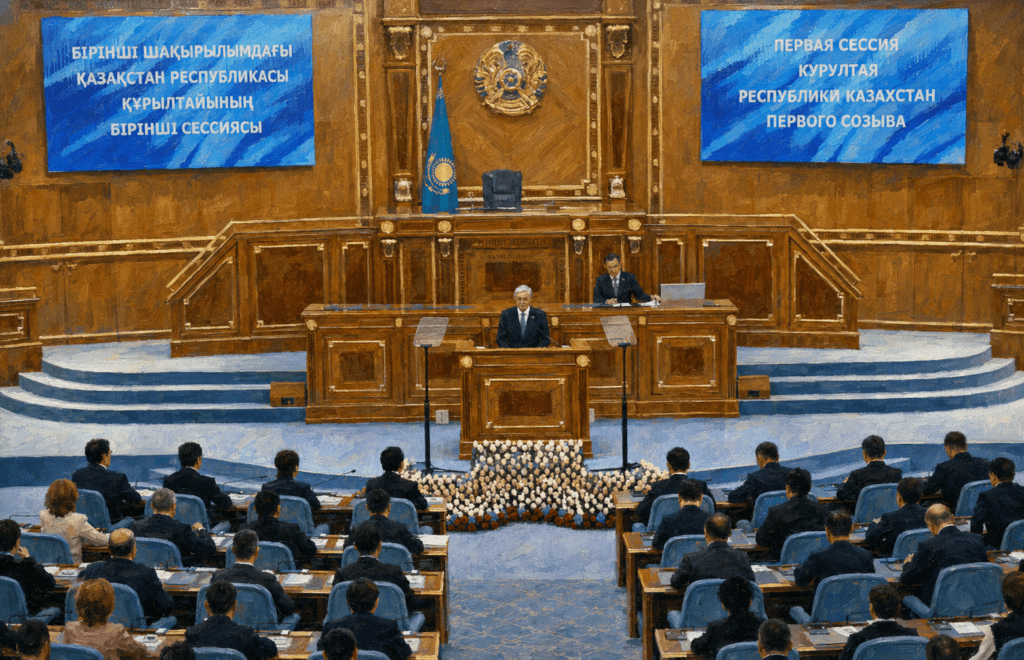
Kazakhstan does not plan to introduce compulsory voting or impose fines on citizens who fail to participate in elections and referendums, Central Election Commission (CEC) Secretary Shavkat Utemisov said. Speaking on the sidelines of a joint session of parliament, Utemisov acknowledged that declining voter participation, particularly among young people, remains a challenge in Kazakhstan. He said, however, that the country does not intend to adopt practices used in some states where voting is mandatory. Utemisov added that some countries have lowered the voting age, citing Belgium, while others impose penalties, including fines, on citizens who fail to appear at polling stations. “But Kazakhstan is not taking that path at the moment; for us, this issue is not as pressing as it is in the West,” he said. Kazakhstan’s most recent major electoral event was the constitutional referendum held on March 15. According to the CEC, approximately 12.4 million citizens were eligible to vote, while more than 9.1 million cast ballots, a turnout of 73.12%. The next major political event will be elections to Kazakhstan’s new unicameral parliament, the Kurultai, which President Kassym-Jomart Tokayev previously said would take place in August. Utemisov stressed that draft amendments to the Constitutional Law “On Elections,” adopted by the outgoing parliament, contain no provisions introducing mandatory voting. According to him, the CEC also has no plans to initiate such amendments in the near future. The election official added that ensuring voter turnout should be the responsibility of political parties participating in campaigns. At the same time, he warned that any attempts to encourage participation through cash payments or gifts could be interpreted as voter bribery. During the joint parliamentary session, lawmakers also approved the Constitutional Law “On the Kurultai of the Republic of Kazakhstan and the Status of Its Deputies,” which will enter into force on July 1. The new parliament will consist of 145 deputies, compared to the current bicameral legislature, which includes 148 members, 98 deputies in the Mazhilis and 50 senators.  Deputies in the Kurultai will serve five-year terms. Elections will be held exclusively under a proportional representation system based on party lists. “The draft law defines the place of the Kurultai within the system of state authorities, the principles of its operation, its structure, the procedure for its formation, and the mechanisms for exercising its powers,” Mazhilis deputy Aidos Sarym said. According to Sarym, the legislation also establishes the powers of the new parliament to adopt laws, participate in the formation of state bodies, and conduct parliamentary oversight. A separate provision states that the Kurultai will become the legal successor to the current parliament. The Times of Central Asia previously reported that the August vote will become Kazakhstan’s first parliamentary election in which citizens vote exclusively for political parties rather than individual candidates.

How Kazakhstan Is Preparing for Parliamentary Elections

Kazakhstan is preparing for a major political reset centered on the introduction of a unicameral parliament, the Kurultai. Until now, legislative power in the country has been exercised by two chambers, the Mazhilis and the Senate. On April 10, President Kassym-Jomart Tokayev announced that elections would take place in August 2026. According to Tokayev, political parties will have a clear planning horizon and enough time to prepare for the campaign and voter outreach. A Stage Already Passed In 2023, Kazakhstan introduced significant changes to its political system. For the first time in 19 years, a mixed electoral model was used in elections to the lower chamber, the Mazhilis. Under this system, 69 deputies were elected via party lists, while 29 were chosen in single-member constituencies, allowing candidates to run independently of party affiliation. This option has now been removed, although the reasons remain unclear. These reforms were presented as part of a broader democratization effort. In the 2023 parliamentary elections, six parties passed the 5% threshold. Amanat, formerly Nur Otan, won 53.9% of the vote, followed by Auyl with 10.9%, Respublica with 8.59%, Aq Jol with 8.41%, the People’s Party of Kazakhstan with 6.8%, and the Nationwide Social Democratic Party (OSDP) with 5.2%. The Baytaq party received 2.3% and did not enter parliament. In practice, however, Amanat has remained the most active force in the Mazhilis. Some initiatives from Aq Jol, traditionally focused on business interests, have also stood out, while other parties have been less visible to voters. Amanat has advantages not available to other parties, including the presence of many senior officials in its ranks. The Auyl party was expected to represent agrarian and conservative interests, but its initiatives have not been clearly articulated. The OSDP, which has long positioned itself as an opposition party, previously claimed it was excluded from parliament. However, once represented in the Mazhilis, its initiatives have largely focused on narrow issues and have had limited impact on the broader political agenda. The People’s Party of Kazakhstan, once known for raising sharp issues, has been less active in the current parliament. Against this backdrop, Aq Jol has been comparatively stronger, showing a greater ability to shape the agenda and articulate clear positions. Baytaq has occupied an environmental niche, but despite the country’s significant ecological challenges, its voice has remained faint, making its prospects of entering the Kurultai uncertain. Respublica, a new party founded by young entrepreneurs, has also struggled to produce notable results. A potential eighth party, Adilet, may soon join the seven officially registered parties. The party has announced its launch and begun the registration process, though it has yet to name a formal leader. Some political analysts have described Adilet as a pro-government party. Political analyst Daniyar Ashimbayev noted that the concept of multiple pro-government parties is not new in Kazakhstan and suggested that some deputies could shift to Adilet by July. Systemic Criticism Political parties represented in parliament are regularly criticized by analysts for holding positions that closely align with Amanat...

Six Months to Rewrite the State: Kazakhstan Accelerates Its Constitutional Reset

Speaking on September 8, 2025, in his Address to the People of Kazakhstan in Parliament, President Kassym-Jomart Tokayev outlined plans for new political reforms. At the time, nothing in his remarks suggested either the scale of the changes his initiative would entail or the speed with which they would be implemented. Yet on March 15 of this year, Kazakh citizens will vote in a referendum on a new draft Constitution, developed at high speed over roughly six months, including a period of state-organized public consultations and expert review. According to materials published on the Constitutional Court’s page on the state portal, where the final version of the draft Basic Law was published, the starting point for constitutional reform was Tokayev’s proposal to create a unicameral Parliament. The president announced the idea on September 8, 2025. A month later, on October 8, an order was signed establishing a working group on parliamentary reform. Over the following months, the group reviewed more than 2,000 proposals from citizens and experts. At the fifth session of the National Kurultai in January 2026, Tokayev summarized the proposals on parliamentary reform, the scope of which had already expanded beyond restructuring Parliament to revising the Constitution as a whole. On January 21, a Constitutional Commission was established, comprising 130 members, including representatives of the National Kurultai, legal experts, officials from central government agencies, media executives, chairpersons of maslikhats, members of regional public councils, and academics. The first draft of the Basic Law was published on January 31. On February 11, a “referendum” version of the draft was presented to the president, incorporating comments received, including his own. Tokayev had outlined his remarks the previous day during an expanded government meeting. The question to be put to voters in March is: “Do you accept the new Constitution of the Republic of Kazakhstan, the draft of which was published in the mass media on February 12, 2026?” What is particularly notable is that on September 8, the president had cautioned against haste, calling parliamentary reform a “very serious issue” and stating that rushing it would be inappropriate. “This reform must be the subject of detailed discussion in civil society, among experts, and, of course, in the current Parliament… I believe that, given the extraordinary nature of the reform, the discussion will take at least a year, after which a nationwide referendum could be held in 2027, and then the necessary amendments could be made to the Constitution,” Tokayev said at the time. A little over five months later, however, the country is preparing for changes that extend beyond the initial proposal to abolish the upper house. At a government meeting, Tokayev emphasized that “no one is setting the task of negating the significance of the current Constitution, which has played a huge role in all of our country's achievements over the past 30 years. “Nevertheless, it should be noted that it was adopted when our country was just getting on its feet and bears the imprint of the first...

Kazakhstan’s Draft Constitution and the Reordering of State Authority

Kazakhstan’s current constitutional reform is no longer limited to parliamentary redesign. A draft updated basic law has been released for public discussion, and it presents the effort as a review of the state’s political architecture culminating in a nationwide referendum. The draft is described as the product of months of work initiated by President Kassym-Jomart Tokayev, with large-scale changes proposed for the country’s political system. A replacement-style text, an explicit state-architecture rationale, and a referendum endpoint together signal a reform agenda that reaches beyond legislative mechanics to the overall distribution of authority, the protection of fundamental rights, and strengthening of the rule of law. Kazakhstan’s current constitution was adopted by referendum in August 1995, replacing the January 1993 basic law. It has been amended repeatedly, including significant revisions in 1998, 2007, 2011, and 2022. The 2022 referendum package was a particularly extensive set of amendments. It presented a model of a presidential republic with a strong parliament, redistributed selected powers from the presidency to parliament, and created new parliamentary mechanisms. It also strengthened the ombudsman, enabled direct citizen appeals to the Constitutional Court, established a commissioner framework for socially vulnerable categories, established a ban on the death penalty, and set a single seven-year presidential term without the possibility of reelection. From Proposal to Draft Basic Law The current draft emerged from a process launched under Tokayev in late 2025. In September 2025, he proposed moving to a unicameral parliament, which set the reform’s initial direction. A working group was established in October 2025 to develop proposals, and in January 2026, a commission was formed to carry the work forward. The commission was chaired by Elvira Azimova, head of the Constitutional Court of Kazakhstan, linking the drafting process to the institution that reviews the basic law. The commission’s work moved beyond incremental amendments. It reviewed proposals affecting seventy-seven constitutional articles, about 84% of the current text, and that breadth drove the decision to prepare a fundamentally new basic law rather than another package of revisions. Rewriting most of the operative text shifts the reform from a parliamentary adjustment to a redesign of the state’s governing framework. The resulting draft is structured as a replacement-style document, with an updated preamble and a reorganization into eleven sections and ninety-five articles. The institutional centerpiece of the draft is a shift from a two-chamber parliament to a single chamber and to proportional representation for electing deputies. The proposed supreme legislative body, the Kurultai, would have 145 deputies, slightly fewer than the combined 148 members of the current Mazhilis and Senate of Kazakhstan. The draft also grants the Kurultai expanded powers, pairing structural consolidation with a change in how legislative authority is organized, including oversight, political accountability, and approval of key state appointments and conciliation procedures. Alongside the proposed legislature, the draft creates a national dialogue platform, the People's Council of Kazakhstan, described as the highest advisory body representing citizens’ interests and granted the right of legislative initiative. This adds a second channel for agenda-setting with...

Opinion: Tokayev’s National Kurultai Address: A Moral Message, Not a Political One

On January 20, 2026, Kassym-Jomart Tokayev, the President of Kazakhstan, addressed the nation at a session of the National Kurultai, an age-old platform for public dialogue, akin to a wise men’s council – at any rate, that’s how it’s often billed. To no one’s surprise, Tokayev pressed ahead with his stated agenda of political reform, highlighting foreign, economic, and development policies and goals. While not devoid of interest, those parts of the speech felt like little more than window dressing that tended to obscure the address’s underlying fire and true import. Tokayev’s oration seemed at points to echo Alexis de Tocqueville’s ideas in Democracy in America: nations endure only when citizens pair civic participation with moral virtue and personal responsibility, because unchecked individualism ultimately weakens free societies and institutions, regardless of the presence of law and order. On closer examination, Tokayev’s thinking reflects Tocqueville’s view that building democracy is hard but doable. As Tocqueville wrote: “nothing is more wonderful than the art of being free, but nothing is harder to learn how to use than freedom,” pointing towards the belief that nation-building depends on freedom bound to virtue. Tokayev’s Kurultai message went far beyond a list of technical fixes, platitudes about the economy, and empty cheerleading. Nor did it read as a sleight of hand or bait-and-switch tactic to preserve power in the face of a failing democracy. Those familiar with Tokayev know he has called for Tocquevillian-like responsible citizenship for years, which, to be sure, requires at times tough love. Tokayev drove home a familiar theme, that the nation’s fate rests on the character and outlook of its people—not just on its economy, wealth, and politics. He maintained that traditional values present the vital adhesive of society, without which, every effort at statecraft withers—or worse, becomes easy prey to unsavory ambitions or certain secular ideologies which have taken on religious force in modern culture. At the heart of Kazakhstan’s future, Tokayev thinks, there must lie a commitment to enduring human principles and timeless truths: unity, selflessness, sharing, mutual understanding, patience, compromise, and common sense. These values are not solely theoretical constructs but qualities evident for successful outcomes. They positively shape family formation, social relations, conflict resolution, and citizens’ engagement with the state and outsiders. What’s more, economic and institutional strength is only possible when built upon a society united by common values, clarity of purpose, and a spirit of service. Transforming Public Consciousness President Tokayev stressed that changing minds matters more than changing laws and hollow pep talks. Without a common moral compass, nation-building is fragile. Strong cultural and spiritual roots foster social cohesion, building trust, identity, and civic duty. Towards this end, he urged the older generation “to promote the values of work and enterprise, and wean young people from verbosity, glorification, laziness, indifference, and idleness.” Tokayev’s strategy for consolidating national consciousness focuses on two core investments: on advancing cultural infrastructure (museums, theatres, libraries) and creative capital, thereby recharging towns and schools as sites of learning, dialogue, and shared...

Analysis: Three Decades of Parliamentary Reform in Central Asia — and What Changed

Kazakhstan’s President Kassym-Jomart Tokayev announced his reform plans on January 20, including structural changes to the government. Arguably, one of the least consequential of those changes is replacing the current bicameral parliament with a unicameral parliament. Across Central Asia, over the last 35 years, parliaments have repeatedly switched from unicameral to bicameral parliaments, or vice versa, the number of deputies has increased and decreased, and in some cases, parallel bodies have come into existence and later disappeared. Kazakhstan When the Soviet Union collapsed in late 1991, each of the former republics, including the Central Asian countries of Kazakhstan, Kyrgyzstan, Tajikistan, Turkmenistan, and Uzbekistan, had a unicameral, republican Supreme Soviet elected in 1990. These Supreme Soviets continued functioning after independence until 1994, and in the case of Kyrgyzstan and Tajikistan, until 1995. In Kazakhstan, in December 1993, the majority of the 360 deputies in the Supreme Soviet voted to dissolve the body. In March 1994, there were elections to the new parliament (Supreme Kenges) that had 177 seats. During the tumultuous year of 1995, the parliament was dissolved by then-President Nursultan Nazarbayev, who ruled by decree until snap parliamentary elections in December of that year. However, on August 29, 1995, voters approved a new constitution in a national referendum. That constitution created a bicameral parliament with 67 deputies in the Mazhilis, the lower house, and 50 deputies in the Senate, 10 of them directly appointed by the president. Deputies to the Mazhilis were chosen in popular elections. Senators were chosen in indirect elections involving deputies from local, provincial, and municipal councils of large cities. In the snap parliamentary elections of October 1999, 10 seats were added and chosen by party lists, while the original 67 continued to be contested in single-mandate districts. That structure lasted until 2007. Constitutional amendments adopted in late May that year increased the number of seats in the Mazhilis to 107, of which 98 were to be chosen by party lists. Nazarbayev’s Nur-Otan party won all 98 of the party list seats in the August elections. The remaining nine representatives came from the Assembly of Peoples of Kazakhstan, a group representing the various ethnic groups in Kazakhstan that Nazarbayev created in 1995. Eight additional members of the Assembly were given seats in the Senate. The Assembly held its own elections to fill those seats. Kazakhstan conducted a constitutional referendum in June 2022, in part aimed at mollifying discontent that lingered from the mass unrest in early January that year, which left 238 people dead. Some amendments stripped away powers in the executive branch that had accumulated during the 28 years Nazarbayev was president, and more power was given to parliament. Another amendment removed the nine Mazhilis seats reserved for members of the Assembly of Peoples of Kazakhstan. One amendment reduced the number of Senate members appointed by the president back to 10, after it had been raised to 15 under a 2007 amendment. Kyrgyzstan A referendum in Kyrgyzstan on constitutional amendments in October 1994 created a bicameral...