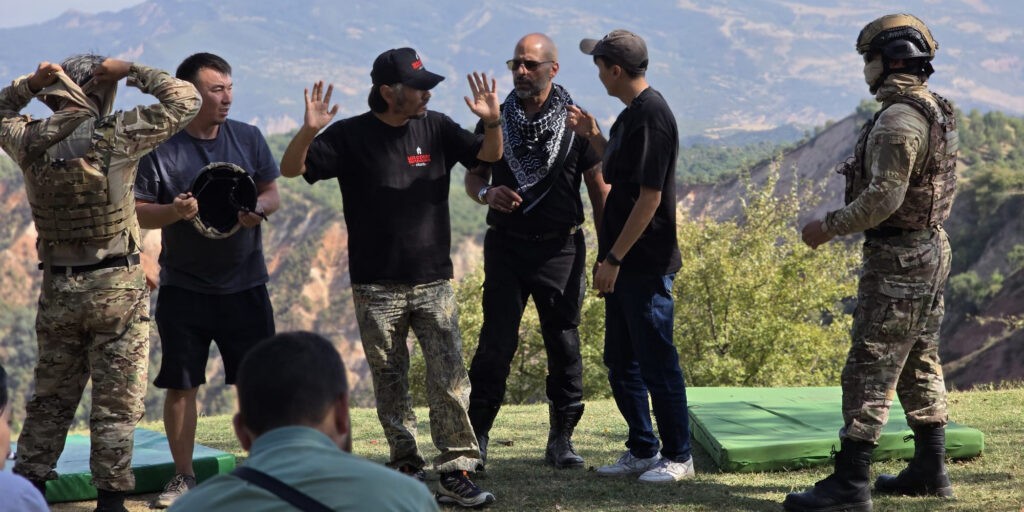
The Filmmakers Behind Kanjar on Action and Cultural Heritage
A stolen dagger drives the action in Kanjar, a Kyrgyz thriller that explores the loss of cultural heritage. Director and screenwriter Adilet Akmatov draws on his experience as a stunt performer and fight choreographer to bring the story to the screen. Co-producer and actor Mohamed Hamad Haymour took a different route into the project. Born in Canada to Lebanese parents, he moved to Kyrgyzstan with his wife intending to open a restaurant. A meeting with Akmatov led him into filmmaking and his first feature-film role, playing a villain. Following a preview screening, Akmatov and Haymour spoke to Shahsanem Murray about the film and their work together. TCA: Adilet, what drew you to make this film? Adilet Akmatov: Now a director and screenwriter, I have hands-on experience as a stunt performer, choreographing fight scenes, operating cameras, and editing. For me, a movie never starts with a genre; it starts with a story and an emotion. I love genre cinema, but a human theme should always remain at the core of the action, adventure, or thriller. This film is exactly that kind of film. It is an action thriller, but it also addresses memory, responsibility, and human choice. TCA: What inspired your screenplay? Adilet Akmatov: First and foremost, I was intrigued by the concept of a historical artifact. More than a mere object, it represents a fragment of a nation’s heritage. At one point in the script, one of my characters says: “This dagger has outlasted dynasties, wars, and migrations, absorbing the memory of several generations.” I was fascinated to see how I could develop a story that would prompt audiences to question the significance of such ancient objects in their understanding of the world and their place in it. In the plot, a dagger is stolen and, against all odds, must be retrieved. But beneath the surface, I wanted to explore what happens to people and, indeed, society at large, when memory is treated as a commodity to be bought and sold. That is the root of the conflict that runs through the film. TCA: How did you approach working with the cast? Adilet Akmatov: On my set, there is no division between stars and lesser-known actors. There is only a shared objective. Trust is paramount, especially in an action movie. Action is not just about thrilling movements; it requires precision, discipline, and a deep understanding of your partner. If one person slips up for even a second, it can directly impact someone else. Therefore, I always try to find common ground with the actors first, to understand their personalities and capabilities, and only then do I choreograph the scene. It is imperative that when an actor executes a staged movement, they truly understand why their character is doing it. Each of the male characters in the film is an individual in his own right. I did not want to create a generic mass of ‘bad guys’. Each has his own perspective on the situation and his own limit of how...