


Tajikistan’s President Rahmon Visits Mongolia as Ulaanbaatar Expands Central Asia Outreach
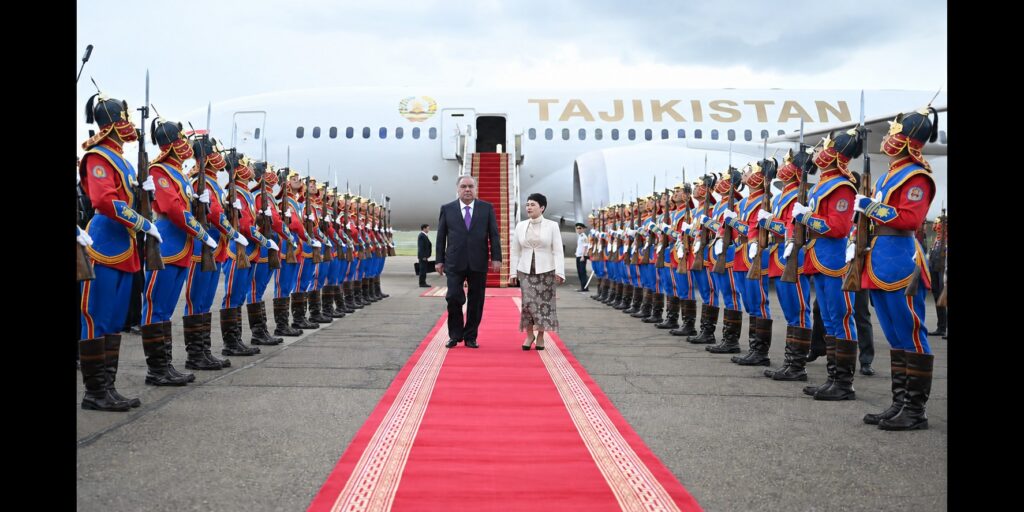
Tajikistan’s President Emomali Rahmon is visiting Mongolia for the first time since 2009, as the two countries pursue closer ties and Mongolia expands its engagement with Central Asia. An honor guard welcomed Rahmon on his arrival in the Mongolian capital of Ulaanbaatar on Monday, and the Tajik leader later met President Ukhnaa Khurelsukh, Tajikistan’s presidential office said. The two presidents aim to expand cooperation in politics, trade, the economy, agriculture, energy, transport, and culture, and will also discuss regional and international issues, according to Montsame, Mongolia’s state-owned news agency. “The visit will mark the first state visit by Tajikistan’s president to Mongolia in 17 years, following his previous visit in 2009,” Montsame reported. “It also serves as a reciprocal visit following President Khurelsukh's state visit to Tajikistan in 2025.” While trade between Mongolia and Tajikistan is relatively small, the warming ties are part of a wider Mongolian government policy to engage with Central Asia and diversify its economic partners. Coal, copper and other mining products are a big part of the economy of landlocked Mongolia, whose exports primarily go to China. Russia is to the north of Mongolia, and China is to the south, while Mongolia’s western tip is separated from Kazakhstan by a sliver of Chinese territory. “Northeast Asia remains Mongolia’s primary economic anchor in terms of exports, investment, and access to seaports,” Khaliunaa Batjargal wrote in a Think Mongol Institute analysis. “At the same time, Central Asia offers a different set of strategic opportunities. Cooperation with similarly landlocked, resource-based economies creates space for new market access and alternative transport options.” The analysis was published in April, shortly after a visit by the Mongolian leader to Kazakhstan, where he met President Kassym-Jomart Tokayev. Deals and high-level visits have also occurred in recent years between Mongolia and other Central Asian countries, including Kyrgyzstan, Uzbekistan, and Turkmenistan. Mongolia, a former Soviet satellite state with a population of several million, sought to build relationships with Central Asian countries after the collapse of the Soviet Union in 1991, but that effort stagnated in the 2000s as opportunities for Mongolia increased in East Asia while Russia maintained a close relationship with the former Soviet republics, according to a Jamestown Foundation analysis by Nurbek Bekmurzaev in 2024. Now, as Central Asian countries expand their own trading partners and corridors, Mongolia is seeking to explore the potential of the region as a transit hub. Many analysts view an old debate about whether Mongolia is part of Central Asia or Northeast Asia as more academic than practical.
