• KGS/USD = 0.01143 -0%
  • KZT/USD = 0.00191 -0%
  • TJS/USD = 0.10823 0.19%
  • UZS/USD = 0.00008 0%
  • TMT/USD = 0.28490 -0.28%
  • KGS/USD = 0.01143 -0%
  • KZT/USD = 0.00191 -0%
  • TJS/USD = 0.10823 0.19%
  • UZS/USD = 0.00008 0%
  • TMT/USD = 0.28490 -0.28%
  • KGS/USD = 0.01143 -0%
  • KZT/USD = 0.00191 -0%
  • TJS/USD = 0.10823 0.19%
  • UZS/USD = 0.00008 0%
  • TMT/USD = 0.28490 -0.28%
  • KGS/USD = 0.01143 -0%
  • KZT/USD = 0.00191 -0%
  • TJS/USD = 0.10823 0.19%
  • UZS/USD = 0.00008 0%
  • TMT/USD = 0.28490 -0.28%
  • KGS/USD = 0.01143 -0%
  • KZT/USD = 0.00191 -0%
  • TJS/USD = 0.10823 0.19%
  • UZS/USD = 0.00008 0%
  • TMT/USD = 0.28490 -0.28%
  • KGS/USD = 0.01143 -0%
  • KZT/USD = 0.00191 -0%
  • TJS/USD = 0.10823 0.19%
  • UZS/USD = 0.00008 0%
  • TMT/USD = 0.28490 -0.28%
  • KGS/USD = 0.01143 -0%
  • KZT/USD = 0.00191 -0%
  • TJS/USD = 0.10823 0.19%
  • UZS/USD = 0.00008 0%
  • TMT/USD = 0.28490 -0.28%
  • KGS/USD = 0.01143 -0%
  • KZT/USD = 0.00191 -0%
  • TJS/USD = 0.10823 0.19%
  • UZS/USD = 0.00008 0%
  • TMT/USD = 0.28490 -0.28%
16 November 2025

Viewing results 1 - 6 of 12

Kyrgyz Parliament Considers Tighter Climbing Rules After Mountain Deaths

Kyrgyzstan’s parliament is looking at ways to make mountaineering safer after the deaths and presumed deaths of several climbers this year, including a Russian woman who was stranded for days on the highest mountain in the country. The debate comes as authorities promote Kyrgyzstan’s spectacular mountain landscapes in an effort to attract more tourists.  A draft law that was introduced on September 4 in the country's parliament, the Jogorku Kenesh, would require mountaineers who plan to climb above 6,000 meters to get a permit and have insurance that covers medical assistance and evacuation. The bill, put forward by lawmaker Emil Toktoshev, also proposes the development of more infrastructure for mountaineering routes and bases and better communication about emergencies.  “In recent years, active development of mountaineering and mountain tourism has been observed in Kyrgyzstan, which requires legal regulation of this sphere,” says a note posted with the draft law on the parliament’s website. “Despite the growing number of ascents to mountain peaks, legislation in the field of mountaineering remains insufficient, creating legal gaps in matters of safety, environmental responsibility, and the issuance of permits,” the note says.  While high-altitude mountain climbing can be inherently risky, the drama surrounding the plight of Russian Natalya Nagovitsyna on Pobeda Peak, which is 7,439 meters above sea level, attracted international attention and prompted a push for more regulation to help to prevent such disasters. Nagovitsyna, whose husband, Sergey Nagovitsyn, died while climbing in Kyrgyzstan in 2021, broke a leg on Pobeda on August 12. Following risky attempts to rescue her, searchers conducted a high-altitude drone inspection of the mountain ridge where she had been left in early September and said there was no sign of life. There is widespread consensus that Nagovitsyna did not survive on the upper reaches of Pobeda, with minimal supplies and shelter in the brutal climate. Her body has not been recovered.  An Italian friend who had tried to help Nagovitsyna died, and another Russian climber died after climbing Pobeda and falling ill in a separate incident in August. Additionally, two Iranian climbers on Pobeda were reported missing and are presumed dead.   Anna Piunova, editor of Mountain.RU, a Russian website that covers climbing news, said that Nagovitsyna possibly should have climbed Pobeda with an experienced guide and that climbers in general should be aware of their limitations.  “And maybe, when you go into the mountains without a guide, without proper insurance covering PSR (search and rescue operations), in the company of strangers, with only a minimal kit, you need to clearly understand that you’ll have to rely only on yourself,” Piunova said on Instagram. “And choose routes according to your abilities, not your ambitions.” Rescue services and mountaineering infrastructure in Kyrgyzstan are less developed than in the Alps and parts of the Himalayas in Nepal.  The draft bill submitted by lawmaker Toktoshev says a permit system for mountaineers would allow state agencies to monitor climbing routes and react more quickly to emergencies such as avalanche risks and oxygen deficiency, using funds from...

Rescue Operations Formally End on Kyrgyz Mountain; Russian Climber Natalya Nagovitsyna Presumed Dead

The head of Kyrgyzstan’s mountaineering federation says another high-altitude drone inspection of a mountain ridge where injured Russian climber Natalya Nagovitsyna was stranded failed to show any “signs of life.” The announcement by Eduard Kubatov was expected because few people had held out hope that Nagovitsyna was still alive on Pobeda Peak, Kyrgyzstan’s highest mountain at 7,439 meters above sea level. She broke a leg high on the mountain on August 12 and subsequent efforts to rescue her failed in extremely difficult conditions, placing other climbers and officials at risk.   The drone fly-by on Tuesday and the involvement in the operation of Kubatov, who had recently returned from an ascent of K2 mountain in Pakistan without supplementary oxygen, appeared to be a last attempt to address any lingering doubts about Nagovitsyna’s fate. Accompanied by a rescue mountaineer and a drone operator, Kubatov flew by helicopter to South Inylchek base camp at Pobeda Peak to participate in the search. Further rescue efforts were “inappropriate,” they said in a signed letter. “All rescue operations have been stopped, and we must acknowledge this sad fact for all of us. All video materials from the inspection (over 10 minutes) will be handed personally to Natalya’s son,” Kubatov said on Instagram.  Saying that “we must state that there are no signs of life” from Nagovitsyna, Kubatov also posted drone footage that showed an orange tent on snow at the foot of a rock face, high on Pobeda. The surface of the tent rippled lightly in the wind, but it was impossible to see inside.   On August 19, a drone filmed movement at the same tent, where Nagovitsyna had stayed as other climbers tried to get help. One of those climbers, Italian Luca Sinigaglia, fell ill and died. Kyrgyz security officials said another drone flight on August 27 did not show any movement at the site.  “The Kyrgyz side did everything possible to organize the rescue of the mountaineer, but the extreme altitude, the harsh weather conditions, the hard helicopter landing, and the physical state of the rescuers did not allow us to achieve the hoped-for results,” Kubatov said. “In the history of Pobeda, there has not been a single successful rescue operation at an altitude of 7,200 meters, and we had no right to further risk the lives of the mountaineer rescuers.” Victoria Bonya, a Russian model, entertainer and mountaineering enthusiast, helped to organize the drone mission on Tuesday.  Bonya said Nagovitsyna “has passed away in peace.”

How Climbers Die: The Tragedy of Natalya Nagovitsyna and the Perils of the Peaks

Professional climbers have all but given up hope for Russian mountaineer Natalya Nagovitsyna, who remains stranded on Pobeda Peak (Victory Peak) in the Tien Shan mountains of Kyrgyzstan. No successful evacuation has been recorded from this treacherous summit since 1955. Still, Nagovitsyna’s son continues to hold out hope, citing drone footage taken last week that appeared to show her waving from her tent and still in good spirits. However, on August 27, a military drone captured thermal imaging of conditions on Pobeda Peak, showing no signs of life in Nagovitsyna’s tent, as confirmed in imagery published on the official website of Kyrgyzstan’s State Committee for National Security (GKNB). Officially Declared Lost Russian Investigative Committee Chairman Alexander Bastrykin has ordered his office to coordinate with the Ministry of Emergency Situations and submit an operational report regarding Nagovitsyna’s case. However, rescue services have already called off search operations and dismantled the base camp at Pobeda Peak. Alexander Yakovenko, head of the classical mountaineering commission of the Russian Mountaineering Federation, stated: “In reality, there’s no one left to rescue; we can only speak of a body recovery. The climbing season at Victory Peak has ended, and the base camp has been removed.” Yakovenko emphasized that Pobeda Peak is one of the most difficult and dangerous mountains for rescue operations. Since the 1960s, many bodies have been left behind, unreachable due to extreme weather and inaccessible terrain. A Mountain That Does Not Forgive Veteran Russian climber Alexander Shcherbashin recently told reporters that a rescue mission for Nagovitsyna would be logistically impossible. “In my view, survival is unlikely. The ridge is long, and evacuating someone from there typically requires between 8 and 18 people, under varying conditions,” he said. Another experienced mountaineer, Alexander Kirikov, described Pobeda Peak as “a mountain that does not forgive mistakes.” “There are fatal accidents there nearly every year, going back to the late 1950s. I estimate the mountain has claimed over 150 lives,” he noted. Death in the Mountains Mountaineering remains one of the world’s most dangerous sports. On average, 24 out of every 10,000 climbers die annually. Hundreds perish each year in mountain accidents. The highest-risk peaks are the so-called eight-thousanders. Everest (Jomolungma), while the most fatal in absolute numbers, owes its toll to the sheer volume of climbers. The deadliest is Annapurna I in the Himalayas, where the fatality rate approaches 50%. Other notorious peaks include K2 (Chogori, “Savage Mountain”) and Nanga Parbat, dubbed “the man-eater.” The former Soviet Union has no eight-thousanders, but Pobeda Peak is widely recognized as its most dangerous seven-thousander. It was here that Natalya Nagovitsyna’s story unfolded. Tragedy has struck her family before. In 2021, just 16 kilometers away on nearby Khan Tengri, Nagovitsyna’s husband died in her arms after suffering a stroke during their ascent. As her case unfolded this summer, another Russian climber, Alexey Ermakov, died on Khan Tengri. “We passed him on the route; he was climbing up as we were descending,” said Alexey Trubachev, a mountain guide and founder...

Russian Climber Stranded on Kyrgyzstan’s Pobeda Peak is Feared Dead

In 2021, Russian climber Natalia Nagovitsina stayed with her sick husband overnight on one of Kyrgyzstan’s highest mountains and later recounted the ordeal in which he died in a documentary titled  “Stay with Khan Tengri: Tragedy on the Mountain.” Now rescue workers and experienced climbers believe it is likely that Nagovitsina is dead after she became immobilized with a broken leg on the upper reaches of another mountain in Kyrgyzstan and efforts to bring her down in bad weather failed. Her story, and the deaths of others who scaled Pobeda Peak this year, have made for a grim high-altitude climbing season within the Central Asian country, which is celebrating its best-known climber, Eduard Kubatov, for recently reaching the summit of K2 in Pakistan without supplementary oxygen.    Various accounts have described Nagovitsina’s ordeal since she broke a leg on August 12 on Pobeda, Kyrygzstan’s highest mountain at 7,439 meters above sea level. It lies on the border between Kyrgyzstan and China and is also known by the Kyrgyz name Jengish Chokusu (Victory Peak). Italian climber and friend Luca Sinigaglia helped to bring food, a tent and a sleeping bag to Nagovitsina several days later, but he then fell ill and died. Subsequently, on August 16, a Kyrgyz helicopter involved in rescue operations made a hard landing, injuring some on board. On August 19, a drone filmed movement at Nagovitsina’ sleeping bag on the ridge where she was stranded, but few climbing veterans believe she could have since survived extended exposure to the brutally cold conditions on the mountain.  “There is practically no chance” that Nagovitsina is alive after nearly two weeks on the mountain, wrote Anna Piunova, editor of Mountain.RU, a Russian website that covers climbing news. Some climbers, including Bishkek-based Kadyr Saydilkan, bristled at any online commentators who suggested that Nagovitsina, who was in her late 40s, was to blame for the disaster, or didn’t deserve to be rescued, or shouldn’t have been on the mountain in the first place because she was a woman.  Nagovitsina, Saydilkan said on Facebook, “fought with death for ten days and survived as long as she could. She dreamed, set goals, lived freely, with love, and pursued her dream!!! And you?”

Mass Evacuation from Kyrgyzstan’s Seven-Thousanders, But One Climber Remains Trapped

A major rescue operation has concluded in Kyrgyzstan, where military pilots evacuated 62 climbers and tourists from the high-altitude peaks of Pobeda and Khan Tengri. The evacuation was prompted by life-threatening conditions, including strong winds and a heightened risk of avalanches that left hundreds stranded. An international group of climbers had earlier become trapped on Victory Peak, where an Italian citizen died during the descent. A helicopter dispatched by the Kyrgyz Ministry of Defense was forced to make an emergency landing on the slope. Fortunately, the crew and rescuers sustained only minor injuries. Given the extreme altitudes, only military helicopters are capable of operating in the area, prompting authorities to deploy additional forces. Once weather conditions temporarily improved, two military helicopters conducted six flights, evacuating climbers from various countries, including Germany, the United Kingdom, Russia, China, and Kazakhstan. Some were flown to the Yuzhny Enilchek and Polyana base camps at approximately 5,000 meters, while others were hospitalized in Karakol. Those seriously injured are expected to be transferred to Bishkek for further treatment. Meanwhile, a 47-year-old Russian climber remains stranded at around 7,000 meters after breaking her leg during the descent. German and Italian climbers provided emergency assistance, including a tent, sleeping bag, and food supplies. Two attempts to evacuate her without professional support failed. One of the rescuers, an Italian climber, succumbed to severe hypothermia and died. According to the Kyrgyz Ministry of Emergency Situations, the stranded climber has survived for seven days at this extreme altitude. “She is alive and has been in high-altitude conditions for seven days. Preparations are underway for a rescue operation to transport her,” the Ministry of Defense stated. The situation remains critical as weather conditions continue to shift rapidly, diminishing the chances of a successful rescue with every passing hour.

Italian Climber Dies During Descent from Peak Pobeda in Kyrgyzstan

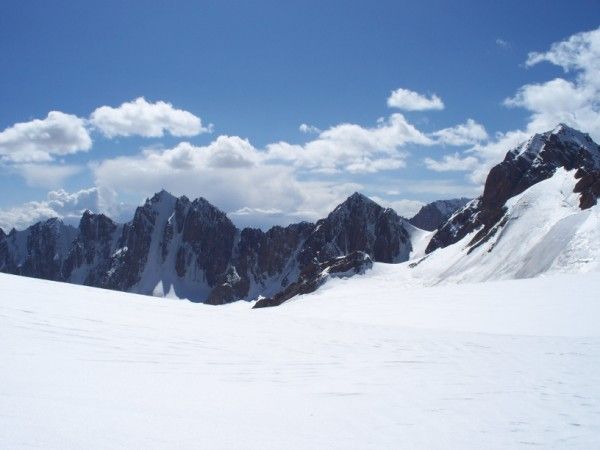
An Italian climber has died and several others were injured during a descent from Peak Pobeda (Victory Peak), one of Kyrgyzstan’s three seven-thousanders, according to the Kyrgyz Ministry of Defense. The injured include citizens of Germany and Russia who were part of the same mountaineering group. The Ministry dispatched a Mi-8 military helicopter with six rescuers on board to reach the group. However, adverse weather forced the helicopter to make a hard landing near the climbers. All those on board survived, though several sustained injuries of varying severity. A second helicopter was later sent to continue the rescue operation. “The helicopter made a hard landing at high altitude under difficult weather conditions. The crew members and mountain rescuers involved in the evacuation were on board, and all of them survived. Specialists were sent to the scene to evacuate the injured,” the Defense Ministry told The Times of Central Asia. The injured rescuers and crew members were transported to a hospital in Karakol, where they are in stable condition. [caption id="attachment_35055" align="aligncenter" width="800"] Peak Pobeda; image: 韵升(Yunsheng) 白(Bai)[/caption] Due to worsening weather and nightfall, not all climbers could be evacuated immediately. Recovery efforts resumed the following day. A special commission has been formed to investigate the incident, identify the causes of the accident, and assess the technical condition of the aircraft. At 7,439 meters, Peak Pobeda is the highest point in the Tien Shan mountain range. Its eastern slopes lie within China. The routes to its summit are among the most technically challenging in the world, marked by steep ice faces, sudden gusts of wind, and extreme cold. Despite the risks, the area attracts dozens of climbers annually, drawn by its remoteness and the allure of unclimbed neighboring peaks.