Viewing results 1 - 6 of 3
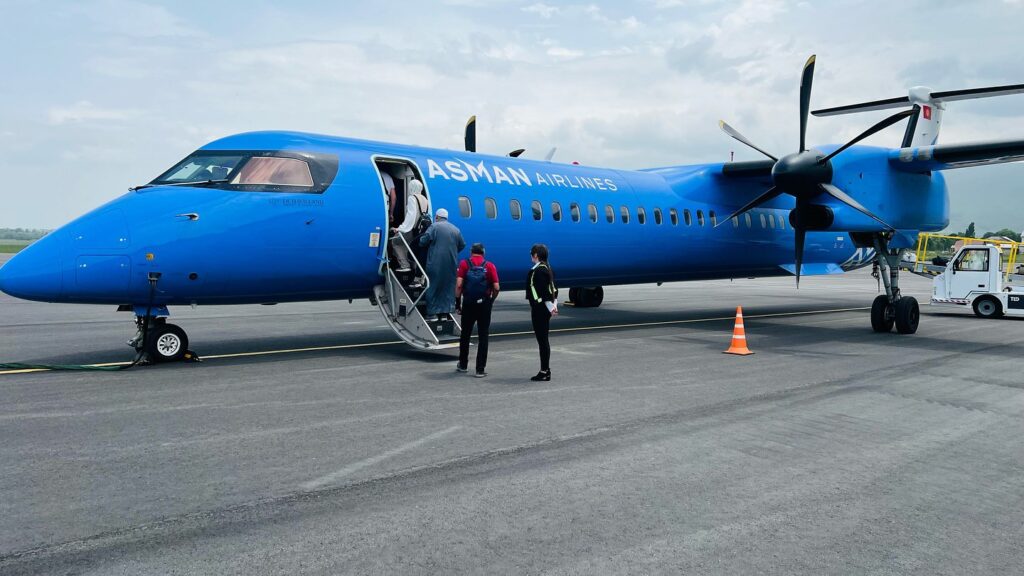
Regular passenger flights now link Almaty, Kazakhstan’s largest city, to Lake Issyk-Kul, Kyrgyzstan’s premier tourist destination. The new air service was launched by Kyrgyzstan’s Asman Airlines on June 27, according to Kazakhstan’s Ministry of Transport. The airline will operate two weekly flights, on Mondays and Fridays, between Almaty and Tamchy airport, located on the lake’s northern shore. Kazakhstan's low-cost carrier Fly Arystan is also set to launch direct flights between Almaty and Issyk-Kul, beginning July 3. These flights will run twice a week, on Thursdays and Sundays. Lake Issyk-Kul remains a favored summer destination for tourists across the region, particularly among Almaty residents seeking weekend getaways. The new air routes are expected to improve access for travelers from southern Kazakhstan, significantly reducing travel time and simplifying logistics during the peak tourist season. The Asman Airlines flight between Almaty and Issyk-Kul takes approximately one hour and 20 minutes. Previously, travelers had to drive over 460 kilometers via Bishkek, a journey that typically took about eight hours. Efforts to shorten this overland route continue. The Times of Central Asia recently reported on the advancement of a long-discussed highway project aimed at directly linking Almaty to Issyk-Kul. Although the two locations are only 80 kilometers apart in a straight line, mountain ranges force travelers to detour through the Kyrgyz capital. The lake has also become more accessible to tourists from Uzbekistan. On June 22, Uzbek budget airline Fly Khiva launched regular flights from Tashkent to Tamchy. These flights will operate every Sunday through August 10, 2025.
Uzbekistan has approved regular flights for airlines from Malaysia, South Korea, and Egypt, the Civil Aviation Agency under the Ministry of Transport of Uzbekistan announced. Under an intergovernmental air services agreement between Uzbekistan and Malaysia, AirAsia X Berhad received approval on February 3, 2025, to operate regular flights between Kuala Lumpur and Tashkent. On the same day, South Korea’s T’way Air was also granted permission to launch regular flights on the Seoul-Tashkent-Seoul route under the Uzbekistan-South Korea air services agreement. Both AirAsia X Berhad and T’way Air will operate these flights using Airbus A330 aircraft. On February 4, Egypt’s Red Sea Airlines received approval to operate regular flights between Sharm el-Sheikh and Tashkent. This decision follows the Uzbekistan-Egypt air services agreement, and the airline will use Boeing 737 aircraft for these flights. Previously, The Times of Central Asia reported that Uzbekistan Airways altered its flight routes to Europe starting in January, bypassing Russian and Belarusian airspace. The airline’s press service stated that the decision was based on recommendations from the European Union Aviation Safety Agency (EASA), and was not related to the recent Azerbaijan Airlines crash.
Uzbekistan’s Ministry of Transport has agreed with China Southern Airlines to increase the frequency of flights on the Beijing-Tashkent route from four to seven per week, and on the Urumqi (Xinjiang)-Tashkent route from three to four per week. They also agreed to launch three weekly flights on the Guangzhou-Urumqi-Tashkent route in 2025. At the last C5+1 China-Central Asia Civil Aviation Conference, held in Xi'an in June, Uzbekistan and China agreed to increase the number of flights between the two countries and open new air corridors. Four airlines from Uzbekistan were assigned 58 regular flights per week to transport passengers from the international airports of Tashkent and Samarkand to 12 Chinese cities. Currently, the Uzbek airlines Qanot Sharq, Centrum Air, and Air Samarkand are working to meet the certification requirements of the Chinese aviation administration so that they can begin regular flights to China. At the moment, nine Uzbek and Chinese airlines operate 63 regular flights per week to 16 destinations in both countries, including 21 flights for passengers and 42 for cargo.