


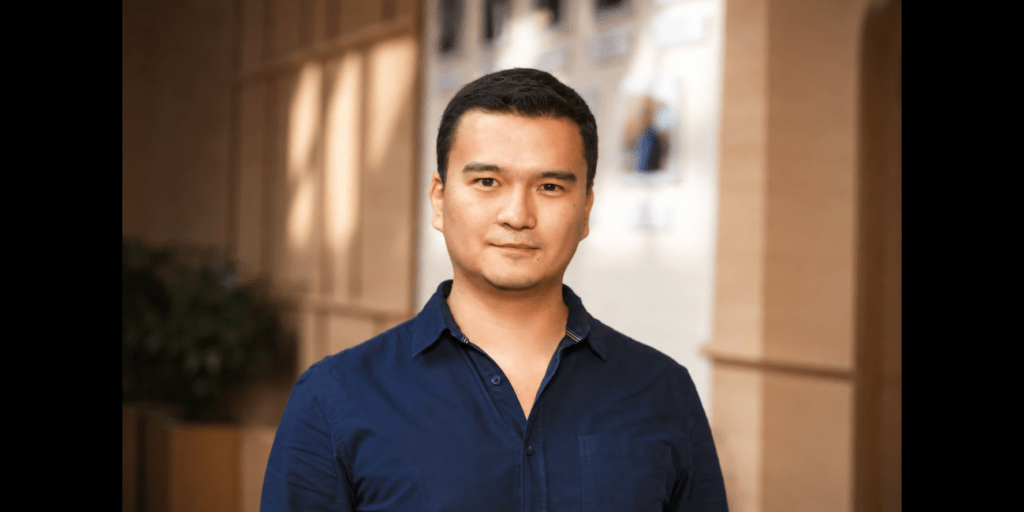
Screenwriter Yefrat Sharipov on AI and the Future of Kazakhstani Cinema
Screenwriter Yefrat Sharipov is a graduate of Kazakhstan’s Academy of Civil Aviation and the New York Film Academy (NYFA), and one of the country’s most sought-after screenwriters in recent years. He worked on the box office hit Dos-Mukasan, a film about the legendary Kazakhstani musical group often described as the local equivalent of The Beatles. He now reflects on the future of global cinema, the role of artificial intelligence, and why Kazakhstani stories can resonate far beyond the country’s borders. In an interview with The Times of Central Asia, Sharipov discusses how engineering thinking shapes his approach to storytelling, why screenwriters must understand the inner workings of the film industry, and how technology may soon erase language barriers. TCA: You’re a screenwriter with an engineering background who graduated from the Academy of Civil Aviation. How did that happen? Sharipov: Honestly, it’s difficult for me to explain myself. The desire to write stories has been with me since childhood; I always knew I would never stop doing it. The need to express myself through writing appeared very early. Back in school, I was already trying to write short stories, novellas, poetry, even songs. But when it came time to choose a profession, I decided to pursue a technical field, although I never stopped writing “for the drawer.” Later, when I entered the film industry and worked on projects in other roles, I remembered this passion and realized there was a way to apply it professionally. There was a huge demand for screenwriters. At first, it was mostly curiosity, I wanted to see whether anyone besides me would actually find my stories interesting. Gradually, things started to work out, and here I am. TCA: What did you write about as a child? Sharipov: About whatever fascinated me at the time. At one point, I became obsessed with Tolkien and started inventing fantasy stories with imaginary creatures. I mostly wrote for myself, though sometimes I let friends, parents, and relatives read my work. I remember my mother always praising me, and I usually got good grades for essays at school. My friends and I even kept what we called “school chronicles,” where we humorously wrote about everything happening around us. Honestly, if I were a better speaker, maybe I would have become a stand-up comedian. TCA: Does your technical education help you in your current work? Sharipov: It does. Technical disciplines probably influenced the way I approach storytelling. I look at stories almost like an engineer, everything has to be structured and logical. Before starting a film, I research the subject deeply. I don’t just read materials casually. I use an approach similar to scientific research. I gather facts, critically analyze the material, and repeatedly verify information. TCA: So, every film becomes almost like a dissertation. But cinema is always about people. Can human beings really be approached scientifically? Sharipov: When I worked on the Dos-Mukasan biopic, I didn’t just rely on archival material, I tried to meet personally with everyone who had...
