• KZT/USD = 0.00223
  • TJS/USD = 0.10810
  • UZS/USD = 0.00009
  • TMT/USD = 0.29850
  • KZT/USD = 0.00223
  • TJS/USD = 0.10810
  • UZS/USD = 0.00009
  • TMT/USD = 0.29850
  • KZT/USD = 0.00223
  • TJS/USD = 0.10810
  • UZS/USD = 0.00009
  • TMT/USD = 0.29850
  • KZT/USD = 0.00223
  • TJS/USD = 0.10810
  • UZS/USD = 0.00009
  • TMT/USD = 0.29850
  • KZT/USD = 0.00223
  • TJS/USD = 0.10810
  • UZS/USD = 0.00009
  • TMT/USD = 0.29850
  • KZT/USD = 0.00223
  • TJS/USD = 0.10810
  • UZS/USD = 0.00009
  • TMT/USD = 0.29850
  • KZT/USD = 0.00223
  • TJS/USD = 0.10810
  • UZS/USD = 0.00009
  • TMT/USD = 0.29850
  • KZT/USD = 0.00223
  • TJS/USD = 0.10810
  • UZS/USD = 0.00009
  • TMT/USD = 0.29850
22 September 2026

Viewing results 1 - 6 of 8

World Nomad Games Face Growing Pains as Crowds Swell

On many levels, the sixth World Nomad Games were a success. Large crowds filled venues in Bishkek and around Issyk-Kul, with organizers saying more than 200,000 people had visited Kyrchyn Gorge by September 3. The opening ceremony alone drew swathes of spectators, and the Games brought traditional sports before an international audience on a scale far beyond their first edition in 2014. However, when the skies opened in the Kyrchyn Gorge, the crowds, journalists and athletes alike found themselves stranded. Long queues waited impatiently for buses that had stopped coming. The mountain setting that made this part of the festival so memorable left visitors dependent on transport that could not reliably get them home. The scene captured a problem that followed the Games from their opening in Bishkek to the final competitions at Issyk-Kul. Kyrgyzstan had created an event that people wanted to attend in large numbers, but arrangements for those crowds repeatedly fell short. The sixth Games, held from August 31 to September 6, brought an international sporting festival back to its birthplace. More than 3,000 athletes from 104 countries attended, compared with 583 competitors from 19 countries at the first edition in 2014. That expansion gave the homecoming much of its energy. It also increased the demands on venues and the transport connecting them. At the new Bishkek Arena, around 29,000 people attended the opening ceremony. The stadium was still under construction, with its formal opening scheduled for October. Inside, eventgoers sang along with local performers, and even some security guards joined in. The enthusiasm was unmistakable. The arena presented practical problems, however, with spectators having to duck under girders and concrete struts in the concourse to reach their seats. Concession stands quickly ran out of bottled water as the numbers built. A sign reading “All food is gone” offered a blunt assessment of the catering arrangements. Tension grew around the shortages. For those spending hours inside the venue, access to drinking water was a basic requirement that the opening night failed to deliver. The Ministry of Health later said 55 participants and spectators sought medical assistance during the opening, including two injury cases. No serious injuries were recorded, and nobody required hospitalization. [video width="848" height="478" mp4="https://timesca.com/wp-content/uploads/2026/09/WhatsApp-Video-2026-09-09-at-14.40.50.mp4"][/video] There was also a roughly 90-minute pause during the event while dignitaries arrived for the formal ceremony. The show finally resumed on a grand scale, but the wait extended an already long evening in a venue struggling to supply its audience. By the time headliner Nicole Scherzinger took to the stage, the arena was half-empty, with people walking for hours past roadblocks as police whistled furiously at their attempts to get home. Transport problems became more prominent once the Games moved to Issyk-Kul. Footage seen by TCA showed people fighting to board shuttle buses. Travel between venues frequently became an ordeal, with visitors unsure whether they would be able to get onto any vehicles. The organizers responded to the early queues. On September 2, the Games’ media headquarters said 40 additional...

Kazakhstan Tops World Nomad Games Amid Conflicting Medal Counts

Kazakhstan finished at the top of the 2026 World Nomad Games medal standings, although conflicting published results have left questions over the final tally. According to the rules, the team with the most gold medals wins. The sixth edition ended in Kyrgyzstan on September 6, following a week of traditional sports around Issyk-Kul. The Games opened in Bishkek on August 31 before competition moved to venues around Cholpon Ata and Kyrchyn. Qazinform reported that Kazakhstan finished with 32 gold medals and 74 medals overall. Kyrgyzstan placed second despite collecting more medals in total, because gold medals determined the rankings. The outlet credited the host nation with 84 medals, including 30 gold. It placed Russia third with 36 medals and Mongolia fourth with 21. Uzbekistan completed its top five with 19 medals. Kyrgyzstan’s presidential press secretary, Askat Alagozov, acknowledged a “technical discrepancy” in the count on September 7, according to state news agency Kabar. He said the organizing committee decided to count the medals of three Kazakh athletes separately, putting Kazakhstan first in the overall team standings. “We congratulate our Kazakh brothers on their victory!” Alagozov said. He emphasized that the Games’ main achievement was bringing the two peoples together through mutual respect and fair competition. A further report carried by Asia News Network says Mongolia finished fourth with 26 medals. That differs from the 21 medals reported by Qazinform. These differences do not establish that medals were wrongly awarded, but they do mean the available accounts cannot be combined into a definitive final table. For Kazakhstan, the closing day proved decisive. Its athletes added six gold medals as the country secured first place. Alagozov’s statement confirmed Kazakhstan’s first place, although published medal totals still differ. Kabar also reported that the Games’ media headquarters said no official medal or overall team standings were maintained between countries.

Kyrgyzstan Beats Kazakhstan 12-0 to Win World Nomad Games Kok Boru Gold

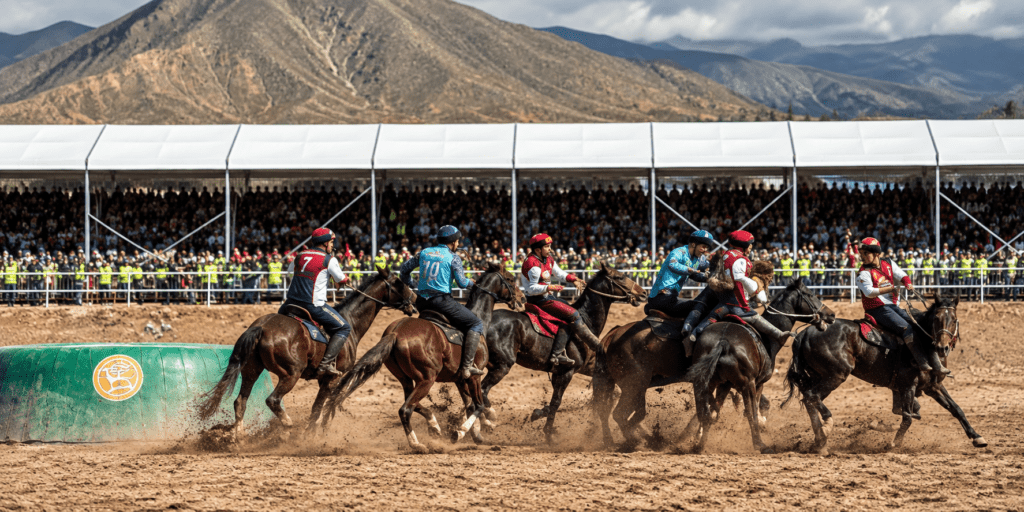
Kyrgyzstan has won the kok-boru title at the 6th World Nomad Games after overwhelming Kazakhstan 12-0 in Sunday’s final at the Kok-Boru Arena in Cholpon-Ata. The hosts dominated the match and shut Kazakhstan out entirely. In the third period, Baytegin Omorbekov, Ernazar Koshumbaev, and Mirbek Mukashev added to Kyrgyzstan’s total, before Anarbek uulu Seitbek scored again as the margin widened. [video width="478" height="850" mp4="https://timesca.com/wp-content/uploads/2026/09/A-gY_JlG.mp4"][/video] The victory gave Kyrgyzstan the gold medal, with Kazakhstan taking silver and Russia bronze. The medal ceremony was held later on Sunday in Cholpon-Ata. The sport combines horsemanship, strength, and close physical contact, and remains one of the biggest crowd draws at the Games. Kyrgyzstan also defeated Kazakhstan 7-2 in the kokpar final, completing a sweep of the two major mounted team events on the final day of competition. Before the final, several men reportedly tried to force their way through a police cordon into the stands and were detained. The incident did not disrupt the match.

One Target, 145 Meters: Kyrchyn’s Archers Take on Korea’s Long-Range Test

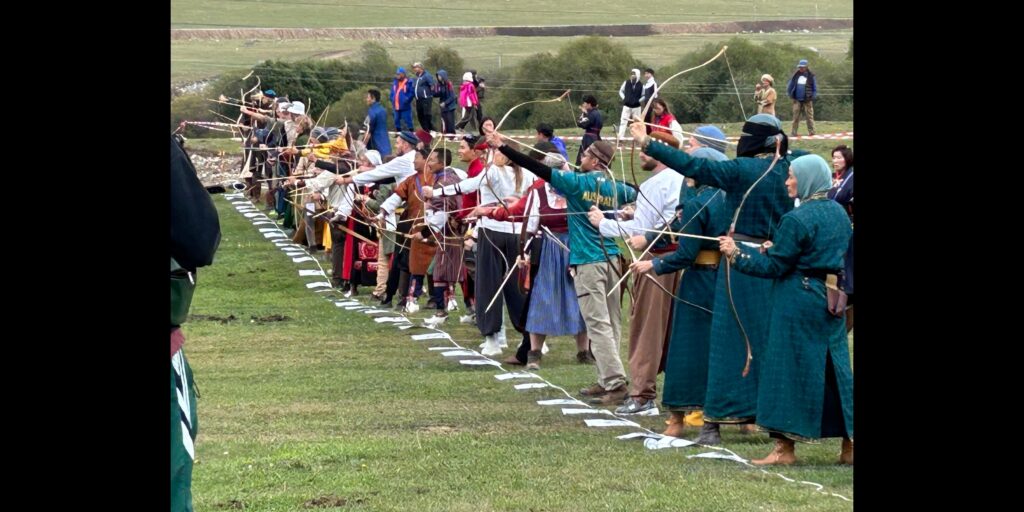
The archers formed a long, uneven line across the grass at Kyrchyn Gorge on Friday, bows rising almost in unison beneath a bank of clouds. Their target was 145 meters away, far enough for the arrows to climb visibly before dropping back toward the range. It was the final and most unfamiliar test in the World Nomad Games’ traditional ground archery program: a Korean-style competition at a distance many of the international entrants had never attempted before. [video width="1024" height="576" mp4="https://timesca.com/wp-content/uploads/2026/09/WhatsApp-Video-2026-09-04-at-17.18.45.mp4"][/video] A total of 196 archers from 51 countries took part in the traditional archery program at Kyrchyn. The first two days used Kyrgyz and Turkish targets at shorter distances. Friday’s Korean round pushed both men and women out to 145 meters. Under the special Korean rules, each competitor shoots 15 qualification arrows across three rounds. The top 16 men and top 16 women advance to a 10-arrow final. Korean national team archers served as judges and officials rather than competing, leaving international archers to take on one of Korea’s defining traditional distances. For Kristina Dolgilevica, coach of Great Britain’s ground-archery team and president of the UK Traditional Archers’ International Association, the distance changes almost everything. “You have to adjust and adapt in so many ways,” she told The Times of Central Asia. “Not just your technique, not just your aim. You have to also adjust and tweak your equipment.” The British longbows were only one part of a field whose equipment, experience, and expectations varied widely. Germany’s Jürgen Junkmanns had at least faced the problem before. The German prehistoric-archery specialist and bowyer has spent decades studying historical bows and said he had travelled to Korea several times to shoot there. Even so, he described the distance as unusual at home. “In Germany we don’t shoot these distances, so we’re not used to it,” he said. For Canada, there was no opportunity to practice it at all. Vancouver-based Patricia Gonsalves, founder of Lykopis Archery, has more than three decades of experience in traditional archery and was accompanying Canada’s sole competitor. “We can’t train this distance in Canada,” she said. “There’s nowhere that we can train for this.” The weather added another variable. Gonsalves said archers from British Columbia were accustomed to rain, but Kyrchyn’s rapid changes had forced them to think differently about their arrows and fletching. A strong gust matters more when an arrow remains airborne for so long. Austria’s Kunda Kiba came to Kyrchyn with far less experience. She said this was her first World Nomad Games and her first competition in this form of archery. Her assessment was simpler: “It was wonderful. It’s very fun, and that’s what I wanted.” The international mix was part of the appeal for Britain’s John Stanley, who was also writing about the Games for World Archery. He had only shot 145 meters once before, but the distance was not what made the week feel unusual. “Every 20 minutes, there’s some brand-new experience you’ve never had before,” Stanley said. “You’re sitting on...

Britain’s Horseback Archers Ride Into Kyrchyn at the World Nomad Games

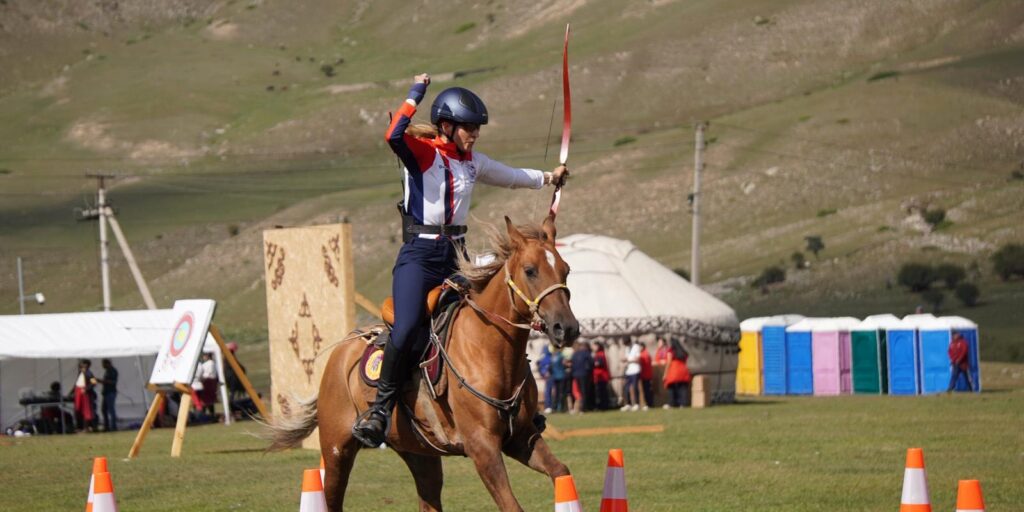
At Kyrchyn Gorge on Thursday, a British rider released an arrow at a target from horseback as her steed carried her between the course markers, with the green slopes of the Tian Shan rising behind the World Nomad Games venue. Horseback archery brings the two disciplines together in a single run. Riders must control the horse while nocking, drawing, and releasing arrows at targets as they move down the track. The official Kyrgyz-style rules require the horse to remain in motion throughout the run. [video width="1024" height="576" mp4="https://timesca.com/wp-content/uploads/2026/09/This-one.mp4"][/video] The Games use two horseback archery formats. In the Kyrgyz style, riders race along a 100-meter track and shoot at small targets while keeping the horse moving. The Hungarian, or Magyar, style changes the challenge: riders pass a central tower carrying targets that can be shot repeatedly as the angle changes. Speed therefore counts alongside accuracy, but riders must also adapt to a horse they may have known for only a short time. [caption id="attachment_55346" align="aligncenter" width="1774"] Image: TCA, Stephen M. Bland[/caption] The venue is part of the spectacle. Beyond the course, a newly built clay fortress rises from Kyrchyn like a Silk Road settlement. It forms part of the Games’ “Universe of Nomads” ethno-town. Its buildings draw on regional architecture dating from the Middle Ages and were constructed with natural materials including soil, clay, and stone. [caption id="attachment_55352" align="aligncenter" width="1600"] Image: TCA, Stephen M. Bland[/caption] Inside the walls, visitors crowded around long tables and food stalls beneath traditional textiles as vendors bustled. Outside, rows of white yurts spread across the verdant valley floor. Golden eagles and falcons pealed nearby, as Kyrchyn is also hosting the Games’ traditional hunting with birds and other events. [caption id="attachment_55351" align="aligncenter" width="1600"] Image: TCA, Stephen M. Bland[/caption] In the gorge, the boundaries between competition and cultural festival largely disappear, with sport unfolding inside a temporary nomadic settlement rather than around a conventional arena. [caption id="attachment_55347" align="aligncenter" width="1774"] Image: TCA, Stephen M. Bland[/caption] Among the British riders competing at Kyrchyn are Becca Sweetman and Kristina Schapiro. TCA spoke with them after Thursday’s Kyrgyz-style runs. TCA: Is this a sport you have been doing for some time back home? Becca Sweetman: We’ve both been doing it for about eight years and competing for the British team for more than four years. TCA: How did it go today? Becca Sweetman: It’s a challenging competition because you have to change horses for every single run, which we don’t do at any other international competition. Kristina had a few amazing runs, and she’s currently in second place. Half the competition is done, so we’ll see how it continues. I managed to hit some targets, which is always good. [caption id="attachment_55349" align="aligncenter" width="1600"] Image: Mae Pollard[/caption] TCA: Have you been to the World Nomad Games before, and what has your general impression been? Kristina Schapiro: It’s our first time competing in horseback archery at the World Nomad Games. It’s a little disorganized, but it’s an incredible experience. At the opening ceremony, I...

Kyrgyzstan Beats United States 16-7 as Kok Boru Opens at World Nomad Games

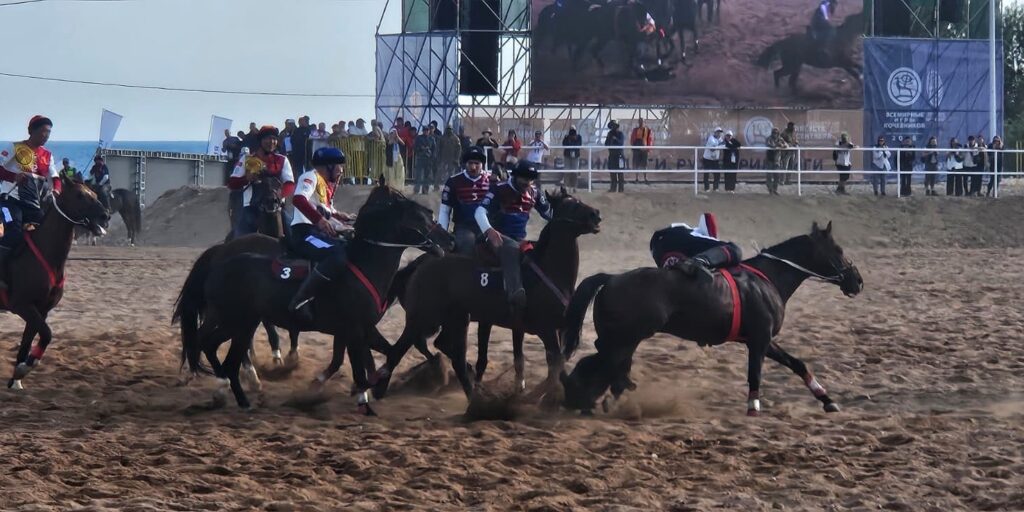
Two years after Kazakhstan beat Team USA in Astana, the Americans again faced a World Nomad Games host in kok boru. Kyrgyzstan won 16–7 at the Cholpon-Ata Kok Boru Arena on Wednesday, but the U.S. riders were a markedly different proposition from the side that failed to score in 2024. Kok boru, whose name means “gray wolf,” occupies a special place in Kyrgyz culture. UNESCO added it to the Representative List of the Intangible Cultural Heritage of Humanity in 2017, recognizing its place in the country’s cultural identity, while the arena commentator repeatedly described the sport as a point of national pride. Tradition traces the game to mounted hunters fighting for possession of a wolf killed while protecting livestock, an old practice later developed into a team contest. The modern game uses a prepared headless goat carcass, which a rider must carry across the field and get into the opposing tai kazan, the raised circular goal at either end. Kyrgyzstan restored the real carcass for these Games after Kazakhstan used a synthetic rubber serke in Astana, making the object’s weight and bulk unmistakable whenever a rider leaned almost to the sand to seize it. Under the current rules, four riders from each team compete on the field during three 15-minute periods. The carcass normally weighs 30–32 kilograms, and although riders may press one another with their bodies or use their horses to nudge for position, striking is prohibited. [video width="848" height="478" mp4="https://timesca.com/wp-content/uploads/2026/09/WhatsApp-Video-2026-09-02-at-21.55.39.mp4"][/video] Team USA started strongly, trading scores with Kyrgyzstan early and holding its own in the scrums for possession. Horses pressed flank to flank in what could look like an impossible embrace as riders bent low into the crush. When one came free with the goat held against the saddle, the tangle opened immediately into a gallop toward the tai kazan. Nurzhan Melisbek uulu opened the scoring for Kyrgyzstan after just 23 seconds, but Team USA answered and kept the opening exchanges close. By the middle of the first period, Kyrgyzstan had begun finding more openings and closed it 7–2. During the first break, Ennio Morricone’s theme from Sergio Leone’s A Fistful of Dollars played over the speakers in what appeared to be a nod to the American cowboys. The Americans returned to the field with renewed energy and scored almost immediately, with the board soon showing 8–3. Kyrgyzstan did not loosen its grip for long, but neither did the second period become the one-way procession seen in Astana. The hosts added five points to the Americans’ three, taking the cumulative score to 12–5. During the second period, U.S. No. 33 Zanen Pitts fell from his horse but quickly recovered. No. 2 Nick Willert was also back with Team USA, two years after explaining in a 2024 interview with The Times of Central Asia that the Americans combined techniques learned from Central Asian players with Western horsemanship. Finding suitable horses and having enough time to become familiar with them, he said, had always been a major difficulty for the team. Kyrgyzstan controlled...