• KGS/USD = 0.01144 0%
  • KZT/USD = 0.00216 0%
  • TJS/USD = 0.10585 -0.28%
  • UZS/USD = 0.00008 0%
  • TMT/USD = 0.28530 0%
  • KGS/USD = 0.01144 0%
  • KZT/USD = 0.00216 0%
  • TJS/USD = 0.10585 -0.28%
  • UZS/USD = 0.00008 0%
  • TMT/USD = 0.28530 0%
  • KGS/USD = 0.01144 0%
  • KZT/USD = 0.00216 0%
  • TJS/USD = 0.10585 -0.28%
  • UZS/USD = 0.00008 0%
  • TMT/USD = 0.28530 0%
  • KGS/USD = 0.01144 0%
  • KZT/USD = 0.00216 0%
  • TJS/USD = 0.10585 -0.28%
  • UZS/USD = 0.00008 0%
  • TMT/USD = 0.28530 0%
  • KGS/USD = 0.01144 0%
  • KZT/USD = 0.00216 0%
  • TJS/USD = 0.10585 -0.28%
  • UZS/USD = 0.00008 0%
  • TMT/USD = 0.28530 0%
  • KGS/USD = 0.01144 0%
  • KZT/USD = 0.00216 0%
  • TJS/USD = 0.10585 -0.28%
  • UZS/USD = 0.00008 0%
  • TMT/USD = 0.28530 0%
  • KGS/USD = 0.01144 0%
  • KZT/USD = 0.00216 0%
  • TJS/USD = 0.10585 -0.28%
  • UZS/USD = 0.00008 0%
  • TMT/USD = 0.28530 0%
  • KGS/USD = 0.01144 0%
  • KZT/USD = 0.00216 0%
  • TJS/USD = 0.10585 -0.28%
  • UZS/USD = 0.00008 0%
  • TMT/USD = 0.28530 0%

Viewing results 1 - 6 of 37

Kazakhstan Has Selected a Site for Its Second Nuclear Power Plant

The Kazakh government has approved the location for its second nuclear power plant. According to an official decree, the facility will be constructed in the Zhambyl district of the Almaty region, adjacent to the site selected for the country's first nuclear plant. The Ministry of Justice published Government Resolution No. 40, dated January 26, 2026, titled On the Construction and Construction Site of the Nuclear Facility “Second Nuclear Power Plant”, in the Adilet system of regulatory legal acts. The resolution came into effect on the day of its signing. Nuclear projects typically proceed through feasibility studies, environmental review, and financing arrangements, and timelines can shift as plans move from preliminary approval to full construction. Earlier reports indicated that contracts for the construction of Kazakhstan’s second and third nuclear plants were awarded to China’s CNNC, with the first plant being developed by the Russian state corporation Rosatom. Its site is located in the village of Ulken, also in Zhambyl district, on the shore of Lake Balkhash, approximately 400 km northwest of Almaty. Thus, Kazakhstan’s first two nuclear power facilities will be concentrated in the country’s southern region. The design capacity of the first plant is 2.4 GW, comprising two VVER-1200 reactors, each with a capacity of 1.2 GW. Rosatom has already begun preparatory work on the site. The foundation is scheduled to be poured in 2029, with commissioning planned for 2035. Previously, Kurchatov in the Abai region, near the former Semipalatinsk nuclear test site, was considered as a possible location for one of the three planned plants. This site was reviewed with International Atomic Energy Agency participation. However, the current government decision confirms a focus on the Almaty region. The Kazakh authorities view nuclear energy as a strategic solution to the country’s growing electricity shortage. At the same time, in January, Energy Minister Yerlan Akkenzhenov stated that Kazakhstan would be able to fully meet domestic energy demand by the end of the first quarter of 2027, without nuclear power, and by 2029, the country is expected to reach a surplus and begin electricity exports.

Uzbekistan Clarifies Nuclear Plant Timeline After Reports of Delay

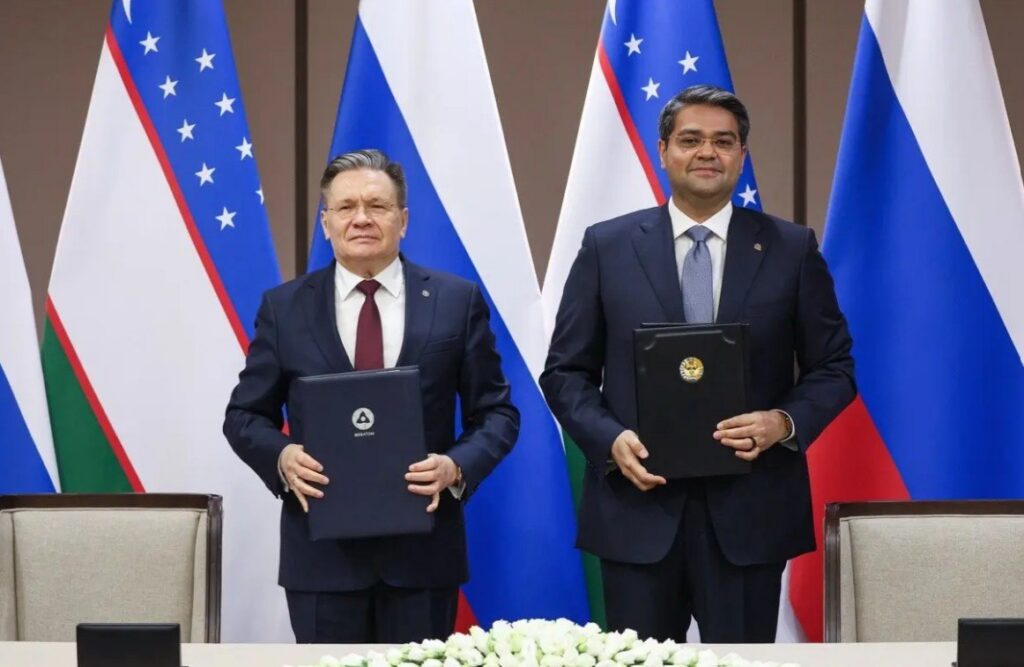
Uzbekistan’s plans to begin construction of its first nuclear power plant have come under renewed scrutiny following the publication of a draft state program suggesting the start of work could be postponed until December 2026. The draft made public on the regulation.adliya.uz portal prompted widespread media speculation. According to the document, Uzbekistan intends to spend 2026 negotiating, signing, and registering an additional agreement with Russia’s state nuclear corporation, Rosatom. The proposed agreement would revise the configuration of the integrated nuclear power plant project, combining a large-capacity VVER-1000 reactor with small modular RITM-200N reactors. Some outlets interpreted this language as a sign that the pouring of the first concrete might not occur until the end of 2026. In response, the Uzatom nuclear energy agency issued an official clarification, stating that previously announced timelines remain unchanged. In a statement released after the draft’s publication, Uzatom stressed that the document does not stipulate any postponement of construction. The agency noted that the December 2026 date reflects a conservative planning scenario in which all preparatory and licensing procedures are finalized by that time. Uzatom emphasized its adherence to national legislation and international standards on nuclear and radiation safety. It added that the first concrete pouring, considered a key milestone, will only proceed after receiving all necessary permits and approvals from relevant authorities. “We clearly understand the level of responsibility involved in this stage,” the agency said, adding that work on the project is advancing across all areas. The clarification comes amid sustained public interest in Uzbekistan’s nuclear energy plans. Speaking at World Atomic Week in Moscow in September last year, Uzatom Director Azim Akhmedkhadjaev stated that Uzbekistan aims to fully commission a high-capacity nuclear power plant by 2035. According to him, the first small modular reactor in the Jizzakh region is expected to begin operations in 2029, with a second unit following six months later. The first reactor of the large-scale facility is scheduled to come online in 2033, with full capacity reached by 2035, though Akhmedkhadjaev noted that final timelines are contingent on the completion of contractual agreements. Uzatom said it will continue to provide timely updates as the project progresses through its key phases.

Kazakhstan Names First Nuclear Facility the Balkhash Nuclear Power Plant

Kazakhstan has officially named its first nuclear power facility the Balkhash Nuclear Power Plant, following the results of a national competition. More than 10,000 unique names were proposed by citizens across the country, with “Balqash Atom Elektr Stansiyasy” (in Kazakh) receiving the most votes. Nationwide Contest Engages Public in Naming The competition to name the new plant was conducted via the eGov Mobile platform and ran from September 25 to October 10. Open to citizens aged 16 and older, the contest received 27,157 entries, generating 10,460 unique name suggestions. These figures accounted for variations in Cyrillic and Latin spelling, as well as synonymous formulations. A selection committee was established on September 5, comprising public figures, members of the creative sector, philologists, historians, and nuclear energy experts. In its final session, the committee reviewed the 100 most popular submissions. Why “Balqash” Was Selected The winning name, “Balqash Atom Elektr Stansiyasy,” was submitted by 882 participants, placing it at the top of the popularity ranking. The Atomic Energy Agency noted that naming nuclear power plants after their geographical location aligns with international conventions. In this case, the name references the Balkhash Lake region, where the plant is under development. The commission also approved the following official version of the name in English: Balkhash Nuclear Power Plant. Participants who proposed the winning name will receive electronic certificates of co-authorship via the eGov Mobile app within one month. Authorities have compiled a database of all name proposals, which may be used in future naming efforts for additional nuclear units or plants. Despite the public engagement, some citizens on social media questioned the outcome, expressing skepticism about the need for a contest that ultimately selected a geographically obvious name. Construction Progresses at Ulken Site While the naming contest was underway, initial construction began at the nuclear plant’s designated site near the village of Ulken in the Almaty region. Preparatory work commenced in August, led by the Russian state corporation Rosatom as the general contractor. By the end of October, design and survey work was already in progress. The Ulken Nuclear Power Plant is expected to play a central role in Kazakhstan’s long-term energy strategy. Discussions are also underway regarding a potential second nuclear facility in the Zhambyl District of the Almaty region, though this project remains in the evaluation phase. Experts consider the area a promising location for future development.

IAEA Approves Site for Nuclear Power Plant in Eastern Kazakhstan

The International Atomic Energy Agency (IAEA) has approved a site near the city of Kurchatov in Kazakhstan’s eastern Abai region for the potential construction of a nuclear power plant, according to its Chairman Almasadam Satkaliyev. Kazakhstan held a national referendum last year on nuclear energy development, with over 71 percent of voters endorsing the construction of a nuclear power plant. Following the vote, the government selected Russia’s Rosatom as the contractor for the country’s first facility, located in the Almaty region. Construction has already begun near the village of Ulken on the shores of Lake Balkhash, approximately 400 kilometers from Almaty. President Kassym-Jomart Tokayev has since outlined plans to build a network of two to three nuclear power plants across the country. He has instructed the government to finalize both the vendor selection and site locations. China’s National Nuclear Corporation (CNNC) has been chosen to construct two additional plants, although their locations remain undecided. Kurchatov, adjacent to the former Semipalatinsk nuclear test site, and the Mangystau region on the Caspian Sea coast are under consideration. Speaking before parliament, Satkaliyev confirmed that the Kurchatov site has received IAEA approval. “We have a very transparent procedure before any decision on construction: mandatory public hearings, mandatory conclusions from the Ministry of Emergency Situations and other authorized state bodies, a full site survey, and an assessment by international experts. The IAEA has already approved the Kurchatov site, but without the consent of the local population, construction will not begin anywhere in Kazakhstan,” he said. Satkaliyev emphasized that no final decision has been made regarding construction in Kurchatov, but he expressed personal support for deploying small and medium modular reactors in the Abai region, which he described as “not as critically dangerous.” A decision has also not been finalized on the potential western site. Satkaliyev noted that the Caspian coast remains under review for the installation of small or medium reactors. “A corresponding study will soon be carried out to assess the feasibility of construction, based on IAEA criteria: seismic activity, safety, availability of a reservoir, and sufficient water supply. We believe this site has strong potential,” he said. During a recent meeting of the State Commission on the Atomic Industry, the Zhambyl district in the Almaty region was identified as another prospective site. “This means the second plant will also be in the south of the country, where there is currently an energy deficit. Electricity is transmitted there via the North-South transit line. A plant in this region would improve the reliability and stability of energy supply,” Satkaliyev explained. As previously reported by The Times of Central Asia, Tokayev also announced plans to establish nuclear science cities in Almaty and Kurchatov to support the development of nuclear energy and nuclear medicine.

Uzbekistan Plans Full Launch of Large Nuclear Power Plant by 2035

Uzbekistan plans to fully launch a high-capacity nuclear power plant by 2035, according to Azim Akhmedkhadjaev, director of the “Uzatom” agency. Speaking on September 25 at World Atomic Week in Moscow, Akhmedkhadjaev said the first small modular reactor is expected to begin operations in 2029 in the Jizzakh region, followed by a second unit six months later. The large-scale plant will see its first reactor come online in 2033, with full capacity expected by 2035. He noted, however, that final timelines depend on the conclusion of outstanding contract agreements. Akhmedkhadjaev confirmed that production of reactor equipment is already underway and that the project is proceeding on schedule. Responding to a question from a Spot correspondent, he reiterated the target dates for the larger reactors and emphasized that the timeline will be refined once contracts are finalized. The announcement aligns with Uzbekistan’s broader nuclear energy strategy. As previously reported by The Times of Central Asia, the country plans to build both small modular and larger reactors at a single integrated nuclear facility. Under a revised agreement with Russia, Uzbekistan intends to construct two large VVER-1000 reactors alongside two smaller RITM-200N units. The initial framework for the project was established in 2018 and updated in 2024. Earlier this year, The Times of Central Asia reported that Rosatom had begun manufacturing reactor components for the smaller units, with the first steel castings for the RITM-200N already produced in Saint Petersburg. Uzbekistan’s pivot to nuclear energy is part of its strategy to meet rapidly increasing electricity demand, which is projected to reach 135 billion kWh by 2035, nearly double current consumption levels. To address this, the government is expanding generation capacity and modernizing the national grid. While the plans are ambitious, challenges remain. As Akhmedkhadjaev acknowledged, the full implementation timeline depends heavily on contract finalization. Nevertheless, Uzbekistan’s dual-track approach, combining scalable small reactors with large base-load units, suggests a strategic commitment to energy security and diversification.

From Gas to Gigawatts: Uzbekistan Powers Ahead with Dual Nuclear Deal

Uzbekistan has confirmed it will be building a large nuclear power plant (NPP) with two 1000-megawatt (MW) reactors as the country prepares for a sharp increase in electricity consumption in the coming years. Uzbekistan’s state atomic energy company, Uzatom, posted on September 26 that a new agreement calls for both a large and small NPP to be constructed at the same site in Uzbekistan. The revised plan for NPPs in Uzbekistan combines agreements the country signed with the Russian state nuclear company Rosatom in 2018 and 2024. Uzbek Prime Minister Abdullo Aripov and his Russian counterpart at the time, Dmitri Medvedev, signed a deal in September 2018 for a large NPP with two VVER-1200 reactors.  However, in late May 2024, during Russian President Vladimir Putin’s visit to Uzbekistan, a new agreement was signed for six small reactors, each with a capacity of 55 MW. Preparation work for six RITM-200N reactors started shortly after in the Farish district of Jizzakh Province. In June 2025, Russia’s Ministry of Economic Development said the agreement was restructured. The latest official agreement, signed September 26, 2025, commits to building an integrated NPP with two large VVER-1000 reactors and two small modular RITM-200N units. The Farish facility will be the first to house both a large and a small NPP at the same site. Speaking on the sidelines of the World Nuclear Week conference in Moscow on September 25, Uzatom director Azim Akhmedkhadjaev said, “We are the first in Central Asia to create an innovative solution for the future… (a) project combining advanced small modular reactor technology with time-tested solutions from large-scale nuclear energy.” The new agreement calls for the construction of two VVER-1000 units instead of the original VVER-1200 models. There was no explanation for the change in the type of reactors for the Uzbek facility. Uzbek Deputy Prime Minister Jamshid Khodjaev was also at the conference in Moscow. Hojayev noted Uzbekistan is seeking to increase renewable energy sources so that by 2030, these sources will produce more than 40% of Uzbekistan’s energy. Khodjaev pointed to solar and wind projects in explaining why the small NPPs are necessary. “Large blocks (reactors) provide stable baseload generation, while small blocks cover peak loads and balance the erratic operation of solar and wind farms,” according to Khodjaev. Essentially, the smaller reactors will help ensure a constant flow of electricity into the domestic grid when there is insufficient wind or sun to keep wind farms and solar power stations operating at full capacity. As Much as Possible and More Khodjaev has said that when both the large and small NPPs are operational in 2035, it will add some 15-billion-kilowatt hours (kWh) to Uzbekistan’s power grid. Electricity production in Uzbekistan has risen from some 59 billion kWh in 2016 to about 81.5 billion kWh in 2024. A relatively small percentage of that is exported to neighbors. A recent agreement with Kazakhstan calls for sending some 900 million kWh of Uzbek electricity to its northern neighbor between March and December 2026....