Viewing results 1 - 6 of 16
Another mass die-out of seals from an unknown disease has occurred on the Turkmen coast of the Caspian Sea, Radio Azatlyk has reported. In recent days, experts have found dozens of dead seals, whilst the Turkmen authorities have ordered the military to shoot animals swimming to the shore. But oceanographers are dissatisfied with the actions of the authorities. "The state believes that seals are not needed,” said an expert who wishes to remain anonymous. “If these animals are killed, as they do with stray dogs and cats, they will soon disappear. Instead of shooting and destroying seals, the state should increase the number of specialists studying these animals and increase efforts to save them." Caspian seals are considered endemic to the Caspian Sea and are listed in the Red Book of Turkmenistan, as well as in the Red Book of the International Union for Conservation of Nature. According to oceanologists, the death of Caspian seals in the winter and spring season every year has become a trend. It is still impossible to say exactly what the cause of the mass die-outs is, since no information has been released about the studies conducted. But Turkmen oceanologists attribute the main cause of the deaths to be the violation of the ecology of the Caspian Sea, emissions from oil and gas enterprises, regular naval exercises, and an increase in factories in coastal areas. In August of this year, Turkmen Foreign Minister, Rashid Meredov expressed his concerns about the deteriorating ecology of the Caspian Sea, including the mass death of seals in 1997, 2000, 2021 and 2022. However, no concrete steps have been taken to remedy the issue.
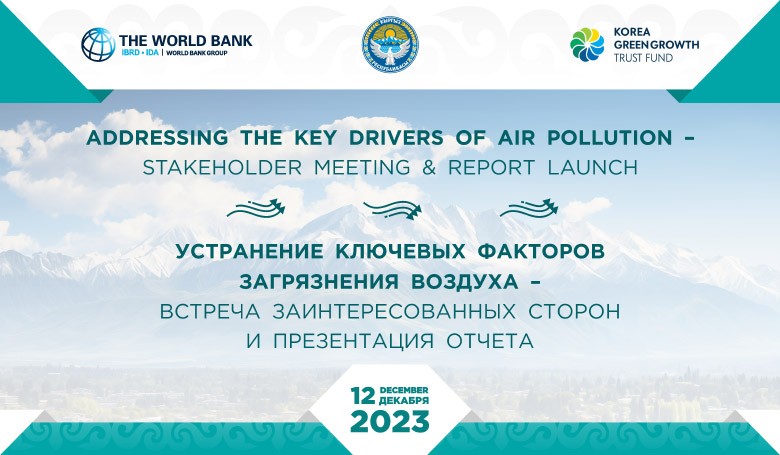
The World Bank and the Ministry of Natural Resources, Ecology and Technical Supervision (MNRETS) of the Kyrgyz Republic on December 12th hosted a stakeholder meeting to launch the World Bank's new report, Air Quality Analysis for Bishkek: PM2.5 Source Apportionment and Emission Reduction Measures, according to a statement on the World Bank website. The World Bank conducted this study in close coordination with MNRETS Hydrometeorological Service (Kyrgyzhydromet) under the Ministry of Emergency Situations and Bishkek Municipality to evaluate the air quality in Bishkek, focusing on PM2.5 pollution. Exposure to fine inhalable particles (PM2.5 with a diameter of 2.5 micro-meters or less) poses serious health risks, including respiratory infections, cancer, cardiovascular diseases, and premature deaths. In Bishkek, the average annual PM2.5 concentrations in 2022 surpassed the WHO guideline value of 5 µg/m3 by nearly sevenfold. During the last several winters, average daily concentrations of PM2.5 were often above 200 µg/m3, surpassing the WHO guideline of 15 µg/m3 by more than 13 times and placing Bishkek among the world’s most polluted cities. The losses caused by air pollution in Bishkek are estimated to be equivalent to 1.2% of the Kyrgyz Republic’s GDP, while air pollution at country level is estimated cost 5.1% of the GDP. In line with priorities and recommendations identified in the study, the World Bank jointly with MNRETS, KyrgyzHydromet and Bishkek Municipality has prepared a $50 million Kyrgyz Republic Air Quality Improvement Project to help the country reduce air pollution and the adverse effects it has on public health and the economy. This project is expected to not only directly benefit residents of Bishkek by improving the city’s air quality, but will also support the establishment of a sound Air Quality Management System that will drive policy actions for air quality improvement, aiming to mitigate the impact of air pollution on public health and economic development across the country.