


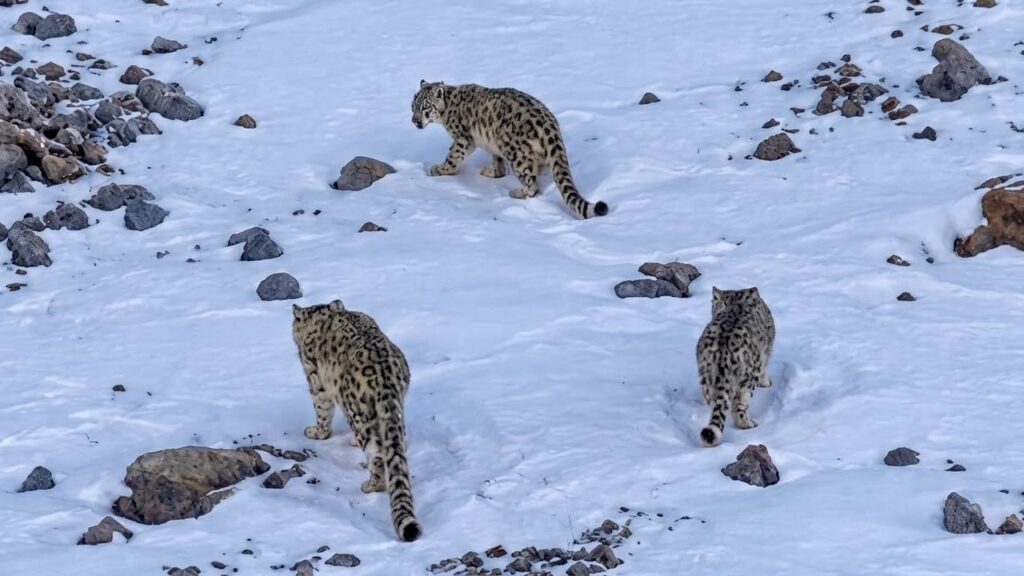
Three Snow Leopards in Kyrgyzstan Filmed as Conservation Efforts Expand
In a rare sight for wildlife watchers, three snow leopards have been filmed climbing a mountainside in Kyrgyzstan’s Naryn region. Employees of the Ministry of Natural Resources, Ecology, and Technical Supervision recorded the animals during a survey of a nature reserve, and the ministry released the footage on November 11. Its release came less than three weeks after Ak Ilbirs opened on October 23, International Snow Leopard Day. The snow leopard research and rehabilitation center in the village of Ananyevo on the shores of Lake Issyk-Kul is the first specialized facility of its kind in Central Asia. Russia’s Republic of Tatarstan helped establish the 1,600-square-meter complex, which includes laboratories, a veterinary facility, accommodations for specialists, and a museum. Kyrgyz and Russian scientists plan to study the genetic diversity of snow leopards, collect biological samples for a specialized repository known as a biobank, treat injured animals, and prepare them for release back into the wild. The snow leopard, also known as the irbis, is a national symbol of Kyrgyzstan. Its main habitats are in the Naryn and Issyk-Kul regions, among the remote mountain ranges of the Tian Shan. Kyrgyz authorities say snow leopard numbers have increased in recent years, although estimates vary considerably. In March 2026, Deputy Minister Asel Raimkulova told a parliamentary committee that more than 550 snow leopards lived in Kyrgyzstan. In September 2025, a ministry official reported a 2024 estimate of 511 animals, up from 282 in 2013. An assessment conducted between 2020 and 2024 under the Global Snow Leopard and Ecosystem Protection Program, however, estimated the population at approximately 285 adult animals. That study, which used 875 camera traps, produced an estimated range of 234 to 349. Snow leopards are difficult to count across vast mountainous areas, and these figures cannot reliably establish population growth without a comparison of the research methods. Snow leopards inhabit 12 countries across Asia and are classified as vulnerable by the International Union for Conservation of Nature. Their main threats include poaching, declining populations of wild hoofed prey, climate change, and conflicts with herders. They sometimes prey on livestock, prompting retaliatory killings by local residents. In Kyrgyzstan, anyone who illegally kills a snow leopard faces a compensation payment of 2 million soms, approximately $22,900, and possible criminal prosecution. Suspected poaching can be reported through the 108 hotline. In October 2024, Kazakhstan and Kyrgyzstan signed a five-year agreement to jointly protect snow leopards in the northern Tian Shan. It covers Kazakhstan’s Kolsai Kolderi and Ile-Alatau national parks, along with the Almaty State Nature Reserve and Kyrgyzstan’s Chon-Kemin State Nature Park. At the time of the agreement, Kazakhstan estimated its snow leopard population at between 152 and 189 animals. The agreement provides for joint monitoring of the predators and their prey, with scientific data shared to coordinate conservation measures. In November 2026, the two countries’ environment ministers discussed expanding these efforts, including measures to combat poaching and preserve wildlife corridors. In June 2026, all five Central Asian countries signed a joint statement of interest...
