
• KGS/USD = 0.01144 0%
  • KZT/USD = 0.00199 0%
  • TJS/USD = 0.10857 -0.18%
  • UZS/USD = 0.00008 0%
  • TMT/USD = 0.28571 0%
  • KGS/USD = 0.01144 0%
  • KZT/USD = 0.00199 0%
  • TJS/USD = 0.10857 -0.18%
  • UZS/USD = 0.00008 0%
  • TMT/USD = 0.28571 0%
  • KGS/USD = 0.01144 0%
  • KZT/USD = 0.00199 0%
  • TJS/USD = 0.10857 -0.18%
  • UZS/USD = 0.00008 0%
  • TMT/USD = 0.28571 0%
  • KGS/USD = 0.01144 0%
  • KZT/USD = 0.00199 0%
  • TJS/USD = 0.10857 -0.18%
  • UZS/USD = 0.00008 0%
  • TMT/USD = 0.28571 0%
  • KGS/USD = 0.01144 0%
  • KZT/USD = 0.00199 0%
  • TJS/USD = 0.10857 -0.18%
  • UZS/USD = 0.00008 0%
  • TMT/USD = 0.28571 0%
  • KGS/USD = 0.01144 0%
  • KZT/USD = 0.00199 0%
  • TJS/USD = 0.10857 -0.18%
  • UZS/USD = 0.00008 0%
  • TMT/USD = 0.28571 0%
  • KGS/USD = 0.01144 0%
  • KZT/USD = 0.00199 0%
  • TJS/USD = 0.10857 -0.18%
  • UZS/USD = 0.00008 0%
  • TMT/USD = 0.28571 0%
  • KGS/USD = 0.01144 0%
  • KZT/USD = 0.00199 0%
  • TJS/USD = 0.10857 -0.18%
  • UZS/USD = 0.00008 0%
  • TMT/USD = 0.28571 0%
05 December 2025

Viewing results 1 - 6 of 3

Mice in “Miniature Hotel” Poised for Space Launch from Baikonur

A crew of mice, flies, and ants, to be used for biomedical research in space, are on board a spacecraft that Russia is preparing to launch from the Baikonur Cosmodrome in Kazakhstan. On other missions, the rocket typically rolls to the launch pad a few days before launch. On this one, however, a Soyuz rocket that will hoist the Bion-M No. 2 biosatellite into orbit rolled out on Tuesday, one day ahead of the scheduled lift-off. “This is due to the preservation of the biological samples on board,” said Roscosmos, Russia’s space agency. “The goal is to reach weightlessness as quickly as possible.” The purpose of sending mice to space is to evaluate the impact of radiation and zero gravity on the rodents, including whether time in space affects their hormonal balance, immunity, reproductive processes, and metabolism. Russia has conducted similar missions in the past, including the Bion-M No.1 satellite launch in 2013 that ferried mice, gerbils, snails, and fish to space. The Bion-M No. 2 mission has been delayed multiple times in recent years. Such experiments could help prepare humans for long-term space travel. Mice have a genetic similarity to humans, and their short life cycle allows for the tracking of changes across generations, according to Roscosmos. During the 30-day mission of the Bion-M No. 2, “scientists will receive real-time data on the rodents' condition using special cameras and sensors inside the mouse boxes. Moreover, some individuals will have implanted chips,” the space agency said. It said the living conditions of the dozens of mice on the satellite resemble a “miniature hotel” in which they have feeding, lighting, ventilation, and waste disposal systems. The accommodation is more spacious than it was for the mice on the Bion-M No. 1 satellite more than a decade ago. Fruit flies, ants, tomato seeds and fungi are also on this week’s space-bound mission. The tomato seeds, part of an experiment being conducted by Russian and Belarusian schoolchildren, will be planted on Earth after the space mission to see how they grow.

Baikonur Cosmodrome Gears Up for 70th Anniversary; Trespassers Detained

Two European tourists have been detained while trying to take photographs at the Baikonur Cosmodrome in Kazakhstan, Russian media reported on Thursday, as officials prepare to celebrate the 70th anniversary of the Russia-operated spaceflight center on June 2. “The men were trying to sneak to the Buran rocket and take photos," an unidentified law enforcement official told Russia’s state news agency TASS, which reported on Thursday that the men, who were from Czechia, also known as the Czech Republic, were released after being fined 5,000 rubles, or $60. The trespassers were the latest in a long list of space enthusiasts and adventure-seekers who have tried to get close to a Soviet-era facility that pioneered early space exploration and remains a vital if aging part of Russia’s space program. The disused Buran spacecraft, a space shuttle that was developed in the 1970s and 1980s by the Soviet Union, is an object of particular fascination. The Buran flew once in 1988, but the program was abandoned because of high costs and a lack of purpose. Russian and Kazakh media, meanwhile, are reporting on plans for anniversary celebrations at the cosmodrome, which is serviced by a city of the same name in the desert environment in southern Kazakhstan. Some rocket mock-ups will be on display and an open-air museum is being set up, the Kazinform news agency reported. One of the mock-ups is 22 meters high and is a model of the Soviet N1 lunar rocket that failed in its four test launches in the late 1960s and early 1970s. Space journalist Anatoly Zak was not impressed by the planned display, saying on X that he is concerned about reports that Russia is destroying “artifacts and documents” that illuminate the historical record of the Soviet space program. Another piece of Baikonur history occurred on Saturday when a Venus-bound lander probe, which launched from the cosmodrome in 1972 but never got out of Earth’s orbit, made an uncontrolled re-entry into Earth’s atmosphere. Russian space agency Roscosmos said the lander fell in the Indian Ocean west of Jakarta, though questions remain about its fate, including whether it burned up during re-entry or somehow remained intact.

Crew of Record-Breaking Cosmonauts Land in Kazakh Steppe

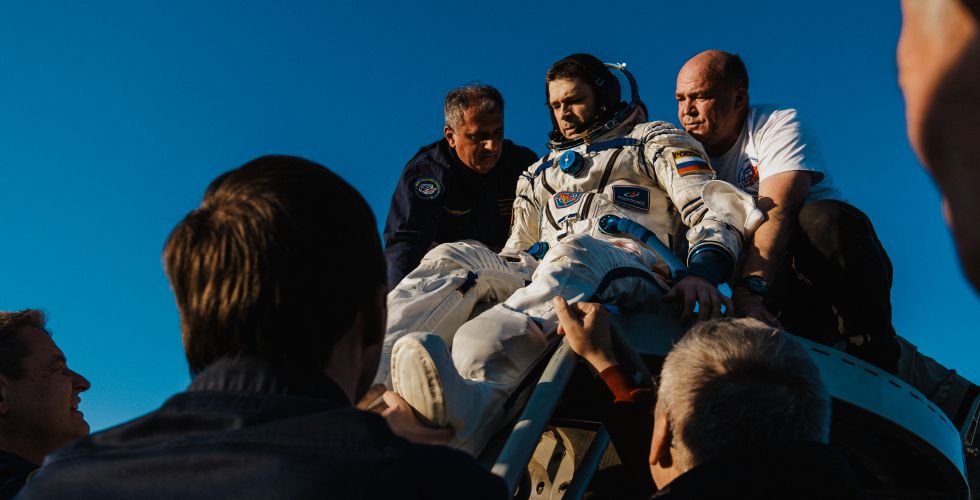
The descent vehicle of the Soyuz MS-25 spacecraft has successfully landed in the steppe of Kazakhstan, near the town of Zhezkazgan. Russian cosmonauts Oleg Kononenko, Nikolai Chub, and NASA astronaut Tracy Dyson were on board. Cosmonauts Kononenko and Chub spent 374 days in space, making their mission one of the longest in International Space Station (ISS) history. This is second only to the flights of Valery Polyakov and Sergey Avdeev, who spent 438 and 380 days in space, respectively, on the Mir station. Tracy Dyson stayed in orbit for 184 days. During their mission, Kononenko and Chub participated in several scientific experiments, took four Progress MS cargo ships, and conducted two spacewalks. The flight was an important contribution to the development of applied and fundamental research on the ISS. The spacecraft landed yesterday at 14:59, Moscow time. Kononenko and Chub's flight was a significant event for the space programs of Roscosmos and NASA. Despite completing their mission, the crew of the 72nd long-duration expedition, including Russian and American cosmonauts and astronauts, continues to work on the ISS. The station crew includes Roscosmos cosmonauts Alexei Ovchinin, Ivan Wagner, and Alexander Grebenkin, and NASA astronauts Donald Pettit, Matthew Dominick, Michael Barratt, Jeanette Epps, Barry Wilmore, and Sunita Williams. The International Space Station (ISS) is one of mankind's most impressive engineering projects. It was launched in 1998, and is the product of 16 countries. The station revolves around the Earth every 90 minutes, allowing the crew to observe 16 sunrises and sunsets daily. In addition, the ISS is the largest object ever built in space, measuring about 109 meters long. The ISS is also considered the most expensive object built by humans, costing an estimated $120 billion by 2014, alone. According to NASA, the ISS "costs about $3 billion a year, roughly a third of NASA’s annual human space flight budget."
