
• KZT/USD = 0.00226
  • TJS/USD = 0.10830
  • UZS/USD = 0.00009
  • TMT/USD = 0.29760
  • KZT/USD = 0.00226
  • TJS/USD = 0.10830
  • UZS/USD = 0.00009
  • TMT/USD = 0.29760
  • KZT/USD = 0.00226
  • TJS/USD = 0.10830
  • UZS/USD = 0.00009
  • TMT/USD = 0.29760
  • KZT/USD = 0.00226
  • TJS/USD = 0.10830
  • UZS/USD = 0.00009
  • TMT/USD = 0.29760
  • KZT/USD = 0.00226
  • TJS/USD = 0.10830
  • UZS/USD = 0.00009
  • TMT/USD = 0.29760
  • KZT/USD = 0.00226
  • TJS/USD = 0.10830
  • UZS/USD = 0.00009
  • TMT/USD = 0.29760
  • KZT/USD = 0.00226
  • TJS/USD = 0.10830
  • UZS/USD = 0.00009
  • TMT/USD = 0.29760
  • KZT/USD = 0.00226
  • TJS/USD = 0.10830
  • UZS/USD = 0.00009
  • TMT/USD = 0.29760
26 September 2026

Viewing results 1 - 6 of 3

Trade and Migrant Workers Fuel Serbia’s Growing Ties with Uzbekistan

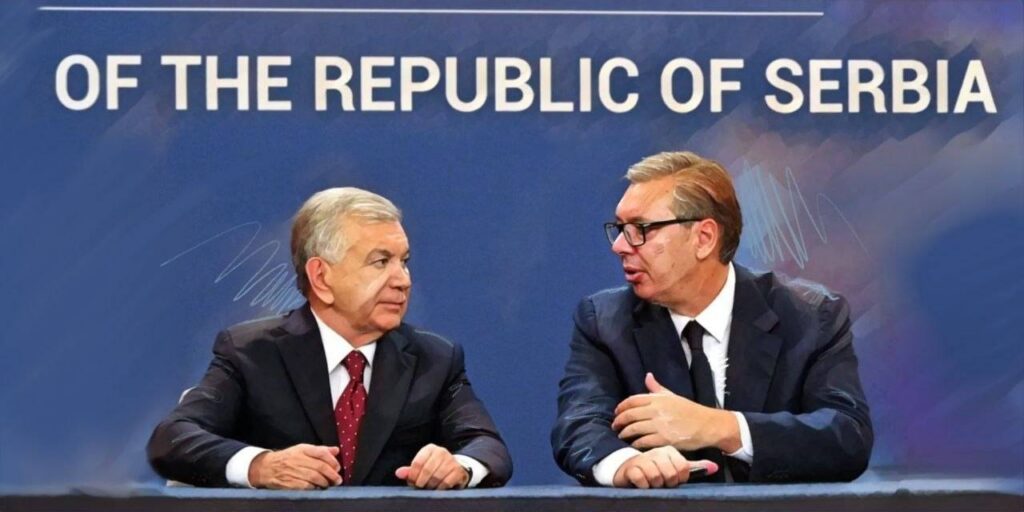
BELGRADE – While seeking to join the European Union – a process that has been going on for nearly two decades – Serbia is also moving to build closer relations with Central Asia. After expanding cooperation with Kazakhstan earlier this year, the Southeast European nation is now looking to replicate that momentum in its relations with Uzbekistan. At first glance, the two countries seem to have little in common. Serbia is a relatively small economy with strong ties to European markets, while Uzbekistan is Central Asia’s most populous nation and one of the region’s fastest-growing economies. Yet the two states are actively expanding their cooperation. On September 8, Serbian President Aleksandar Vucic and his Uzbek counterpart, Shavkat Mirziyoyev, signed a joint statement establishing a strategic partnership between Belgrade and Tashkent. Uzbekistan’s leader’s visit to Serbia comes less than a year after Vucic made his first official trip to the Central Asian state. In the meantime, the Serbian government announced its plans to open an embassy in Tashkent – a move that will undoubtedly further strengthen diplomatic and economic ties between the two countries. While the economy was at the top of the agenda during Vucic and Mirziyoyev’s talks in Belgrade, the meeting also carried significant political importance for the Serbian leader. Mirziyoyev arrived in Serbia on September 7, when thousands of people gathered to attend the funeral of former Bosnian Serb military commander Ratko Mladic. His death and the public tribute to him have reopened divisions over Serbia’s wartime legacy and further complicated its relationship with the European Union. Vucic had a long-standing reason not to attend the ceremony: he was due to meet Mirziyoyev at the airport. However, multiple opposition figures accused the Serbian leader of using Mirziyoyev’s visit as a justification for staying away, with one alleging that the visit had actually been rescheduled to give him an excuse. The following day, the two leaders, as well as Serbian and Uzbek delegations, signed 20 agreements in various fields, from digitalization and renewable energy to trade, transport, agriculture, tourism, healthcare, and culture. Vucic even hinted that Serbia aims to expand military ties with Uzbekistan. As he stressed, Belgrade plans to develop long-range ballistic missiles over the next year and has invited Uzbekistan to cooperate in this area. Meanwhile, the Southeast European nation is expected to establish direct flights between Belgrade and Tashkent within the next seven to eight months. More importantly, Serbia, which has free trade agreements with the European Union, China, Turkey, the UK, and the Eurasian Economic Union, as well as regional Balkan nations, hopes to strike such a deal with Uzbekistan. According to Jagoda Lazarevic, the country’s Minister of Internal and Foreign Trade, if the process succeeds, Serbia would become the first European country to enter into free trade talks with Uzbekistan. However, bilateral trade between the two nations remains relatively small, reaching $41.8 million in 2025. By comparison, according to data from Kazakhstan’s Ministry of Trade and Integration, trade between the largest Central Asian country...
Vučić in Astana: Trade, Defense, and Technology Drive Kazakhstan–Serbia Talks

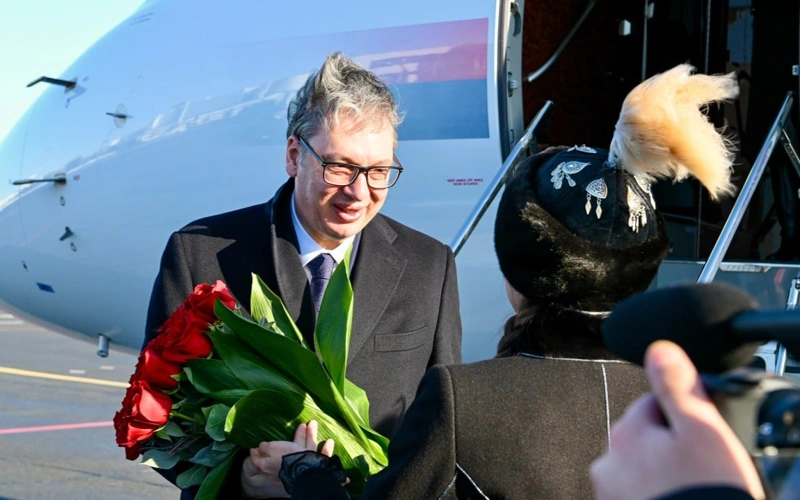
Serbian President Aleksandar Vučić arrived in Astana on February 26 for a two-day official visit. Prime Minister Olzhas Bektenov and Astana Mayor Jenis Qasymbek received him at the airport. Vučić is scheduled to hold talks with President Kassym-Jomart Tokayev on February 26–27. The agenda includes political dialogue, trade, digital transformation, healthcare, science, culture, and judicial cooperation. The two presidents are expected to adopt a joint statement and oversee the signing of ten memorandums. Kazakhstan also plans to award Vučić the Order of the Golden Eagle, the country’s highest state honor. The Serbian delegation includes Minister of Internal and External Trade Jagoda Lazarević, Minister without Portfolio Nenad Popović, and Mihailo Jovanović, director of Serbia’s Office for eGovernment and IT. Economic ties form a central pillar of the visit. Kazakhstan’s government stated that bilateral trade grew by 7.6% in 2025. At the first meeting of the Kazakhstan–Serbia Business Council and Business Forum in Astana, Nenad Popović said trade turnover reached about $117 million in 2025, an increase of roughly 7%. “The free-trade agreement between our countries ensures a strong institutional basis. It is now important to further strengthen this foundation with concrete projects and targeted mechanisms to support entrepreneurship in Kazakhstan and Serbia, as well as their business communities,” he stated. Defense cooperation has also emerged as a significant outcome of the business meetings. Kazakhstan’s LLP SP Kaztechnology and Serbia’s Yugoimport SDPR agreed to cooperate on the repair and modernization of 122mm and 152mm self-propelled artillery systems from the Nora and Soko/Soho families. LLP Great Sky and Yugoimport SDPR also signed a framework agreement on technology transfer and the organization of high-energy materials production. The visit extends beyond defense. Astana Hub signed memorandums with Serbia’s Digital Transformation Center, SEE UP Accelerator, and Science Technology Park Belgrade. Kazakhstan’s National Biotechnology Center also signed a memorandum with Serbia’s Bio4 Campus. Diplomatic relations between Kazakhstan and Serbia were established in December 1996. As previously reported by The Times of Central Asia, momentum in bilateral ties increased in late 2024 when Tokayev visited Serbia, and the sides signed multiple cooperation agreements in trade, investment, and industry. The Astana meetings signal a practical expansion of relations between Central Asia and the Balkans. Trade remains modest in absolute terms, but the new agreements in defense, digital technology, and biotechnology point to the growth of a broader industrial partnership.

Kazakhstan and Serbia Strengthen Ties Despite Different Geopolitical Paths

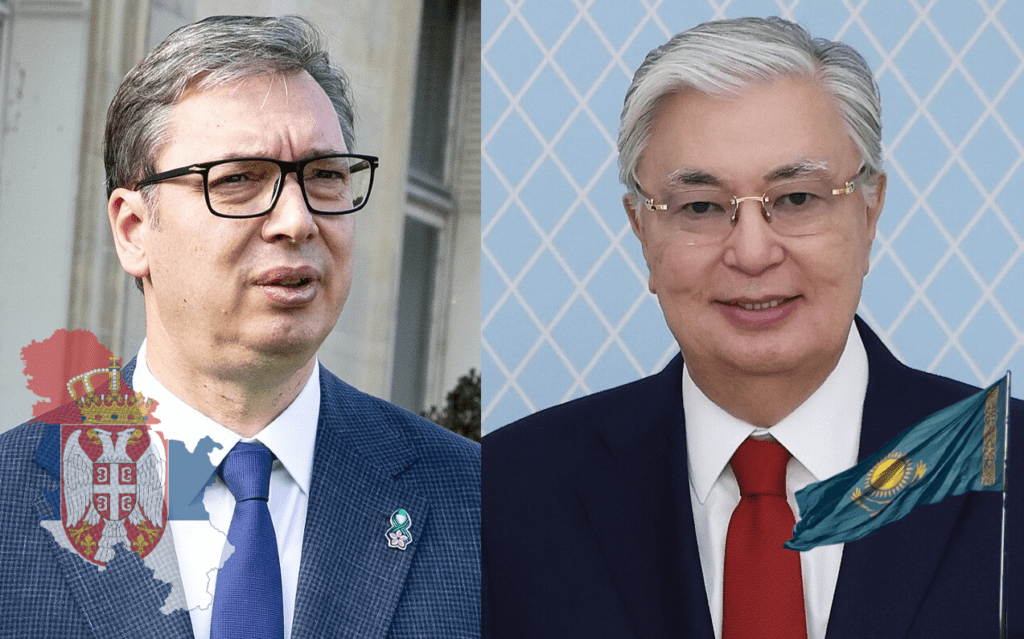
Serbian President Vucic (54) might physically resemble Kazakh leader Kassym-Jomart Tokayev (71), but the geopolitical positions of Sebia and Kazakhstan could not be more different. While the Balkan nation – a European Union candidate since 2012 – remains in the EU’s “eternal waiting room”, the Central Asian country – a member of the Russian-led Eurasian Economic Union – seems to have found a delicate balance between Russia, China, and the West. Those differences, however, have not prevented Serbia and Kazakhstan from strengthening their bilateral ties. Over the past six months, the two countries have been actively preparing for Tokayev’s trip to Serbia. This year, he spoke by phone with Vucic twice, while various Serbian and Kazakh officials held several meetings. On November 18-19, Tokayev finally visited the Southeastern European nation, where he met with his Serbian counterpart. According to the Kazakh leader, they discussed strengthening trade and economic relations and bilateral partnerships between the two nations. “It is essential that we develop cooperation. We had constructive talks and reached important deals,” Tokayev stressed. During his visit to the Balkan country, Serbian and Kazakh ministers signed several bilateral agreements. One of them is a 2025 plan on military cooperation. It is, therefore, no surprise that, following the talks in Belgrade, Vucic and Tokayev attended an exhibition of arms and military equipment at the Batajnica military airport near the Serbian capital. Indeed, military ties seem to be an important aspect of the Serbian-Kazakh relationship. Back in 2017, the two nations signed a memorandum of understanding in the field of military-technical collaboration. Six years later, in November 2023, Kazakhstan and Serbia inked intergovernmental agreements on military-technical cooperation, while in June of this year Serbian and Kazakh defense ministers discussed in Astana military relations between the two countries. Also, in September, Roman Vassilenko, Kazakhstan’s Deputy Foreign Minister, announced that Belgrade and Astana plan то expand cooperation in the defense industry. It remains to be seen how Moscow – Astana’s nominal ally in the Collective Security Treaty Organization (CSTO) – will react to Kazakhstan’s ambitions to deepen military ties with Serbia – a nominally neutral country that has indirectly supplied Ukraine with $885 million worth of weapons. Despite being in different geopolitical positions, Serbia and Kazakhstan seem to share the same approach regarding Ukraine. Both nations support the Eastern European country’s territorial integrity, while trying to preserve relatively good relations with the Kremlin. At the same time, they support each other’s territorial integrity, which is particularly important for Serbia given that Kazakhstan does not recognize the 2008 unilateral independence of Kosovo. In 2022, sitting next to Russian President Vladimir Putin, Tokayev said that if the right to self-determination is put into practice worldwide, then there will be over 600 countries instead of the 193 states which are currently members of the United Nations. “For this reason, we do not recognize either Taiwan, or Kosovo, or South Ossetia, or Abkhazia… This principle will also be applied to quasi-state territories, which, in our opinion, are Lugansk and...
