

• KZT/USD = 0.00222
  • TJS/USD = 0.10820
  • UZS/USD = 0.00009
  • TMT/USD = 0.29760
  • KZT/USD = 0.00222
  • TJS/USD = 0.10820
  • UZS/USD = 0.00009
  • TMT/USD = 0.29760
  • KZT/USD = 0.00222
  • TJS/USD = 0.10820
  • UZS/USD = 0.00009
  • TMT/USD = 0.29760
  • KZT/USD = 0.00222
  • TJS/USD = 0.10820
  • UZS/USD = 0.00009
  • TMT/USD = 0.29760
  • KZT/USD = 0.00222
  • TJS/USD = 0.10820
  • UZS/USD = 0.00009
  • TMT/USD = 0.29760
  • KZT/USD = 0.00222
  • TJS/USD = 0.10820
  • UZS/USD = 0.00009
  • TMT/USD = 0.29760
  • KZT/USD = 0.00222
  • TJS/USD = 0.10820
  • UZS/USD = 0.00009
  • TMT/USD = 0.29760
  • KZT/USD = 0.00222
  • TJS/USD = 0.10820
  • UZS/USD = 0.00009
  • TMT/USD = 0.29760
13 September 2026

Viewing results 1 - 6 of 2

S&P Bolsters Kazakhstan’s Standing as Central Asia’s Financial Hub

S&P Global Ratings has improved its assessment of Kazakhstan’s banking industry as Astana Finance Days opens on September 9, lowering the industry risk score for the country’s banking system from 7 to 6 and citing stronger regulation and supervision. According to Kazakhstan’s Agency for Regulation and Development of the Financial Market, the September 4 decision improved the industry risk component of S&P’s Banking Industry Country Risk Assessment, or BICRA. S&P also changed the trend on Kazakhstan’s separate economic risk assessment from stable to positive. S&P’s BICRA framework evaluates banking systems on a scale of 1 to 10, with lower numbers indicating lower risk. Industry risk assesses factors including banking regulation and supervision, competitive dynamics, and the stability of systemwide funding. Kazakhstan’s overall BICRA grouping remains at 7, while its industry risk score improved from 7 to 6. The industry risk comparison puts the change in perspective. S&P’s published assessments place the United States at 3, Germany at 4, and Brazil at 5. Kazakhstan’s new score of 6 places it alongside banking systems including Bahrain, Oman and Thailand in recent S&P assessments. Within Central Asia, the difference is wider. S&P has assigned Kyrgyzstan an industry-risk score of 8 and Uzbekistan a score of 9. S&P does not currently publish BICRA assessments for Tajikistan or Turkmenistan. S&P also considers Kazakhstan’s banking regulation and supervision more effective than those of Uzbekistan, Kyrgyzstan, Armenia, and Azerbaijan, according to the Kazakh regulator. Stronger Supervision The regulator attributed S&P’s decision to regular asset-quality reviews, risk-based supervisory assessments and measures to limit excessive bank risk-taking, particularly in retail lending. It also cited tighter capital and liquidity oversight and stress testing. The change has already affected individual institutions. The regulator reported an upgrade of the Bank Center Credit’s long-term rating to BB+, while Halyk Bank’s BBB− rating received a positive outlook, indicating the possibility of a future upgrade. The banking decision follows S&P’s August 21 sovereign upgrade from BBB− to BBB with a stable outlook. Kazakhstan remains Central Asia’s only investment-grade sovereign. In an interview with TCA, National Bank Governor Timur Suleimenov linked that improvement to a stronger monetary policy framework, banking resilience, and closer coordination with the government. Kazakhstan also has Central Asia’s most developed capital markets. Almaty’s banks, professional services and Kazakhstan Stock Exchange operate alongside the Astana International Financial Centre and its exchange, giving the country an established concentration of financial business. Capital on the Agenda The timing of S&P’s decision gives the assessment added relevance as Kazakhstan hosts Astana Finance Days. The forum’s announced program includes regulation, law and market confidence, capital market development, and financing for the real economy. Organizers expect more than 5,500 participants from over 80 countries, with representatives of BlackRock, Goldman Sachs and Brookfield among the confirmed speakers. In an August 27 interview with TCA, Zhanbolat Kakishev, chief product officer at the AIFC Authority, said a cumulative $26.3 billion in investment had been attracted to Kazakhstan through the center’s ecosystem, which included more than 6,000 registered companies from 90 countries....
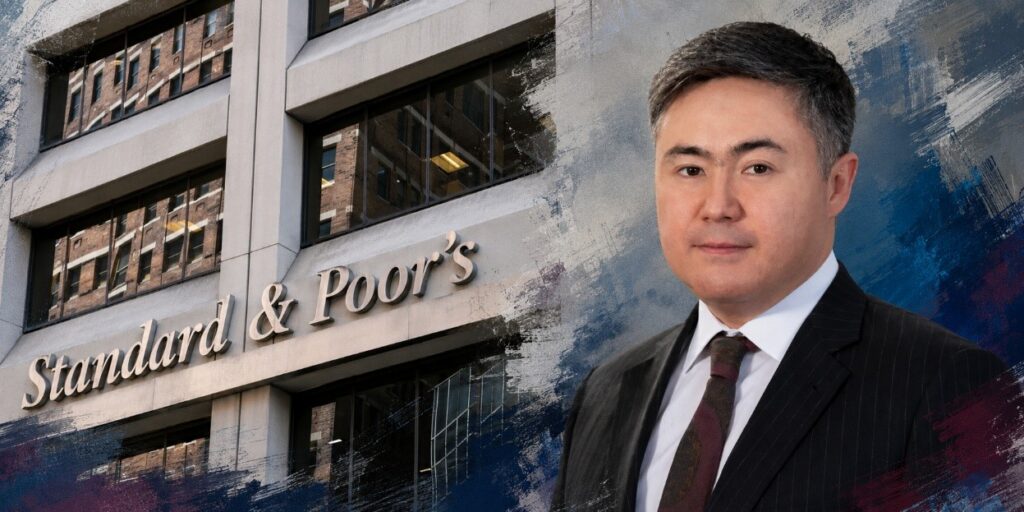

Suleimenov Says Stronger Policy Framework Supported Kazakhstan’s S&P Upgrade

A stronger monetary-policy framework, a resilient banking sector, and closer coordination with the government were among the strengths recognized in S&P Global Ratings’ upgrade of Kazakhstan, National Bank Governor Timur Suleimenov told The Times of Central Asia. “S&P’s upgrade of Kazakhstan’s sovereign credit rating from ‘BBB-’ to ‘BBB’ is an important external assessment of the resilience of our economy amid continued global uncertainty and commodity market volatility,” Suleimenov said. On August 21, S&P raised Kazakhstan’s long- and short-term sovereign credit ratings to BBB/A-2 from BBB-/A-3. The stable outlook reflects S&P’s view that Kazakhstan’s ample fiscal and external buffers should help it absorb external shocks, while the non-oil budget deficit is expected to narrow further. Kazakhstan last held the BBB rating before S&P downgraded it in February 2016. Kazakhstan now carries the same BBB long-term sovereign rating as India, Indonesia and Greece. It stands one notch above Hungary, Oman and Serbia at BBB-, and one below Bulgaria and Italy at BBB+. The comparison concerns credit risk rather than economic size or development. Why S&P Moved Now S&P expects Kazakhstan’s economy to grow by 5.1% in 2026 and by around 4% to 4.5% annually in 2027–2029, a pace it says exceeds that of peer countries. It also expects a broader tax base, tighter expenditure controls and reduced quasi-fiscal activity by major state-owned enterprises to improve the country’s fiscal position. Stricter rules governing National Fund withdrawals are intended to preserve the assets available to absorb commodity-price falls and other external shocks. According to the National Bank’s account of the decision, S&P also highlighted Kazakhstan’s substantial foreign-currency reserves and strong external position. A Stronger Monetary Framework “We particularly welcome the agency’s recognition of the strengthening of Kazakhstan’s monetary policy framework and the resilience of the banking sector to macroeconomic shocks,” Suleimenov said. Suleimenov had outlined that policy course in earlier interviews with TCA. In April, he described tighter monetary conditions alongside government fiscal consolidation, while in June, after the Bank cut its base rate from 18% to 17%, he cautioned that inflation had not been defeated and said further moves would depend on incoming data. Annual inflation declined from 11% in March to 10.2% in July. S&P cited a stronger monetary-policy framework, closer government-National Bank coordination, fiscal consolidation, reduced quasi-fiscal activity and tighter macroprudential regulation. It also described the banking sector as resilient, with adequate capital and liquidity buffers. The National Bank’s response went beyond the base rate. It increased minimum reserve requirements, used operations linked to gold purchases to absorb excess liquidity and supported measures to slow unsecured consumer lending. The Bank lowered the rate again to 16.75% in July as inflation eased. Even so, inflation remains more than double the National Bank’s medium-term target of 5%. S&P’s assessment recognizes the strengthening of the monetary-policy framework, not the end of Kazakhstan’s inflation problem. “Enhanced coordination between the Government and the National Bank, together with the continued improvement of regulation and supervision, is contributing to stronger macroeconomic and financial stability,” Suleimenov said. Fiscal Reform...