• KGS/USD = 0.01144 0%
  • KZT/USD = 0.00215 0%
  • TJS/USD = 0.10680 0.19%
  • UZS/USD = 0.00008 0%
  • TMT/USD = 0.28530 0%
  • KGS/USD = 0.01144 0%
  • KZT/USD = 0.00215 0%
  • TJS/USD = 0.10680 0.19%
  • UZS/USD = 0.00008 0%
  • TMT/USD = 0.28530 0%
  • KGS/USD = 0.01144 0%
  • KZT/USD = 0.00215 0%
  • TJS/USD = 0.10680 0.19%
  • UZS/USD = 0.00008 0%
  • TMT/USD = 0.28530 0%
  • KGS/USD = 0.01144 0%
  • KZT/USD = 0.00215 0%
  • TJS/USD = 0.10680 0.19%
  • UZS/USD = 0.00008 0%
  • TMT/USD = 0.28530 0%
  • KGS/USD = 0.01144 0%
  • KZT/USD = 0.00215 0%
  • TJS/USD = 0.10680 0.19%
  • UZS/USD = 0.00008 0%
  • TMT/USD = 0.28530 0%
  • KGS/USD = 0.01144 0%
  • KZT/USD = 0.00215 0%
  • TJS/USD = 0.10680 0.19%
  • UZS/USD = 0.00008 0%
  • TMT/USD = 0.28530 0%
  • KGS/USD = 0.01144 0%
  • KZT/USD = 0.00215 0%
  • TJS/USD = 0.10680 0.19%
  • UZS/USD = 0.00008 0%
  • TMT/USD = 0.28530 0%
  • KGS/USD = 0.01144 0%
  • KZT/USD = 0.00215 0%
  • TJS/USD = 0.10680 0.19%
  • UZS/USD = 0.00008 0%
  • TMT/USD = 0.28530 0%

Viewing results 1 - 6 of 218

Kazakh Boxer Alimkhanuly Stripped of One of His Two Championship Titles

Kazakh boxer Zhanibek Alimkhanuly has been stripped of one of his two middleweight world championship titles following a doping case but has retained his second belt. The athlete will be eligible to return to the ring at the end of 2026 after serving a one-year suspension. As previously reported by The Times of Central Asia, in December last year Alimkhanuly found himself at the center of a doping controversy less than a week before one of the most important fights of his career, a unification bout for three middleweight (up to 72.6 kg) titles against Cuban boxer Erislandi Lara. At that time, he tested positive for the banned substance meldonium. Following several months of proceedings, it was determined that the drug containing meldonium had been taken unintentionally. This finding allowed the potential period of disqualification to be reduced to one year. The suspension period began on December 2, 2025, the date of the boxer’s provisional suspension from competition. Accordingly, Alimkhanuly will be eligible to return to the ring on December 3, 2026. At the time of the ruling, the 29-year-old Kazakhstani held two world middleweight titles, under the World Boxing Organization (WBO) and International Boxing Federation (IBF) versions. The WBO decided not to strip the Kazakh boxer of his championship belt. “Although the WBO has the authority to strip the champion of his title, we have concluded that, given all the circumstances and his status as a first-time offender, declaring the title vacant would not be proportionate to the punishment,” the organization said in a statement. In contrast, the IBF ultimately decided to strip the Kazakh boxer of his title. However, the decision was not taken directly because of the positive doping test. Rather, due to the suspension, the boxer will be unable to defend his title within the time frame stipulated by IBF regulations. Under the organization’s rules, a champion is required to defend his belt at least once every nine months. Alimkhanuly had been scheduled to defend his title on July 4, 2026, a date that is no longer feasible because of his suspension. As a result, the IBF Board of Directors declared the title vacant. The president of the Kazakhstan Professional Boxing Federation, Rakhimzhan Yerdenbekov, said the situation should serve as a serious lesson for the athlete’s team. “I believe that this situation has been a major lesson for Zhanibek’s team. He will return to the ring even stronger and win all four world belts,” Yerdenbekov wrote on Instagram. The Alimkhanuly case is the second high-profile doping controversy in Central Asian boxing in a short period. Olympic champion Lazizbek Mullujonov of Uzbekistan was recently banned for three years for violating anti-doping rules.

Uzbekistan Continues Busy Sporting Year with Tashkent Judo Grand Slam

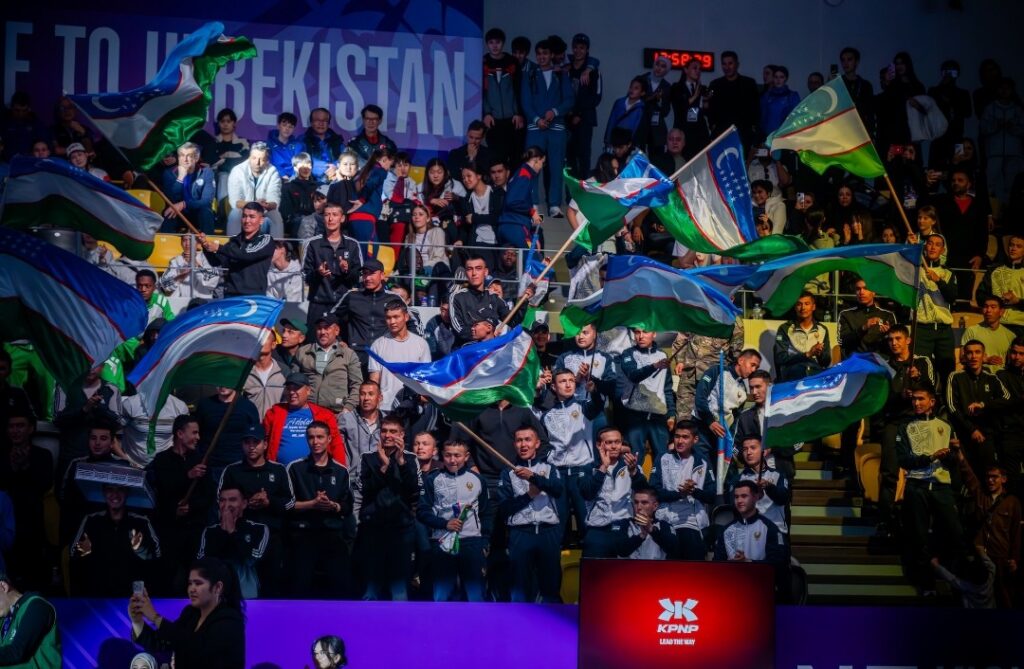
The 12,500-capacity Humo Arena in central Tashkent is preparing to host the OTP Group Tashkent Grand Slam 2026 this week. The three-day elite competition starts on 27 February. The event is the second stop on the 2026 World Judo Tour, following the Paris Grand Slam, and will feature 400 world-class judokas representing more than 40 countries. Home hopes are resting on the Olympic medallist and World champion Davlat Bobonov, while other high-profile competitors include Olympic champions Hidayat Hedarov and Zelym Kotsoiev from Azerbaijan, and the Georgian Lasha Bekauri. The Grand Slam is separated into 14 weight categories. Friday’s action focuses on the lighter weight classes, including the women’s 48kg and men’s 60kg divisions. On Saturday the competition switches to the middleweight categories, while the final day on Sunday features the heavyweights. Uzbekistan is quietly establishing itself as a host for judo tournaments, having previously hosted the 2022 Judo World Championships, and the Grand Slam for the last five years. Uzbek judo is on the rise, with Diyora Keldiyorova winning the country’s first ever gold medal at the Paris 2024 Olympic Games. “We look forward to welcoming the world’s best judokas to compete in Uzbekistan,” said Otabek Umarov, First Vice President of the National Olympic Committee of Uzbekistan, and Vice-President of the Olympic Council of Asia. “It is a great honour for Tashkent to continue to host major international judo events, and we thank the International Judo Federation for their continued trust. Hosting the Grand Slam not only inspires the next generation of athletes but stands as a testament to Uzbekistan’s dedication to the sport.” The 2026 Judo Grand Slam comes at the start of a standout year for Uzbek sports. The country’s football team will make its first appearance at a FIFA World Cup at the tournament in North America this summer. Samarkand will host the World Triathlon Championship Series on 25-26 April, then the 46th Chess Olympiad in September. The World Aquatics Swimming World Cup comes to Tashkent in October. To ensure the spirit of judo remains accessible to all fans and aspiring athletes across Central Asia, the Humo Arena will offer free admission to the public for the duration of the event. For fans abroad, the competition will be broadcast live to a global audience via the JudoTV platform.  

From Denis Ten to Mikhail Shaidorov: Kazakhstan’s Thorny Path to a Gold Medal at the Winter Olympics

The 2026 Winter Olympic Games in Milan, Italy have officially come to a close. At the end of the competition, the Kazakh team won one gold medal and placed 19th in the overall medal standings. This is the country’s best result since 1994, when the team finished 12th at the Lillehammer Olympics, with skier Vladimir Smirnov winning gold. This time, Kazakhstan’s only medal was secured by figure skater Mikhail Shaidorov, who became the first Olympic champion in the history of Kazakh figure skating. It is not the country’s first Olympic medal in the sport, however: in 2014 figure skater Denis Ten won bronze. On February 14, Shaydorov paid tribute to Denis Ten, Kazakhstan's bronze medalist at the 2014 Olympics. “I think Denis Ten influenced not only me but also figure skating in Kazakhstan as a whole. He opened the door for many skaters, including me. And that is incredibly important. I hope that the medal I won today will open new doors for the younger generation, the children of Kazakhstan, who will know that there are no limits,” he said.  Denis Ten, who tragically died at the hands of petty thieves in the center of Almaty, did much to popularize figure skating in Kazakhstan. He dreamed of opening his own school and founding an ice show for this purpose. Shaidorov is one of dozens of boys and girls inspired by the achievements of the Almaty native, who learned to skate at the Ramstor shopping center. The future champion took his first steps on the same rink. As residents often say, Almaty is a big village where everyone knows one another. In fact, there is limited accessible ice in Almaty, which is why Shaidorov was forced to train in the Russian city of Sochi, as Denis Ten had previously trained in Moscow. One of the defining stories behind the young skater’s journey is connected to his training. His father, Stanislav Shaidorov, a former professional figure skater and multiple national champion, helped him pursue his ambitions, including selling a car to invest in his son’s training. Stanislav is acquainted with Russian coach and Olympic champion Alexei Urmanov. In 2017, Urmanov held training camps in Yoshkar-Ola, Russia, where young Mikhail Shaidorov performed his first double axel. “Six months later, we returned to Urmanov. He assessed Misha's progress. Over the course of a year, we learned all the triple jumps, but we had to constantly change rinks. We called every day to arrange a time, which was not always convenient for us. Finally, in the fall of 2018, we were faced with a choice: continue renting ice in Almaty at our own expense or move to Russia to train properly. I called Alexei Evgenievich. He said, ‘Okay, come on over.’ That same day, I sold my car, and the next day we bought tickets and flew to Sochi, where Urmanov works,” recalled Stanislav Shaidorov.  Mikhail, who was 14 at the time, later said in an interview that he had asked his father to leave...

Uzbekistan’s Umarov Appointed to Board of World Motorsport Body

Otabek Umarov, the First Deputy Chairman of Uzbekistan’s National Olympic Committee, has become the first ever Central Asian to join the Senate of the Fédération Internationale de l'Automobile (FIA) – the governing body for motorsport and the federation for mobility organizations. Umarov’s appointment to the FIA Senate ensures that there will be a Central Asian voice at the highest level of the motorsport industry. The FIA’s Senate controls the overall governance of the FIA and oversees the Federation’s financial and administrative matters, covering both sport and mobility.  Umarov is married to Shakhnoza Mirziyoyeva, the youngest daughter of President Shavkat Mirziyoyev. He has spent several years as Deputy Head of the Uzbek State Security Service. In addition to his role at Uzbekistan’s Olympic Committee, Umarov is the Vice President of the Olympic Council of Asia (OCA). In recent years he has led the modernization of the country’s sports infrastructure, which will bring major international events to Uzbekistan this year. Samarkand will host the World Triathlon Championship Series (25-26 April) and the 46th Chess Olympiad (15-28 September), while the World Aquatics Swimming World Cup will be held in Tashkent on 8-10 October. Uzbekistan has also been named host of the 2029 Asian Youth Games. The country’s athletes are currently competing at the Winter Olympic Games in Milan.

Astana to Host UEFA Congress in 2027

The Union of European Football Associations has announced that the 51st UEFA Congress, at which a new president and members of the organization’s Executive Committee will be elected, will take place on March 4, 2027, in Astana. The decision was announced at the 50th anniversary UEFA Congress in Brussels. Kazakhstan was represented at the event by David Loria, Secretary General of the Kazakhstan Football Federation (KFF). The KFF confirmed the selection of the Kazakh capital as the venue for the next congress. UEFA brings together 55 national football associations and is responsible for organizing major international tournaments for clubs and national teams, as well as distributing revenue from media rights and sponsorship contracts. Kazakhstan has been a UEFA member since 2002, despite its geographical location in Central Asia. The UEFA Congress is the highest governing body of European football. It convenes annually and brings together representatives of all national associations. The congress approves strategic, financial, and organizational decisions and elects the organization’s leadership. The 2027 Congress will be an electoral session, with delegates set to elect the UEFA president and the new composition of the Executive Committee. UEFA is currently headed by Aleksander Čeferin, who has held the position since 2016 and was re-elected for another term in 2023. According to the KFF, the right to host the Congress is granted to member associations as a sign of institutional trust and recognition of their contribution to the development of football. The federation stated that the event will be the largest international football business gathering ever held in Kazakhstan and will strengthen the country’s position within the European football community. UEFA will finance the organization of the Congress. No funding from Kazakhstan’s state budget is envisaged. The Times of Central Asia previously reported that the Almaty-based club FC Kairat reached the main stage of the UEFA Champions League for the first time in its history.

A Eurasian Imprint on Judo’s Paris Grand Slam

The Paris Judo Grand Slam took place on February 7–8 at a sold-out Accor Arena, drawing more than 20,000 spectators to one of the sport’s most prestigious annual events. Held under the auspices of the International Judo Federation (IJF) as a flagship stop on the IJF World Tour, the competition carried significant world-ranking points early in the qualification cycle for the Los Angeles 2028 Olympic Games. Nearly 500 athletes from 78 countries participated. While Japan and France dominated the medal table at the Paris Judo Grand Slam, the tournament also underscored a quieter but enduring force in international judo: the sustained competitive influence of Central Asia and the South Caucasus. Japan topped the medal table with gold medals from Takeshi Takeoka (–66 kg), Yuhei Oino (–81 kg), Goki Tajima (–90 kg), and Dota Arai (–100 kg). France secured three home victories through Shirine Boukli (–48 kg), Sarah-Léonie Cysique (–57 kg), and Romane Dicko (+78 kg). The remaining titles reflected the tournament’s global reach. Balabay Aghayev delivered gold for Azerbaijan at –60 kg, Distria Krasniqi won –52 kg for Kosovo, Rafaela Silva captured –63 kg for Brazil, Makhmadbek Makhmadbekov claimed the –73 kg title representing the United Arab Emirates, and Szofi Özbas secured the –70 kg title for Hungary, according to official IJF results. While Azerbaijan is geographically part of the South Caucasus, its Turkic cultural ties, Soviet-era sporting systems, and shared wrestling traditions closely align with Central Asia’s judo landscape. Aghayev’s gold for Azerbaijan, alongside Makhmadbekov’s –73 kg victory, highlighted transnational athlete pathways rooted in a common Eurasian combat sports tradition. Makhmadbekov—an ethnically Tajik judoka born in Russia—has represented the United Arab Emirates in international competition since 2024, reflecting the increasingly transnational nature of elite judo careers. [caption id="attachment_43589" align="aligncenter" width="800"] 73 kg Final: Makhmadbek Makhmadbekov (United Arab Emirates) vs. Manuel Lombardo (Italy); image: Tamara Kulumbegashvili[/caption] Kazakhstan’s national judo team reinforced that regional presence by concluding the Paris Grand Slam with three bronze medals, one of its strongest results in the tournament’s history. Aman Bakhytzhan reached the podium in the –60 kg division, while Abylaikhan Zhubanazar (–81 kg) and Nurlykhan Sharkhan (–100 kg) added further medals on the second day. [caption id="attachment_43590" align="aligncenter" width="796"] 60 kg Final: Balabay Aghayev (Azerbaijan) vs. Dilshot Khalmatov (Uzbekistan); image: Tamara Kulumbegashvili [/caption] Martial arts occupy a distinctive place across Central Asia and Azerbaijan, where indigenous wrestling traditions long predate modern Olympic disciplines. Styles such as kurash in Uzbekistan, kazakh kuresi in Kazakhstan, and gushtingiri in Azerbaijan, alongside their more traditional forms such as gulesh and zorkhana-influenced pekhlivan wrestling, emphasize balance, explosive throws, and physical control. These attributes remain clearly visible in contemporary judo. These traditions continue to be showcased at events such as the World Nomad Games and regional festivals across Central Asia and the Caspian region. They were further refined during the Soviet era, which institutionalized sports and established the region as a major development base for elite combat athletes. Since gaining their independence, Central Asian countries, as well as Azerbaijan, have continued to...