• KGS/USD = 0.01144 0%
  • KZT/USD = 0.00198 -0%
  • TJS/USD = 0.10903 0.18%
  • UZS/USD = 0.00008 0%
  • TMT/USD = 0.28571 0%
  • KGS/USD = 0.01144 0%
  • KZT/USD = 0.00198 -0%
  • TJS/USD = 0.10903 0.18%
  • UZS/USD = 0.00008 0%
  • TMT/USD = 0.28571 0%
  • KGS/USD = 0.01144 0%
  • KZT/USD = 0.00198 -0%
  • TJS/USD = 0.10903 0.18%
  • UZS/USD = 0.00008 0%
  • TMT/USD = 0.28571 0%
  • KGS/USD = 0.01144 0%
  • KZT/USD = 0.00198 -0%
  • TJS/USD = 0.10903 0.18%
  • UZS/USD = 0.00008 0%
  • TMT/USD = 0.28571 0%
  • KGS/USD = 0.01144 0%
  • KZT/USD = 0.00198 -0%
  • TJS/USD = 0.10903 0.18%
  • UZS/USD = 0.00008 0%
  • TMT/USD = 0.28571 0%
  • KGS/USD = 0.01144 0%
  • KZT/USD = 0.00198 -0%
  • TJS/USD = 0.10903 0.18%
  • UZS/USD = 0.00008 0%
  • TMT/USD = 0.28571 0%
  • KGS/USD = 0.01144 0%
  • KZT/USD = 0.00198 -0%
  • TJS/USD = 0.10903 0.18%
  • UZS/USD = 0.00008 0%
  • TMT/USD = 0.28571 0%
  • KGS/USD = 0.01144 0%
  • KZT/USD = 0.00198 -0%
  • TJS/USD = 0.10903 0.18%
  • UZS/USD = 0.00008 0%
  • TMT/USD = 0.28571 0%
05 December 2025

Viewing results 1 - 6 of 16

The Future of Kyrgyz Tech – Scaling Global Companies, Attracting Foreign Capital

In the second installment of our exclusive two-part interview, The Times of Central Asia continues its deep dive into Kyrgyzstan’s evolving tech landscape with Elena Nechaeva, Head of Communications at the High Technology Park of the Kyrgyz Republic (HTP). Last week, we explored the startups and entrepreneurs who are currently building and scaling global businesses. If you missed it, you can read the first part of the interview here. This week, we focus on policy reform, cross-border cooperation, investor outreach, and the path ahead for Kyrgyz entrepreneurs in an increasingly globally competitive market. [caption id="attachment_40428" align="aligncenter" width="1280"] Image: The High Technology Park, Kyrgyz Republic[/caption] TCA: In terms of regulation and policy, what improvements or reforms would you like to see to better support innovation? Elena Nechaeva: There are several policy improvements that could really accelerate innovation in Kyrgyzstan, and many tech leaders have been very open about them. One of the biggest needs is a clearer national strategy for startups. Now, it’s not fully defined who exactly drives startup development and what the government’s long-term role should be. A coordinated approach with clear ownership would help the ecosystem grow much faster. Another important area is venture legislation and a stronger legal framework. Founders and investors often mention the need for a proper venture law, elements of English common law, and better protection of intellectual property. These changes would make it far easier to attract long-term capital and for investors to feel confident working with local companies. There’s also a lot of focus on the importance of modernizing higher education and expanding international partnerships. Strong engineering programs and links between academia and industry are essential for deep-tech development. And finally, Kyrgyzstan needs policies that help retain and attract talent. The digital nomad visa is already showing positive results, but it can be expanded. TCA: How does the Kyrgyz Republic's tech ecosystem compare to others in Central Asia or the wider region? Nechaeva: If you look at the region by population size, Kyrgyzstan is much smaller - about 7 million people, compared to nearly 20 million in Kazakhstan and over 36 million in Uzbekistan. And yet, with a far smaller talent pool and fewer resources, the country already exports more than $130 million in IT services, almost entirely to global markets. Whilst Kyrgyzstan’s tech ecosystem is smaller than some of our neighbors, it is one of the fastest-growing. What makes it different is that it is being developed from the bottom up - driven by founders, engineers, and communities rather than large state programs. That’s why the ecosystem is very agile, open, with a real-world focus on exports. Another difference is the mindset: Kyrgyz startups grow with a “global from day one” approach. They don’t build for a domestic market - they build for the U.S., Europe, and the wider world from day one. That creates a very different culture and pushes teams to compete internationally right from the start. So, while our ecosystem is smaller in size, it’s fast, flexible, and...

How the Kyrgyz Republic’s High Technology Park is Quietly Building a Digital Powerhouse

In an exclusive two-part interview with The Times of Central Asia, Elena Nechaeva, Head of Communications at the High Technology Park of the Kyrgyz Republic (HTP), offers a rare and detailed look into one of Central Asia’s most underreported digital ecosystems. While much attention has been given to the tech potential of Uzbekistan and Kazakhstan, Kyrgyzstan is quietly and deliberately attempting to build a globally connected digital economy, and, in recent years, it has gone from strength to strength. With deepening links to Silicon Valley and a new generation of ambitious startups and entrepreneurs, the country’s tech talent is emerging as some of the most competitive in the region. In this special series, The Times of Central Asia reveals the start-ups, entrepreneurs, and trends shaping Kyrgyzstan’s regional innovation space and why international investors should start paying attention. TCA: Can you briefly describe the mission and strategic goals of the High Technology Park (HTP)? Elena Nechaeva: The High Technology Park of the Kyrgyz Republic is built on a simple belief: the internet is our ocean. For a landlocked country, digital technologies open limitless space, a borderless world where geography no longer defines opportunity. The High Technology Park was created to help Kyrgyz companies export their talent and products and integrate into the wider global technology economy. As a government-backed organization, our mission is to accelerate the country’s economic growth through IT and to create global opportunities for local talent whilst developing the Kyrgyz Republic as an emerging hub for innovation. In the long term, our strategy is focused on three clear priorities. Firstly, we want to reach $1 billion in annual revenue generated by HTP resident companies. We aim to scale Kyrgyz IT exports by supporting companies with a favorable tax regime. This means 0% VAT, 0% corporate income tax, 0% sales tax, 5% personal income tax, to help them grow internationally. Then, we want to enable the first unicorn startup founded in the Kyrgyz Republic. The High Technology Park supports startups through international programs, accelerators, and a number of global partnerships, allowing them to access networks in Silicon Valley, Europe, and Asia. We have also set an ambitious target to train and empower 50,000 software developers. Developing these skills is perhaps the most important thing that we do. We are working closely with universities, schools, bootcamps, and private EdTech companies to cultivate a new generation of engineers and digitally savvy professionals. [caption id="attachment_40039" align="aligncenter" width="1280"] Image courtesy of The High Technology Park, Kyrgyz Republic @ the 2025 Gitex Expo in Dubai[/caption] TCA: How has the High Technology Park evolved since its inception? What have been the most significant milestones to date? Nechaeva: Since its inception, the High Technology Park has evolved from a small initiative into a fast-growing IT hub. The Kyrgyz tech ecosystem began developing in 2008, originally with the founding of the Kyrgyz Association of Software and Service Developers - the first professional organization uniting the country’s tech companies. This laid the foundation for a specialized IT regime. The...

How Kyrgyzstan’s Fastest-Growing Restaurant Tech Startup Is Revolutionizing Dining

Bishkek has long been known for its vibrant restaurant scene. Now the sector is implementing innovations, making the lives of its customers even easier. Meet Pai, the Kyrgyz startup serving as a digital concierge between restaurants and their customers. “In Kazakhstan, I saw a product where you could pay your bill right at your table with two taps and leave without interacting with the staff. That's when I realized you could build a whole world around this, turning every interaction between a guest and an establishment into a digital experience,” says Ehrlan Zholdosh, CEO and Co-Founder of Pai. Zholdosh is not a newcomer to the industry; his experience in product design and management in Eastern Europe and the Middle East was an asset when launching his own company, Pai. Old Habits Die Hard  It’s a universal restaurant experience around the globe when you’re done with your meal and ready for the check – it can take an age to come, and that’s if you can find waitstaff in the first place. Now, with Pai, which essentially turns every table into a payment terminal, this process has been streamlined to the point where it takes only seconds to pay and even leave a tip. The very first MVP (minimum viable product) was launched in Mar 2024. This is when Aibek Nogoev joined as a Co-Founder to completely overhaul the technical side of the product. The co-founder’s team has complementary skillsets — the third Co-Founder, Kairygul Kalbaeva, has over ten years of experience in the restaurant business, which came in handy when onboarding the first customers, as she understands how restaurants operate inside out. As for the Pai team, the majority of its members were hired in ololoPlanet, one of the locations of ololo, the largest chain of tech hubs in Central Asia, where Pai has its offices. Apart from enabling customers to pay faster and more smoothly, Pai aims to build a restaurant super-app that integrates with the ERP systems restaurants use, including customizable loyalty programs. Another strategic benefit for restaurants using Pai is a non-invasive way to collect user data. The Snowball Effect In September, Pai won first place in the country’s largest hackathon, Startup Nation. It may have been tough to onboard customers at the beginning of Pai’s journey, but now there are over 70 active restaurants and more than 100 in the waitlist, with hundreds of thousands of users and a daily turnover in excess of $20,000. Recent changes to Kyrgyz tax legislation linked to the efforts to make the restaurant industry less opaque have been a massive boost as well. The authorities are trying to combat the shadow economy, pushing businesses, including restaurants, to become significantly more transparent, and many in the restaurant industry see Pai as the best solution. Its customer base now includes the majority of the largest restaurant chains in the Kyrgyz Republic, including global franchises. The key challenge lies in its integration with ERP systems, which delivery services usually don’t integrate with. Pai...

Kazakhstan Adds Over 4,000 New IT Companies in Two Years Amid Tech Boom

Kazakhstan’s IT sector has seen rapid expansion, with the number of registered IT companies surpassing 18,600 by the end of 2024, a 16% increase over three years, according to the Ministry of Digital Development, Innovations and Aerospace Industry (MDDIAI). In 2022, the country had around 14,000 IT firms. The surge is attributed in large part to the development of the Astana Hub international technopark, which now hosts more than 1,700 resident companies. Kazakhstan has also launched 19 regional IT hubs and established international platforms in Saudi Arabia, the United States, the United Kingdom, Dubai, and China. Astana Hub, Central Asia’s largest IT startup technopark, has attracted over 336 billion tenge ($624 million) in investments since its launch in 2018. This growth has been supported by state tax incentives totaling 130 billion tenge ($241 million). In 2024, Astana Hub residents generated 620 billion tenge ($1.33 billion) in revenue, accounting for more than half of Kazakhstan’s total IT sector revenue, which reached 1.2 trillion tenge ($2.2 billion). Export earnings contributed 140 billion tenge ($260 million). Looking ahead, the government aims to raise IT service exports to $1 billion by 2026. Support programs include AI’preneurs and the Silk Way Accelerator, which is operated in partnership with Google. More than 40 Kazakhstani startups have taken part in accelerator programs in Silicon Valley through collaborations with AlchemistX, Draper University, and the Silkroad Innovation Hub. The Tech Orda initiative aims to train 100,000 IT professionals by 2025. In parallel, the AI Qyzmet program, the first of its kind in Central Eurasia, focuses on equipping civil servants with skills in artificial intelligence to modernize public administration. Kazakhstan is also building out a national AI ecosystem. The Alem.AI International Center for Artificial Intelligence will offer research and training opportunities, while AlemLLM, the country’s largest Kazakh-language large language model, is now available to startups, academic institutions, and private companies. In July, Kazakhstan launched alem.cloud, Central Asia’s most powerful supercomputer cluster, designed to support AI development and deployment.

ArtSkin: Prosthetics with a Sense of Touch from Kyrgyzstan

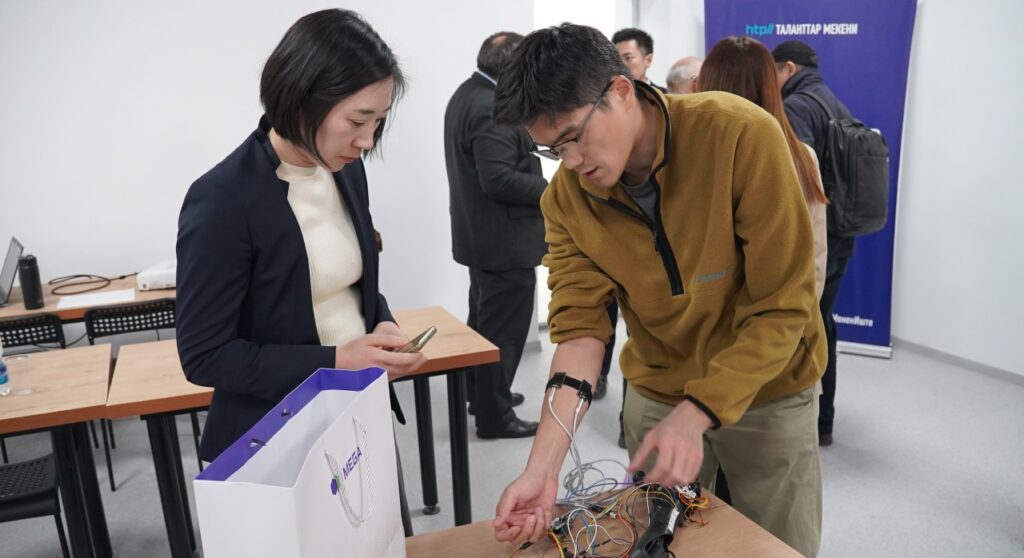
The Kyrgyz startup ecosystem is still in its nascent stages and can’t boast an endless number of founders pursuing their dreams. But those focused on building hardware startups, which is generally significantly more challenging, are even a rarer breed. Despite all of that, there is an ambitious attempt to build artificial skin for prosthetics. Meet ArtSkin. Not like a human hand “Since childhood, I was mad about science and tech, and the first big thing that I made was a prototype of the first airplane by the Wright brothers. I dropped it from the second floor, and it was crushed after flying four meters. Later, when I was twelve, I saw a TV program about robot battles, and it was crazy! Since then, I have wanted to be able to make any kind of robots, and my dream has come true,” says Iliias Dzheentaev’s biography on LinkedIn. Dzheentaev is the CEO and Founder of ArtSkin.  ArtSkin is a hardware startup from Kyrgyzstan that develops artificial skin for prosthetic limbs. It was launched by Dzheentaev in 2024. Before that, he spent three years studying how human skin, the nervous system, and receptors work to understand how to design a device allowing proper touch sensations. The process was time-consuming and challenging due to the lack of relevant information. “My initial prototype was a robotic arm manipulator. I encountered a challenge with grasping flexible objects – figuring out how to make the robot recognize when its claw had squeezed tightly enough to hold the object securely. To solve this, I developed a mechanism that overcomes the resistance of different materials, enabling the robot to firmly grasp objects of various shapes, textures, and densities. Although the mechanism was simple, it made me realize how important this problem is for robotics. This insight then led me to thinking about people who use prosthetics and whether they actually feel anything when wearing them”, Dzheentaev tells The Times of Central Asia. He was not happy with the contemporary prosthetic solutions – basic body-powered mechanical prosthetics rely on physical motions, and more advanced bionic prosthetics translate electrical signals generated by muscle activity into movements, both of which lack feedback. And without the latter, control is incomplete, while with a human hand, one can easily understand its position as well as feel touch and pressure. With this in mind, Dzheentaev built his prototype with a single sensor to test the device on himself. First steps Things got serious when Dzheentaev visited the High Technology Park of the Kyrgyz Republic (HTP), where he was inspired by other founders pitching and raising funds for their startups. At the time, unfamiliar with this environment, Dzheentaev was using his salary to buy electronic components, order materials, and do designs. Not long after, Dzheentaev took part in HTP’s two programs: Dive into Silicon Valley and Unicorn from KG. The finalists for the first one were selected in February 2024. Dive into Silicon Valley in an entry-level incubation program, which sends founders to spend two...

24 Central Eurasian Startups Join Silicon Valley Programs

This fall, 24 startups from Central Eurasia and other regions will join the AlchemistX and Silicon Valley Residency programs, set to begin on September 3. The selected teams will gain direct access to the U.S. venture ecosystem, top investors, and leading technology companies. In 2025, a total of 225 startups from 20 countries applied, but only 24 were selected. Of these, 10 teams from Kazakhstan and Uzbekistan were accepted into the AlchemistX program, while 14 others, representing Qatar, the U.S., Singapore, Georgia, and Mongolia, joined the Silicon Valley Residency. “AlchemistX & Silicon Valley Residency is a strategic corridor linking Central Eurasia with Silicon Valley,” said Kazakhstan’s Minister of Digital Development, Zhaslan Madiev. He highlighted the importance of tangible results, noting that in 2024, 22 participating startups generated $380,000 in revenue within four months and secured $1.4 million in funding. Over the course of the four-month program, participants will receive mentorship from venture partners, attend workshops on U.S. market entry, and pitch their startups to investors at Demo Day. Teams will also have the opportunity to register their companies in the U.S. and become part of the Silkroad Innovation Hub, Kazakhstan’s official innovation outpost in Silicon Valley. “Silkroad Innovation Hub was created as a bridge between Central Eurasia and Silicon Valley, and today we see this mission becoming a reality,” said Asset Abdualiyev, the hub’s founder. The programs are organized by Astana Hub in partnership with IT Park Uzbekistan, Silkroad Innovation Hub, and Alchemist Accelerator, with the support of the digital development ministries of Kazakhstan and Uzbekistan, as well as regional venture funds. The participation of Kazakh and Uzbek startups in Silicon Valley underscores Central Eurasia’s growing presence on the global tech stage and offers new pathways for integration into the international innovation economy. At the first Central Eurasia at Silicon Valley conference held in October 2024, industry leaders projected that the region could give rise to major global IT companies within the next 10 to 15 years. Organizers cite the region’s untapped potential: a population of over 100 million, an average age of 27, and around 200,000 STEM graduates each year. With a maturing startup ecosystem, active universities, growing venture capital networks, and an international presence in Silicon Valley, Central Eurasia is poised to become a new tech frontier.