

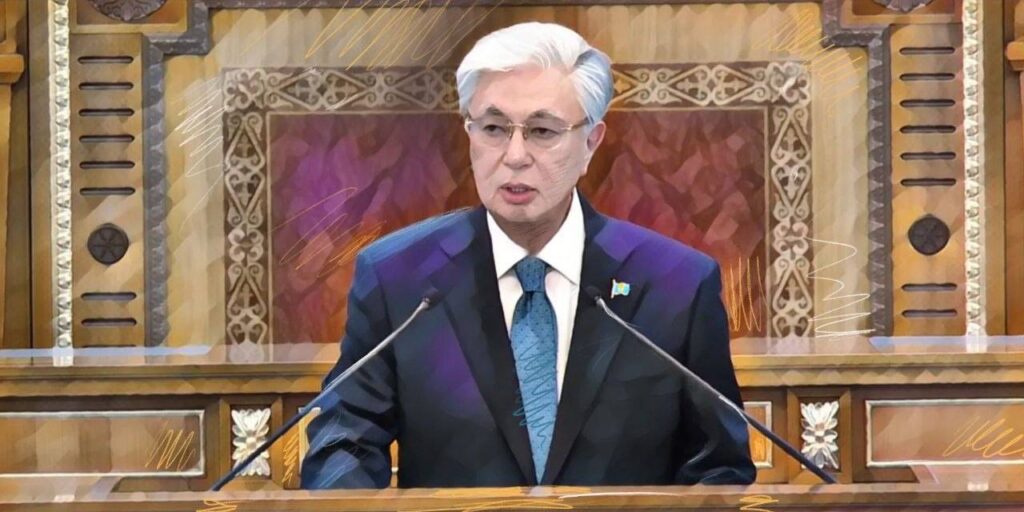
Tokayev Unveils $14 Billion Construction Plan in Kazakhstan State of the Nation Address
Kazakhstan plans to spend 6.5 trillion tenge (about $14.3 billion) from its National Fund on infrastructure projects by 2029 and eliminate its electricity shortage in the same period, President Kassym-Jomart Tokayev announced in his annual State of the Nation Address on October 28. The president also outlined plans to accelerate nuclear power plant construction, expand transport routes between China and Europe, and establish a separate court for investors in the new city of Alatau. $14 Billion for Infrastructure Tokayev proposed declaring 2027 a year of large-scale construction and launching a nationwide program covering roads, airports, railway stations, and public facilities. The government is expected to allocate approximately 6.5 trillion tenge from the National Fund by the end of 2029, including 1.5 trillion tenge ($3.3 billion) for social projects in the remaining months of 2026 and the first two months of 2027. The program envisages building around 70 healthcare facilities and approximately 50 education, sports, and cultural facilities. Plans also include extending gas supplies and clean drinking water to underserved communities. Tokayev said public funding should help attract private investment rather than finance the entire program. The spending plans raise questions about the use of Kazakhstan's accumulated oil revenues. The National Fund was established in part to protect the economy from fluctuations in commodity prices, but its resources are regularly used to meet budgetary needs. Tokayev said Kazakhstan must balance preserving financial reserves for future generations with investing in modern infrastructure. He argued that public spending should deliver economic and social returns. Kazakhstan Aims to Eliminate Electricity Deficit Tokayev acknowledged that Kazakhstan's electricity production is insufficient to meet the needs of its growing economy, particularly as the country seeks to expand industry and build data centers. According to the national grid operator KEGOC, Kazakhstan generated 123.1 billion kilowatt-hours of electricity in 2025, while consuming 124.6 billion. The shortfall of approximately 1.5 billion kilowatt-hours was covered by net imports. The president set a target of achieving a sustained surplus of electricity production over domestic consumption by 2029. Tokayev criticized the longstanding practice of purchasing expensive electricity from neighboring countries during winter peaks in demand and subsequently returning electricity in summer at substantially lower prices. "That's quite a simple little 'business,' and it's been going on for decades," Tokayev remarked. He also pointed to delays in bringing new generating capacity online in Turkestan, Kyzylorda, Almaty, and Ekibastuz, as well as a shortage of qualified energy specialists. To meet the 2029 target, Kazakhstan will need to build new power stations and modernize existing facilities. Tokayev called for further development of coal-fired generation alongside renewable energy, particularly solar power. Nuclear Power Plans Tokayev said construction of the Balkhash nuclear power plant could begin in 2027. He also proposed accelerating preparations for an agreement on the Moyynkum nuclear power plant. Russia's state nuclear corporation Rosatom is leading the Balkhash project, while China National Nuclear Corporation has been selected as the main contractor for the second plant. However, the first reactor at Balkhash is not expected to...
